Which Home Gym Machine Is Worth the Floor Space It Takes?
The Bowflex PR1000 offers the best balance of exercise variety and price for most home users, using Power Rod resistance instead of iron plates. Serious lifters who train daily should consider the Body-Solid EXM2500S for its steel frame, while apartment dwellers short on space do better with the foldable Weider Ultimate Body Works.
The Bowflex PR1000 fits most buyers who want a wide range of strength exercises without the footprint of a full weight rack, using resistance rods rated to 210 pounds. Its rods eventually need replacement after years of heavy use, unlike iron plates that never wear out. Lifters training every day are better served by the steel-frame Body-Solid EXM2500S, built to handle more frequent, heavier loading.
Home gym machines vary enormously in what they actually let you do, since some use resistance rods, others use a weight stack, and a few rely on your own bodyweight and gravity. We compared published weight capacities, frame materials and the number of distinct exercises each design supports, along with recurring patterns in owner feedback about durability and assembly.
The shortlist, ranked
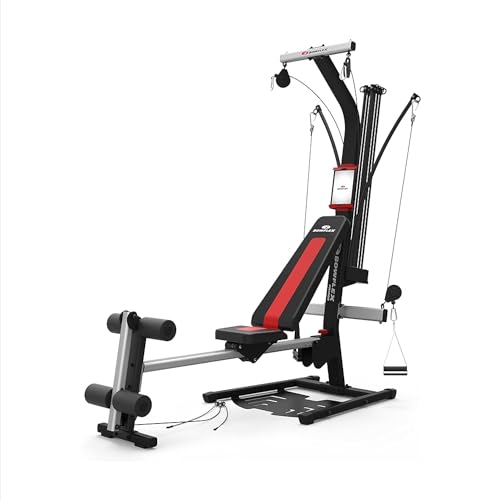
Bowflex PR1000 Home Gym
Bowflex uses flexible Power Rods instead of iron weight plates, delivering up to 210 pounds of resistance across more than 25 exercises. A lat tower and leg attachment extend the machine beyond basic upper-body work. The footprint folds smaller than a comparable plate-loaded gym.
Pros
- Wide exercise variety for a mid-size machine
- Resistance rods need no weight plates to load
- Expandable resistance for growing strength
Cons
- Rods wear out and need replacement over years of heavy use
- Assembly takes several hours out of the box

Marcy MWM-990 Multifunctional Home Gym Station
Marcy keeps costs down with a 150-pound weight stack instead of a larger plate system, enough resistance for beginners and intermediate lifters. A pulldown bar, low pulley and leg developer cover the major muscle groups in one frame. The compact base suits garages and basements with limited ceiling height.
Pros
- Lowest price point among weight-stack home gyms
- Compact base fits low-ceiling basements
- Covers upper body, lower body and core stations
Cons
- 150-pound stack limits growth for advanced lifters
- Pulley cables need periodic tension adjustment

Body-Solid EXM2500S Home Gym
Body-Solid builds this frame from 11-gauge steel rated for near-commercial use, which holds up to daily training better than lighter home units. A 210-pound weight stack covers chest press, lat pulldown, leg extension and more from one seated position. The pulley system uses nylon-coated cables designed to resist fraying over years of use.
Pros
- Commercial-grade steel frame handles daily training
- 210-pound stack suits intermediate to advanced lifters
- Nylon-coated cables resist wear over time
Cons
- Large footprint needs a dedicated room or garage
- Higher price than entry-level home gyms

Weider Ultimate Body Works
This Weider machine uses your own bodyweight on an adjustable glide board instead of plates or rods, which keeps the price and footprint far below traditional home gyms. It folds flat for storage under a bed or in a closet. Resistance bands add upper-body work beyond the gliding squat and push motions.
Pros
- Folds flat for storage in small apartments
- Lowest price of any machine in this roundup
- No weight plates or rods to wear out
Cons
- Resistance depends on body angle, not a precise number
- Bands need replacement sooner than steel components

Body-Solid Powerline BSG10X Smith Cage
Unlike the resistance-rod and weight-stack machines above, this Powerline unit is a guided barbell system that uses standard Olympic plates you add yourself. The linear bearing bar moves on a fixed path, which helps lifters practice squats and bench presses safely without a spotter. A functional trainer cable station attaches to the same frame for added exercises.
Pros
- Guided bar path allows safer solo squats and presses
- Accepts standard Olympic weight plates you already own
- Functional trainer cables add exercise variety
Cons
- Does not include weight plates, which adds to total cost
- Needs more ceiling clearance than seated machines
Bowflex Xtreme 2SE Home Gym
The Xtreme 2SE expands on the PR1000 with a larger lat tower, leg attachment and squat station built into one frame, supporting more than 65 exercises. Power Rods start at 210 pounds and can expand to 410 pounds for advancing lifters. A wider base adds stability during leg press and squat movements.
Pros
- Supports more exercise variations than the base PR1000
- Wider base improves stability during leg work
- Expandable resistance accommodates progress
Cons
- Larger footprint than most single-room setups allow
- Higher price than the standard PR1000

Total Gym XLS Trainer
Total Gym uses an adjustable incline and your own bodyweight to create resistance, similar in concept to the Weider unit but with a sturdier aluminum rail and more incline positions. Over 80 exercises are possible by changing body angle, attachment and glideboard position. Low-impact movement patterns suit users recovering from joint issues or returning to exercise.
Pros
- Low-impact design suits joint-sensitive users
- Folds for storage, though less flat than the Weider
- Higher user weight capacity than typical glideboard machines
Cons
- Costs more than the Weider Ultimate Body Works
- Learning the full exercise range takes time
The lineup, side by side
| # | Model | Max resistance | Best for | Score | Price |
|---|---|---|---|---|---|
| 1 | Bowflex PR1000 Home Gym | 210 lbs (expandable to 410 lbs) | Best overall | 9.2 | Check price |
| 2 | Marcy MWM-990 Multifunctional Home Gym Station | 150 lbs weight stack | Best budget | 8.2 | Check price |
| 3 | Body-Solid EXM2500S Home Gym | 210 lbs weight stack | Best for heavy daily use | 9.0 | Check price |
| 4 | Weider Ultimate Body Works | Bodyweight-based (up to 250 lb user weight) | Best for small spaces | 8.4 | Check price |
| 5 | Body-Solid Powerline BSG10X Smith Cage | Plate-loaded (user-supplied Olympic plates) | Best for strength training with free weights | 8.9 | Check price |
| 6 | Bowflex Xtreme 2SE Home Gym | 210 lbs (expandable to 410 lbs) | Best for full-body exercise variety | 8.7 | Check price |
| 7 | Total Gym XLS Trainer | Bodyweight-based (up to 400 lb user weight) | Best for low-impact bodyweight training | 8.5 | Check price |
How to pick the right one
What to look for in a home gym machine Resistance type drives most of the differences between machines, whether that means iron weight stacks, flexible Power Rods, user-supplied Olympic plates, or simple bodyweight and gravity. Weight capacity matters most for anyone planning to get stronger over time, since a maxed-out machine stops offering a challenge. Footprint and ceiling height often get overlooked until the box arrives, so measure your space before ordering a multi-station frame.
Resistance types compared Weight-stack machines like the Marcy MWM-990 and Body-Solid EXM2500S feel closest to a commercial gym experience, with incremental pin adjustments. Power Rod machines such as the Bowflex PR1000 skip plates entirely, using flexible rods that compress into a smaller shipped footprint. Bodyweight trainers like the Weider Ultimate Body Works and Total Gym XLS cost the least and store the smallest, but resistance scales with body angle rather than a fixed number.
Matching the machine to your space and goals Small apartments do better with foldable bodyweight trainers, since a Weider Ultimate Body Works tucks under a bed when not in use. Garages and dedicated workout rooms can support larger frames like the Bowflex Xtreme 2SE or Body-Solid EXM2500S without crowding daily living space. Lifters who already own a barbell and plates get more value from the Powerline BSG10X Smith Cage than from a machine that duplicates equipment they have.
Who should train on which machine daily Beginners and anyone rehabbing an injury benefit from the low-impact, adjustable resistance of the Total Gym XLS or Weider Ultimate Body Works. Intermediate lifters chasing muscle growth get more structured progression from a weight-stack or Power Rod machine with numbered settings. Anyone training five or more days a week should prioritize the heavier-gauge steel of the Body-Solid EXM2500S over lighter home-grade frames, which wear faster under that frequency.
Frequently asked questions
Is a home gym machine as effective as free weights?
A quality machine like the Body-Solid EXM2500S can build real strength, though free weights and the Powerline BSG10X Smith Cage train stabilizer muscles differently than guided cable or rod resistance.
How much space does a home gym machine need?
Compact folding units like the Weider Ultimate Body Works need as little as 7 feet by 1.5 feet folded, while multi-station frames like the Bowflex Xtreme 2SE need closer to 8 feet by 4 feet of permanent floor space.
Can beginners use a home gym machine safely?
Yes, especially guided options like the Total Gym XLS or Bowflex PR1000, which control the motion path and reduce the injury risk that comes with learning free-weight form.
What is the difference between a Power Rod and a weight stack?
A weight stack uses stacked steel plates with a pin to select resistance, similar to a gym machine, while Power Rods are flexible fiberglass rods that bend to create resistance and take up less storage space.
Do home gym machines need assembly?
Most multi-station machines, including the Bowflex PR1000 and Body-Solid EXM2500S, require several hours of assembly, while bodyweight trainers like the Weider Ultimate Body Works go together faster with fewer parts.
How long do resistance rods or cables last on a home gym?
Power Rods on Bowflex machines typically last several years of regular use before showing wear, and most manufacturers sell replacement rods separately rather than requiring a whole new machine.
Is a Smith machine better than a standard home gym?
A Smith machine like the Powerline BSG10X suits lifters who want to practice barbell movements like squats and bench press safely, while a standard weight-stack or Power Rod machine offers more varied cable exercises in less space.
Can one machine replace an entire home gym setup?
A well-chosen multi-station machine like the Body-Solid EXM2500S or Bowflex Xtreme 2SE covers most major muscle groups, though serious lifters often still add a pull-up bar or adjustable dumbbells over time.
Are bodyweight trainers like the Total Gym worth it compared to weighted machines?
They cost less, store smaller and put less stress on joints, making them a strong choice for beginners or rehab, though they offer less resistance ceiling than a weight-stack machine for advanced strength goals.
The bottom line
Most buyers get the best mix of price and exercise variety from the Bowflex PR1000, especially if space allows for its footprint. Anyone training daily or chasing serious strength gains should instead put the extra money into the Body-Solid EXM2500S for its steel frame and higher weight stack. Skip a multi-station machine entirely if you already own a barbell and plates, since the Powerline BSG10X Smith Cage adds more value in that case than duplicate equipment would.
Derek Holt
Derek has a background coaching recreational and amateur athletes and has worked the sales floor at specialty fitness retailers. He focuses on equipment durability, ergonomics and realistic use cases rather than marketing claims.