8 Indoor Exercise Bikes for Small Apartments and Home Gyms
The Schwinn IC4 leads overall thanks to quiet magnetic resistance, fine resistance steps and open app connectivity. Want the same ride for less? The YOSUDA Indoor Cycling Bike is the value pick. Tight on floor space? The Exerpeutic Folding Magnetic Upright Bike folds away completely.
Want a bike still getting ridden in six months? Buy the Schwinn IC4. On a budget for a spare room? The YOSUDA Indoor Cycling Bike matches much of that feel for less. Short on floor space? The Exerpeutic Folding Magnetic Upright Bike solves that outright.
Indoor bikes are harder to choose than a spec sheet suggests, because what stops people riding is practical, not technical. Noise through a shared wall, a footprint that swallows a room, a saddle position that never quite fits: these end a habit fast. We compared resistance systems, flywheel weights, adjustment ranges and what owners report after a year of use to rank the seven below.
The top picks, ranked

Schwinn IC4 Indoor Cycling Bike
A hundred levels of magnetic resistance, a heavy flywheel and a belt drive combine for a quiet ride that still feels like a road bike under load. Bluetooth links it to most training apps rather than one subscription. Owners report that near silence paired with app freedom is what sets it apart from studio bikes.
Pros
- Quiet enough for apartments and shared walls
- Works with most training apps, not one ecosystem
- Fine resistance steps for structured sessions
Cons
- Console is basic, relying on a tablet for metrics
- Heavy to move once assembled

YOSUDA Indoor Cycling Bike
Belt drive meets a weighted flywheel and friction resistance here, giving a solid ride feel at a price that makes indoor cycling accessible. A tablet holder and simple digital monitor come standard. Owners report ride quality well beyond the cost, though the friction pad eventually needs replacing.
Pros
- Solid ride feel for the money
- Belt drive is quieter than chain designs
- Tablet holder included as standard
Cons
- Friction pads wear and need replacing
- Monitor does not connect to apps

Sunny Health and Fitness SF-B1805 Magnetic Belt Drive Indoor Cycling Bike
Magnetic resistance and a belt drive leave almost nothing to make noise beyond the air you move, which matters when someone sleeps on the other side of a wall. A heavy flywheel keeps the pedal stroke smooth. Owners report riding early mornings in apartments with zero complaints, the real world test that counts.
Pros
- Among the quietest bikes available
- No friction pads to wear out
- High user weight capacity
Cons
- Resistance levels are not numerically indexed
- No app connectivity built in

Marcy Recumbent Exercise Bike ME-709
A recumbent seat with a full backrest removes the wrist, neck and lower back strain that an upright position creates. Step through access makes mounting simple. Owners report this is the bike that keeps getting used by people who found upright models too uncomfortable to continue.
Pros
- Backrest suits riders with back discomfort
- Step through frame is easy to get on and off
- Magnetic resistance runs quietly
Cons
- Longer footprint than an upright bike
- Lower intensity ceiling than a cycling bike

Exerpeutic Folding Magnetic Upright Exercise Bike
It folds roughly in half and rolls into a cupboard or corner, the only realistic option in a studio apartment or a multipurpose room. Magnetic resistance keeps it quiet, and the seat is large and padded. Owners report it is not a serious training bike, and that being able to put it away is exactly why it gets used.
Pros
- Folds small enough for a cupboard
- Quiet magnetic resistance
- Easy assembly and light to move
Cons
- Limited resistance ceiling for hard training
- Frame flexes noticeably when standing on the pedals
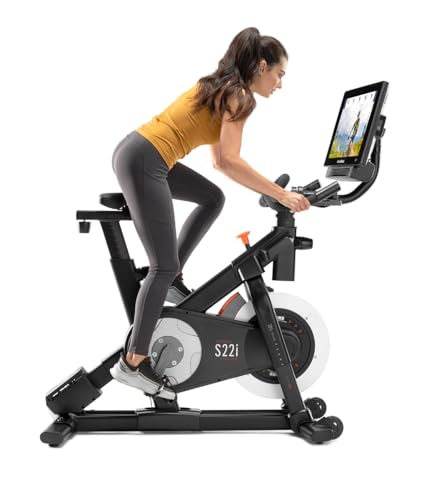
NordicTrack Commercial S22i Studio Cycle
A large rotating touchscreen, automatic resistance control during classes and a frame that tilts to simulate climbs and descents define this studio bike. It runs around a subscription training service. Owners report the incline mechanism genuinely differs from other bikes, though its value depends entirely on using that subscription.
Pros
- Automatic resistance follows the class
- Incline and decline simulate real terrain
- Screen rotates for off bike workouts
Cons
- Most of the value requires an ongoing subscription
- Large and heavy with a substantial footprint

DeskCycle Under Desk Exercise Bike
This pedal unit sits under a desk at a low enough profile to clear your knees, built for accumulating light activity through a working day rather than training. Magnetic resistance keeps it quiet enough for a shared office. Owners report it genuinely adds movement to long seated hours, without pretending to replace a proper bike.
Pros
- Adds movement to a working day
- Quiet enough for a shared office
- Stores anywhere and costs very little
Cons
- Not a cardio workout in its own right
- Slides on hard floors without a mat
How they stack up
| # | Model | Resistance | Best for | Score | Price |
|---|---|---|---|---|---|
| 1 | Schwinn IC4 Indoor Cycling Bike | Magnetic, 100 micro adjustable levels | Best overall | 9.4 | Check price |
| 2 | YOSUDA Indoor Cycling Bike | Friction pad with infinite adjustment | Best value | 9.2 | Check price |
| 3 | Sunny Health and Fitness SF-B1805 Magnetic Belt Drive Indoor Cycling Bike | Magnetic, no pad contact | Best for quiet operation | 9.0 | Check price |
| 4 | Marcy Recumbent Exercise Bike ME-709 | Recumbent with backrest | Best for back support | 8.8 | Check price |
| 5 | Exerpeutic Folding Magnetic Upright Exercise Bike | Folds for storage with transport wheels | Best for small spaces | 8.5 | Check price |
| 6 | NordicTrack Commercial S22i Studio Cycle | Large rotating touchscreen | Best for guided classes | 8.2 | Check price |
| 7 | DeskCycle Under Desk Exercise Bike | Under desk pedal exerciser | Best budget | 8.0 | Check price |
Before you buy
Magnetic or friction resistance, which matters more indoors? Friction resistance uses a pad pressing on the flywheel, simple and cheap, giving a heavy road like feel until the pad wears and starts to squeak. Magnetic resistance uses magnets near the flywheel with zero contact, so it stays near silent, needs no maintenance and allows precise numbered levels. For apartments and shared homes, prioritize magnetic, since noise is the main reason bikes stop getting ridden at convenient hours.
How much floor space does an indoor bike actually need? Measure the bike, then add room to get on and off and to sit upright with arms extended. Recumbent bikes run longer than uprights, studio bikes with screens need clearance in front, and anything requiring a move before use tends to sit unused. Folding bikes solve the space problem outright, at the cost of stability and resistance ceiling. Living in a shared room? Folding may matter more than any performance spec.
Why does bike fit matter more than the components? A bike that cannot adjust to your leg length causes knee pain and kills motivation within weeks. Look for four way adjustment, meaning both seat and handlebars move up and down and fore and aft. Check the stated minimum and maximum rider heights too. Saddle discomfort in the first few rides is normal and usually fades; knee pain from bad positioning does not resolve on its own.
Bluetooth apps or a built in subscription screen? Most people ride indoors while following something, whether a class, a video or a mapped route. Bikes with standard Bluetooth work across a wide range of apps and let you change your mind later. Bikes built around a proprietary subscription give a more polished experience while tying the equipment’s usefulness to a monthly payment. Decide which model fits before buying, since switching later is not simple.
Frequently asked questions
Are magnetic exercise bikes quieter than friction bikes?
Yes, noticeably. Magnetic resistance involves no contact with the flywheel, so the only sound is the drive belt and moving air. Friction bikes are quiet when new and start squeaking as the pad wears. Sharing walls with sleeping neighbors makes magnetic the clear choice.
Do I need a subscription to use an indoor bike?
Not with most models. Bikes like the Schwinn IC4 broadcast standard Bluetooth data that works with many training apps, or you can simply ride while watching anything. Bikes built around a proprietary platform, such as studio cycles with integrated screens, lose most functionality without the subscription.
Upright, recumbent or cycling bike, which should I choose?
Cycling bikes suit hard training and mimic a road bike position. Recumbent bikes suit riders who find upright positions uncomfortable, particularly with back issues, and support longer easier sessions. Upright bikes sit between the two and often fold. Comfort predicts consistency more reliably than performance specs do.
How much does flywheel weight matter?
It affects how smooth the pedal stroke feels, since a heavier flywheel carries momentum through the dead spots. Returns diminish beyond a reasonable weight, and a magnetic bike with a moderate flywheel can feel better than a friction bike with a heavy one. Treat it as one factor among several, not a headline spec.
Will an exercise bike damage my floor or bother the neighbours?
A mat under the bike solves most of it, protecting the floor from sweat and pressure marks while reducing vibration transmitted downward. Magnetic bikes transmit far less noise than friction ones. Standing on the pedals creates the most vibration, so seated riding stays the quieter option in an apartment.
What user weight can these bikes take?
Most bikes here support around 300 pounds, though it varies and folding models usually sit lower. Stated capacity relates to frame stability rather than raw strength, so exceeding it makes a bike feel unstable well before anything breaks. Check the specific figure before buying.
Why does the saddle hurt so much at first?
It is normal for the first few rides on any bike and usually settles as you adapt. Persistent pain is more often a fit problem than a saddle problem, so check saddle height, fore and aft position and handlebar height first. Padded shorts help more than a padded seat cover, which can actually worsen things.
How much assembly is required?
Most bikes arrive largely assembled, needing only stabilisers, seat, handlebars and pedals fitted, a thirty to sixty minute job with the supplied tools. The heaviest part is usually lifting the boxed bike into position, so unpack it in the room where it will live.
What is the best indoor bike for a small apartment?
The Exerpeutic Folding Magnetic Upright Bike folds flat for storage, while the Sunny Health SF-B1805 stays near silent for shared walls without needing to fold at all.
Schwinn IC4 vs YOSUDA, what is the real difference?
The Schwinn IC4 uses fully magnetic resistance with a hundred levels and open Bluetooth connectivity. The YOSUDA relies on a friction pad that wears over time but costs noticeably less to start.
Our pick
The Schwinn IC4 suits the widest range of homes: near silent magnetic resistance and open app connectivity remove the two things that most often end an indoor cycling habit. The YOSUDA Indoor Cycling Bike delivers much of that ride feel for far less, and the Exerpeutic folding bike is the honest answer when there is simply nowhere to leave a bike standing.
Derek Holt
Derek has a background coaching recreational and amateur athletes and has worked the sales floor at specialty fitness retailers. He focuses on equipment durability, ergonomics and realistic use cases rather than marketing claims.
You might also need
Do Exercise Bikes Actually Pay Off for Home Workouts?

6 Exercise Bikes Built to Handle Outdoor Rides
What Usually Causes Exercise Bike Problems at Home
