Which Woodworking Jig Fits the Joint You’re Cutting?
For most builders, the Kreg 720PRO handles pocket hole joinery with the least fuss thanks to its self adjusting clamp. Budget conscious shoppers get nearly the same accuracy from the Massca M2. Occasional users needing storage friendly gear should look at the compact Kreg 320.
The Kreg 720PRO leads this list because its clamp senses material thickness and sets bit depth automatically, taking the guesswork out of pocket holes. Builders on a budget do nearly as well with the Massca M2, and the Kreg 320 covers occasional jobs in tight shop spaces.
Jigs solve different joinery problems, so a system built for dowels rarely doubles as a mortise and tenon tool. We compared published specifications, clamp mechanisms and recurring owner feedback on accuracy, favoring repeatable results over marketing claims.
What to look for
What type of joint should you build first? Pocket holes join boards fast with just a drill and screws, suited to cabinets, frames and shop furniture. Hiding the joint entirely is where dowel jigs win, ideal for edge joining panels into tabletops or shelves. Furniture grade strength close to a traditional mortise and tenon comes from loose tenon jigs instead. Decide what you build most often before comparing features, since joint type narrows the field faster than price or brand.
How much does clamping style affect accuracy? Automatic, thickness sensing clamps like the 720PRO’s remove a manual measuring step and cut operator error. Dowel jigs get similar results through self centering bushings, which index every hole to the board’s middle without extra math. With manual clamps, accuracy still holds, but the user has to set thickness correctly every time. Repeated drilling flexes light plastic bodies, so metal bodied jigs keep holes square over hundreds of joints.
Which jig fits a small shop or tight budget? Compact jigs like the Kreg 320 store in a drawer and skip the bulk of a full clamping station. Milescraft’s PocketJig200 bundles bit, stop collar and screws, so a beginner spends nothing extra to start. Without an automatic clamp, both trade some speed for a lower price. Small shops with limited bench space often prefer this trade, since storage matters more than production speed.
Is a loose tenon jig worth it for furniture? Rockler’s Beadlock Pro drills matching mortises with a standard drill, and a separate tenon locks the two pieces. For visible joints on chairs, tables or doors, that furniture grade strength beats a hidden pocket screw. Learning the index steps takes longer than any pocket hole setup here. Occasional furniture builders often justify the extra time, while cabinet shops making repetitive joints usually stick with pocket holes.
The best picks, ranked

Kreg 720PRO Pocket-Hole Jig
Clamping steps disappear on the 720PRO, since its jaw reads material thickness and sets drill depth automatically. Owners report consistent, tight pocket holes across a full afternoon of cabinet work. Bit and screw storage rides right on the base, so nothing gets lost mid project.
Pros
- Automatic clamp removes manual setup
- Holes stay square job after job
- Bit and screw storage built in
Cons
- Costs more than basic kits
- Takes up more bench space

Massca M2 Pocket Hole Jig
Aluminum and steel construction keeps the M2 rigid under repeated drilling, unlike lighter plastic jigs. Clamping requires a manual thickness adjustment rather than an automatic sensor. Hobby shops choose it for accuracy that rivals pricier stations at a lower cost.
Pros
- Metal body resists flexing under load
- Holes land accurately hole after hole
- Costs less than premium stations
Cons
- Clamp needs manual adjustment per thickness
- Ships with fewer accessories than the 720PRO

Kreg 320 Pocket-Hole Jig
A repositionable single hole guide lets the 320 handle stock wider than its own body. Compact size means it stores in a drawer instead of a shelf. Based on specifications, occasional builders get the same hole geometry as Kreg’s larger stations, just slower.
Pros
- Low cost way into pocket hole joinery
- Fits in a drawer, not a shelf
- Repositions across wide workpieces
Cons
- Requires a separate clamp to hold work
- Slower than a full clamping station
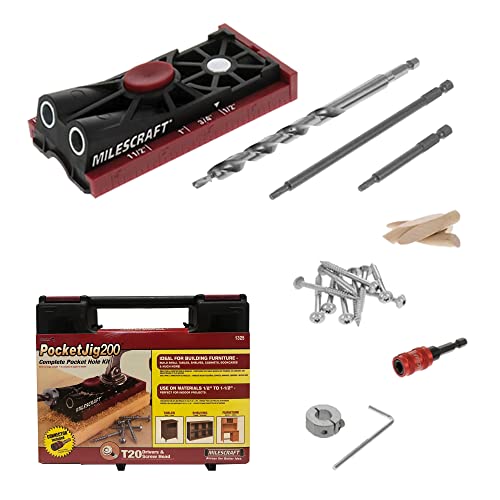
Milescraft 1301 PocketJig200 Kit
Bit, stop collar and screws all ship inside the box, so a first time buyer starts drilling the same day. Three guide holes cover the common pocket hole sizes without extra parts to buy. Owners cite the low price as the main reason they picked it over a full station.
Pros
- Everything needed included in one box
- Simple three hole layout suits new users
- Lowest entry cost among pocket hole kits here
Cons
- Body feels lighter than metal stations
- No integrated clamp to hold boards

Rockler Beadlock Pro Joinery Kit
Loose tenon joints form when a standard drill bores matching mortises through the Beadlock’s indexing guide, then a separate tenon locks the pieces together. Furniture builders reach for it when pocket screws would show or a mortiser costs too much. Learning the index steps takes longer than pocket hole setup.
Pros
- Mortise and tenon strength without a mortiser
- Works with a cordless drill already owned
- Suited to visible furniture joints
Cons
- Steeper learning curve than pocket holes
- Each joint takes longer to complete
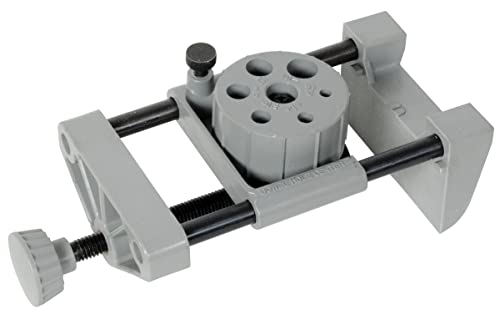
General Tools 849 Doweling Jig
Self centering bushings on the 849 keep dowel holes aligned to the middle of the stock automatically. Cast metal construction holds its tolerances after repeated use, according to the listing. Edge joints and panel glue ups are where owners use it most.
Pros
- Self centering avoids offset dowel holes
- Multiple bushings cover common dowel sizes
- Metal body holds alignment over years
Cons
- Each hole needs its own clamping step
- Long edges take longer than a jig with stops

Wolfcraft 4640404 Dowel Jig
Quick indexing on the 4640404 spaces dowel holes evenly along a board edge without remeasuring each mark. Self centering bushings keep holes on center for tabletop and shelving glue ups. Plastic housing keeps weight down but feels less rugged than General’s cast metal jig.
Pros
- Indexing speeds up repeated dowel spacing
- Self centers without extra measuring
- Lightweight for moving between clamps
Cons
- Works best on straight, flat edges
- Plastic parts feel less durable than metal
The lineup, side by side
| # | Model | Joint type | Best for | Score | Price |
|---|---|---|---|---|---|
| 1 | Kreg 720PRO Pocket-Hole Jig | Pocket hole | Best overall | 9.4 | Check price |
| 2 | Massca M2 Pocket Hole Jig | Pocket hole | Best value | 9.1 | Check price |
| 3 | Kreg 320 Pocket-Hole Jig | Pocket hole | Best budget | 8.8 | Check price |
| 4 | Milescraft 1301 PocketJig200 Kit | Pocket hole | Best for beginners | 8.6 | Check price |
| 5 | Rockler Beadlock Pro Joinery Kit | Loose tenon | Best for loose tenon joints | 8.4 | Check price |
| 6 | General Tools 849 Doweling Jig | Dowel | Best for dowel joints | 8.2 | Check price |
| 7 | Wolfcraft 4640404 Dowel Jig | Dowel | Best for edge joining and panel glue ups | 8.0 | Check price |
Good to know
What is the easiest woodworking jig for a beginner to learn?
Pocket hole jigs are the fastest to pick up, since aligning stock and driving a screw takes only a few tries. Kits like the Milescraft 1301 include the bit and screws needed to start the same day. Dowel and loose tenon jigs ask for more careful measuring before the first cut.
Are pocket hole joints strong enough for furniture?
Sized correctly, pocket hole joints hold up fine in cabinets, face frames and many furniture pieces. Builders often add glue at the joint for extra rigidity on load bearing parts. Heavy structural furniture sometimes calls for dowels or loose tenons instead.
Pocket hole vs dowel joint, which holds up better long term?
Both hold well when sized and glued correctly, so the difference comes down to appearance and speed. Pocket holes are faster but leave a visible plug unless covered. Dowel joints hide completely, which matters more on furniture than on shop cabinets.
What is a loose tenon jig used for?
A loose tenon jig drills matching mortises in two boards so a separate tenon piece can join them. Furniture makers use it for chair rails, table aprons and door frames where strength and a clean look both matter. It approaches the strength of a traditional mortise and tenon without a dedicated mortising machine.
Self centering vs standard doweling jig, which is more accurate?
Self centering jigs index holes to the middle of the board automatically, cutting out measuring errors. Standard jigs give more control over off center holes but demand careful setup each time. Most hobbyists get more consistent results from a self centering design.
Can these jigs be used with a cordless drill?
Yes, every jig on this list works with a standard cordless drill. Match the bit type the jig calls for, stepped or brad point, and set the stop collar to the correct depth.
How do you keep a jig accurate over years of use?
Clear sawdust from guide holes and bushings after every project, since buildup throws off alignment. Check bushings and clamps for wear before a big job. Metal bodied jigs hold their tolerances longer than plastic ones under repeated use.
Is a full pocket hole clamping station worth the extra cost?
For frequent builders, yes, since an automatic clamp like the 720PRO’s saves real time across dozens of joints. Occasional users rarely recover that cost and do fine with a compact jig like the Kreg 320. Weigh how often the jig will come off the shelf.
Do pocket hole screws need to match the material thickness?
Yes, screw length and thread type are matched to how thick and how hard the material is. Too long a screw blows through thin stock, and too short a screw fails to pull thick pieces tight. Most jig makers publish a thickness chart for exactly this.
Which jig works best for edge joining panels into a tabletop?
Self centering dowel jigs like the Wolfcraft 4640404 index evenly spaced holes along a straight edge, which suits panel glue ups well. The General Tools 849 does the same job with a more rugged cast metal body. Both keep boards flush across a wide tabletop glue up.
The verdict
The Kreg 720PRO turns pocket hole joinery into a quick, repeatable step, which is why it tops this list. Choose the Massca M2 for nearly the same accuracy at a lower cost, and reach for the Rockler Beadlock Pro when a project needs furniture grade loose tenon strength. Occasional builders with limited space should keep the compact Kreg 320 on their list.
Jake Monroe
Jake worked as a residential contractor for over a decade before shifting to full-time writing. He evaluates power tools, hand tools and workshop gear through the lens of someone who has actually used them on job sites, not just read the box.


