Smart Displays Compared for Kitchens, Bedrooms and Offices
Amazon Echo Show 8 (3rd Gen) leads on centered camera placement and stronger sound. Google Nest Hub (2nd Gen) suits anyone inside the Google ecosystem better. Amazon Echo Show 5 (3rd Gen) remains the easiest bedside upgrade.
Amazon’s Echo Show 8 (3rd Gen) suits most rooms without compromise, Google’s Nest Hub (2nd Gen) fits close behind for Google households, and the Echo Show 5 (3rd Gen) covers bedside duty on a smaller footprint.
A spec sheet rarely explains how a panel behaves in a bright kitchen or how thin the speakers sound across a room. We compared published display resolutions, speaker layouts, camera and shutter details, and built-in smart home radios, then weighed what owners report about glare, microphone pickup and long-term software support.
The top picks, ranked

Amazon Echo Show 8 (3rd Gen)
An 8 inch panel hits the sweet spot: readable from across a kitchen, small enough for a nightstand. Amazon centered the camera in the bezel and added spatial audio processing, giving noticeably fuller sound than earlier Echo Show generations. A built-in Zigbee and Matter hub controls compatible devices without a separate bridge.
Pros
- Centred camera makes video calls look natural
- Built in hub removes the need for extra bridges
- Adaptive content scales as you walk toward it
Cons
- Alexa still surfaces promotional cards on the home screen
- Glossy panel picks up glare in bright kitchens

Google Nest Hub (2nd Gen)
A fabric-wrapped 7 inch display skips the camera entirely, which suits bedrooms where a lens feels intrusive. Soli radar handles sleep sensing and simple air gestures, while an ambient light sensor dims the panel convincingly at night. Households already living inside Google Photos and Calendar get the most natural fit here.
Pros
- No camera means no privacy worries in bedrooms
- Ambient EQ dimming is genuinely good for overnight use
- Google Photos slideshows look excellent on the panel
Cons
- Cannot make video calls
- Single speaker is thin for music

Amazon Echo Show 5 (3rd Gen)
A compact footprint fits a crowded nightstand without taking it over. The 5.5 inch screen reads best from arm’s length rather than across a room, though tap-to-snooze alarms and sunrise-style wake routines are why most owners keep it. Sound improved over the prior generation, though it remains a small speaker in a small box.
Pros
- Small footprint suits nightstands and desks
- Tap anywhere on top to snooze alarms
- Physical camera shutter is standard
Cons
- Low resolution camera for video calls
- Screen is too small for recipes at a distance

Amazon Echo Show 15
At 15.6 inches, this behaves more like a family noticeboard than a speaker with a screen attached. It mounts flat to a wall in portrait or landscape and runs widgets for shared calendars, sticky notes and shopping lists visible to everyone in the house. Visual ID recognizes faces and swaps in the right person’s reminders, the feature owners mention most.
Pros
- Widget board works well as a family hub
- Large readable screen for recipes and video
- Visual ID personalises what appears
Cons
- Stand is sold separately
- Speakers are modest for the screen size
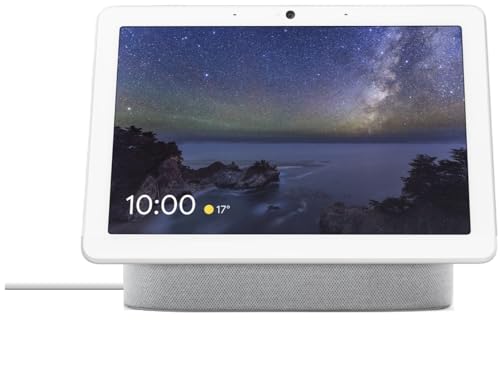
Google Nest Hub Max
A 10 inch display pairs with a 6.5MP wide angle camera that pans and crops to keep you framed while moving around the kitchen. It doubles as an indoor Nest camera once you leave the house, unusual functionality at this size. A rear woofer gives it the strongest sound among the Google displays here.
Pros
- Auto framing keeps you centred on calls
- Best speaker output of the Google displays
- Face Match tailors the screen per person
Cons
- Camera shutter is electronic rather than physical
- Bulky footprint on a shallow counter
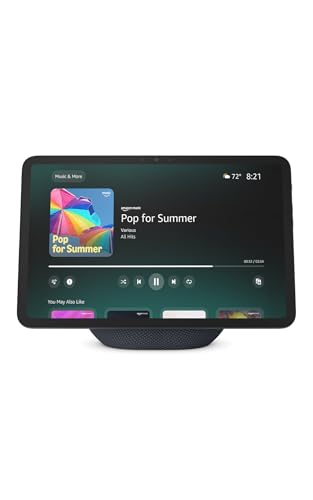
Amazon Echo Show 10 (3rd Gen)
A motorized base rotates the 10 inch screen to track you, useful while cooking when the video keeps facing your direction. This premium speaker array plays the loudest of the group and handles music better than any other display here. Clear space is needed for the base to swivel, so a tight counter corner won’t do.
Pros
- Screen follows you around the room
- Best sound quality of the Echo Show line
- Turns into a pan capable home monitoring camera
Cons
- Needs a large clear area to rotate safely
- Motor noise is audible in a quiet room

Amazon Echo Hub
This is a wall panel first and a smart display second, built to sit by a door showing every light, lock and camera on one dashboard. Power over ethernet or a wall adapter keeps it running, and the screen wakes as you approach. Media playback stays limited compared with an Echo Show, so treat it as a control surface rather than a kitchen TV.
Pros
- Dashboard view of every connected device
- Sits flush on a wall like a thermostat
- Wide radio support covers older accessories
Cons
- No camera and weak built in speakers
- Needs a nearby power or ethernet run
How they compare
| # | Model | Display | Best for | Score | Price |
|---|---|---|---|---|---|
| 1 | Amazon Echo Show 8 (3rd Gen) | 8 inch touchscreen, 1280 x 800 | Best overall | 9.4 | Check price |
| 2 | Google Nest Hub (2nd Gen) | 7 inch touchscreen, 1024 x 600 | Best value | 9.2 | Check price |
| 3 | Amazon Echo Show 5 (3rd Gen) | 5.5 inch touchscreen, 960 x 480 | Best budget | 9.0 | Check price |
| 4 | Amazon Echo Show 15 | 15.6 inch Full HD, 1920 x 1080 | Best for kitchens | 8.8 | Check price |
| 5 | Google Nest Hub Max | 10 inch touchscreen, 1280 x 800 | Best for video calls | 8.6 | Check price |
| 6 | Amazon Echo Show 10 (3rd Gen) | 10.1 inch HD, 1280 x 800 | Best for moving around | 8.3 | Check price |
| 7 | Amazon Echo Hub | 8 inch touchscreen, 1280 x 800 | Best for whole home control | 8.0 | Check price |
How to choose
Matching screen size to the room, not the spec sheet A 5 inch panel works fine at arm’s length on a nightstand and frustrates from the far end of a kitchen counter. An 8 inch display is the practical middle ground for most homes, keeping recipes and video calls readable from a few steps away. Go to 10 inches or larger only when the display has a dedicated spot, since bigger units need more depth and a clear line of sight to earn the extra space.
Deciding how you feel about the camera first Cameras enable video calls, auto framing and home monitoring, but they also point a lens into your living space. Physical shutters matter here, since an electronic off switch relies on software behaving correctly. A camera-free model removes the question entirely for a bedroom, and owners report that’s the single most common reason they choose one.
Checking which smart home radios are actually built in A display with a built-in Zigbee, Thread or Matter radio talks to sensors and bulbs directly instead of routing everything through a separate bridge. Price gaps in this range are usually justified by this feature, based on specifications. If you already own a hub, a display without one is a safe pick, freeing up budget for screen or speaker quality instead.
Staying inside one ecosystem where you can Assistants can’t see each other’s routines, so a household split between two platforms ends up with duplicated automations and confused voice commands. Look at where your photos, calendars, doorbells and thermostats already live, and let that decide the brand. Matter has narrowed the gap for basic device control, but reminders, calendars and shopping lists remain tied to whichever assistant you choose.
Common questions
What size smart display is best for a kitchen?
An 8 inch display is the most practical for a working kitchen, staying readable from a couple of steps back without taking over the counter. If you have wall space and mostly want shared calendars and lists, a 15 inch panel mounted flat is easier to read and frees up counter space entirely.
Can smart displays be used without a camera?
Yes. Google’s Nest Hub (2nd Gen) and Amazon’s Echo Hub ship without any camera, and every Echo Show model here includes a physical shutter that blocks the lens mechanically. Owners commonly pick a camera-free unit for bedrooms and a camera-equipped one for the kitchen or living room.
Do smart displays work as security cameras?
Some do. Google’s Nest Hub Max doubles as an indoor Nest camera, and Amazon’s Echo Show 10 (3rd Gen) can pan around a room for home monitoring. Treat them as useful for checking in rather than replacing a dedicated camera, since they need mains power and sit at counter height.
Do I need a separate smart home hub for a smart display?
Not if the display has the radios built in. Models such as Amazon’s Echo Show 8 (3rd Gen) and Echo Hub include Zigbee, Thread or Matter support, so compatible sensors and bulbs pair straight to them. Wi-Fi-only accessories work with any display on this list.
Can a smart display replace a bedroom alarm clock?
It can, and that’s one of the most common uses owners report. Look for automatic screen dimming at night, a tap-to-snooze surface and sunrise-style wake routines. Amazon’s Echo Show 5 (3rd Gen) and Google’s Nest Hub (2nd Gen) are the two designed most directly for that job.
How good is smart display sound for music?
It varies more than any other spec. Small 5 inch displays carry a single modest driver, fine for podcasts, while Amazon’s Echo Show 10 (3rd Gen) and Google’s Nest Hub Max include a dedicated woofer capable of filling a room. If music matters, treat speaker configuration as the deciding factor.
Will a smart display keep getting software updates?
Both Amazon and Google have shipped feature updates to displays years after launch, with support periods generally longer than for phones. Buying the current generation rather than a clearance older model maximizes how long yours keeps receiving new features.
Can two people share the same smart display?
Yes. Face and voice recognition, such as Visual ID on Echo Show or Face Match on Nest, swaps in the right calendar, reminders and photos for whoever stands in front of the screen. Each person enrolls a profile once during setup.
Echo Show vs Google Nest Hub: which should I buy?
Echo Show models generally include a camera and more built-in radios, suiting video calls and smart home control. Nest Hub models skip the camera on the smaller units and lean into ambient display features like sleep tracking. Pick based on whether your other smart home gear already runs on Alexa or Google.
What is the smallest smart display available?
Amazon’s Echo Show 5 (3rd Gen), at 5.5 inches, is the most compact option in this comparison, built for nightstands and desks rather than across-the-room viewing.
The verdict
Amazon’s Echo Show 8 (3rd Gen) is the display to buy for most households, since the centered camera, stronger speakers and built-in hub cover kitchen, desk and video call duty in one unit. Google households get more from the Nest Hub (2nd Gen), trading the camera for a cleaner bedside experience at a lower outlay. Choose the Echo Show 15 only with wall space to spare and a want for a shared family board rather than a speaker with a screen.
Marcus Chen
Marcus covered consumer electronics for enthusiast tech publications for six years before joining ChoiceCrest. He specializes in translating manufacturer spec sheets into plain-language buying advice, with a focus on audio, computing accessories and smart-home gear.