6 Best 4K Smart TVs You Can Get Under 1000
Hisense U8N takes the overall win with a 144Hz mini-LED panel and dense local dimming. LG C3 OLED delivers the best contrast thanks to self-lit pixels. TCL QM8 hits the highest peak brightness here, which makes it the pick for sun-filled rooms.
Hisense U8N is the strongest all-rounder in this group, combining a mini-LED backlight with a 144Hz native panel. Sunlight a problem? TCL QM8 pushes higher peak brightness than anything else here. For dark-room film watching, LG C3 OLED still wins on contrast because every pixel switches itself off.
Affordable 4K sets diverge on one thing: how the screen produces light. That single choice drives brightness, black level and viewing angle far more than resolution does. We compared published panel types, dimming behaviour, refresh rates and smart platforms, then weighed what long-term owners report about blooming, glare and app support. Each pick below maps to a different room and viewing habit rather than one universal winner.
Before you buy
What panel type should you buy? Four technologies compete here. Mini-LED packs hundreds of tiny backlights into dimming zones, giving high brightness plus respectable blacks. OLED lights each pixel individually for perfect blacks and the widest viewing angles. Direct-lit LED spreads a smaller number of lights behind the panel for even, moderate output. Edge-lit QLED puts the lights along the frame, which keeps the set thin and cheap but caps contrast. That one decision shapes almost everything else.
How bright does your room need the TV to be? Count the windows facing your seating position. South-facing glass and daytime sport push you toward mini-LED, where the TCL QM8 and Hisense U8N sit. A basement or a room with blackout blinds lets OLED contrast do the work at far lower brightness. Rooms in between are the sweet spot for direct-lit sets like the Sony Bravia 3. Glare treatment on the panel surface matters as much as the raw brightness figure.
Which features matter for console gaming? Three specs decide it: native refresh rate, variable refresh rate support and measured input lag. A 120Hz or 144Hz panel lets a current console run its high-frame-rate modes. VRR removes the tearing that shows up when frame rates dip mid-fight. HDMI 2.1 ports carry the bandwidth all of that needs. Stream-only households can ignore the whole list and put the savings toward screen size instead.
How much does the smart platform matter? You touch the operating system every single day, so its layout outlives any spec sheet. Google TV aggregates content across services and handles voice search well. Tizen and webOS run fast and stay free of clutter. Fire TV integrates deeply with Alexa but surfaces a lot of promoted rows. SmartCast covers the basics with fewer apps. Any gap here costs very little to fill with an external streaming stick later.
Our top picks
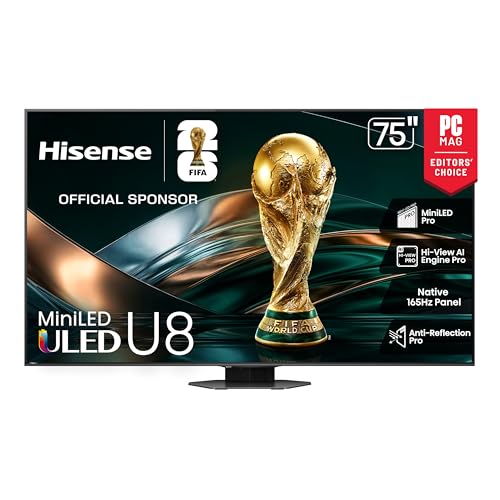
Hisense U8N
Mini-LED backlighting splits the screen into hundreds of dimming zones, so a bright moon can sit in a black sky without washing it out. Native 144Hz means PC gamers get full frame rates without motion interpolation. Owners report it handles daytime sport and late-night films equally well, which is rare at this level.
Pros
- High peak brightness for the class
- Dense local dimming holds deep blacks
- 144Hz panel covers PC and console gaming
Cons
- Blooming shows around small bright objects
- Google TV home screen feels crowded

LG C3 OLED
Each pixel emits its own light and switches off completely for black, producing contrast no backlit set can match. Four HDMI 2.1 ports carry 120Hz signals, and webOS adds variable refresh rate support for both consoles. Peak brightness sits below the mini-LED sets here, so a dim room flatters it most.
Pros
- Perfect blacks and effectively infinite contrast
- Color holds steady from wide off-center seats
- Full 120Hz gaming feature set with low lag
Cons
- Dimmer than mini-LED rivals in daylight
- Only the smaller sizes stay affordable

TCL QM8
Very high peak brightness cuts straight through window glare, which is the main reason to choose it over an OLED. A dense mini-LED array keeps HDR highlights punchy rather than clipped. Sizes run well past 75 inches, so it doubles as a home-theater centerpiece for a large open-plan room.
Pros
- Brightest panel in this comparison
- Dense dimming zones keep HDR highlights clean
- Available in very large screen sizes
Cons
- Color shifts noticeably from off-center seats
- Heavier and deeper than rivals, so check your mount

Samsung Q60D QLED
Quantum dots produce vivid, saturated color inside a slim edge-lit chassis just over an inch deep. Tizen carries every major streaming app and gets years of firmware support. Skipping mini-LED keeps the outlay down, so treat it as a moderate-lighting set rather than a sunroom television.
Pros
- Quantum-dot color looks rich and saturated
- Slim edge-lit panel suits flush wall mounting
- Tizen app library is mature and well supported
Cons
- 60Hz ceiling limits fast console gaming
- Edge lighting cannot match mini-LED contrast

Sony Bravia 3
Sony’s processing tames noise in compressed streams and keeps skin tones natural rather than oversaturated. Direct-lit LEDs sit behind the whole panel, giving more even light than an edge-lit set at the same level. Motion handling suits 24fps film, and Google TV keeps app navigation simple.
Pros
- Accurate color straight out of the box
- Processing cleans up low-bitrate streams
- Direct-lit array spreads light evenly
Cons
- Peak brightness trails every mini-LED here
- 60Hz panel rules out 120Hz console modes

Amazon Fire TV Omni QLED
Far-field microphones let you change inputs, dim lights or check a camera feed without touching the remote. Quantum-dot color and full-array dimming lift it above entry Fire TV models. Alexa routines tie it into existing smart plugs, thermostats and doorbells, which is the reason to pick it over a brighter panel.
Pros
- Hands-free Alexa works across the room
- Quantum-dot color at an accessible level
- Controls existing Alexa smart-home devices
Cons
- Home screen pushes heavy promoted content
- 60Hz panel limits fast-motion gaming

Vizio Quantum Pro
A 120Hz panel at this level is unusual, and it pairs with quantum-dot color and low gaming latency. SmartCast runs everything on-device with built-in casting from a phone. App selection is thinner than Google TV or Tizen, so check your streaming services before committing.
Pros
- 120Hz panel at the lowest outlay here
- Quantum-dot color stays bright and punchy
- Gaming latency is competitive for the class
Cons
- SmartCast app library is limited
- Contrast is modest without mini-LED dimming
How they compare
| # | Model | Display | Best for | Score | Price |
|---|---|---|---|---|---|
| 1 | Hisense U8N | Mini-LED QLED | Best overall | 9.4 | Check price |
| 2 | LG C3 OLED | OLED | Best picture quality | 9.2 | Check price |
| 3 | TCL QM8 | Mini-LED QLED | Best for bright rooms | 9.0 | Check price |
| 4 | Samsung Q60D QLED | QLED (edge-lit) | Best value | 8.8 | Check price |
| 5 | Sony Bravia 3 | Direct-lit LED | Best for movie fans | 8.6 | Check price |
| 6 | Amazon Fire TV Omni QLED | QLED | Best for smart home control | 8.3 | Check price |
| 7 | Vizio Quantum Pro | Quantum-dot LED | Best budget | 8.0 | Check price |
Frequently asked questions
Is mini-LED or OLED better for a bright living room?
Mini-LED wins outdoors-facing rooms because it reaches far higher peak brightness and resists glare. OLED still holds the contrast crown, but sunlight flattens its advantage. Match the technology to your window situation rather than the spec sheet.
What screen size should you choose for a living room?
Seating distance drives it. Around seven to nine feet away, a 65 inch screen fills the field of view comfortably, and 75 inches feels cinematic. Measure the wall and the stand width before ordering, since larger panels need wider furniture.
Do you need a 120Hz TV or is 60Hz fine?
Console and PC gamers benefit from 120Hz, which unlocks high-frame-rate modes and smoother motion. Streaming, broadcast and film content is mastered at 24 to 60 frames per second, so 60Hz shows it perfectly well.
How many dimming zones is enough?
More zones mean tighter control over blooming around bright objects. Mini-LED sets like the Hisense U8N and TCL QM8 run hundreds of them. Edge-lit sets have very few, which is why highlights bleed into dark areas.
Which smart TV platform is best?
Google TV suits people who watch across many services and use voice search. Tizen and webOS feel fastest and cleanest. Fire TV makes sense inside an Alexa household. Pick for daily comfort, because switching later means adding a streaming stick.
Does a 4K TV need a soundbar?
Slim panels leave no cabinet volume for real drivers, so bass and dialogue clarity suffer. A soundbar fixes both. Casual viewing is fine on built-in speakers, but films and sport improve noticeably with external audio.
Can OLED screens still get burn-in?
Modern panels include pixel shifting and logo dimming to reduce the risk. Static elements shown for many hours daily remain the main hazard, such as a news ticker or a game HUD. Varied viewing habits make it a non-issue for most households.
What is the difference between QLED and mini-LED?
QLED describes a quantum-dot layer that boosts color purity. Mini-LED describes the backlight itself, made of much smaller diodes. Many sets use both, which is why the Hisense U8N is listed as mini-LED QLED.
Is HDR worth paying attention to on an affordable TV?
HDR needs brightness to show any benefit, so it pays off most on mini-LED sets. On dimmer panels the effect is subtle. Check peak brightness first, then the supported HDR formats.
How long should a 4K smart TV last?
Panels commonly serve well beyond five years of normal use. App support usually ends before the hardware does, so brand track record on firmware updates matters. Keeping the set updated and avoiding long static images helps.
Our pick
Hisense U8N is the safest choice for a shared living room, pairing mini-LED brightness with a 144Hz panel that suits gaming and sport. Reach for TCL QM8 if sunlight is the daily problem, or LG C3 OLED if your room goes properly dark. Budget-focused buyers still get a 120Hz panel from Vizio Quantum Pro.
Marcus Chen
Marcus covered consumer electronics for enthusiast tech publications for six years before joining ChoiceCrest. He specializes in translating manufacturer spec sheets into plain-language buying advice, with a focus on audio, computing accessories and smart-home gear.