Seed Starting Trays to Get Spring Planting Ahead
Bootstrap Farmer 1020 Extra Strength Trays win for plastic thick enough to reuse for years without cracking. Epic Gardening 6 Cell Trays give deep rooted crops more room before transplanting, and Jiffy 72 Pellet Greenhouse is the simplest complete kit for a first sowing season.
Bootstrap Farmer 1020 Extra Strength Trays are the pick for anyone sowing seeds every spring and tired of replacing cracked trays. Epic Gardening 6 Cell Trays suit deeper rooted crops better, and Jiffy 72 Pellet Greenhouse gets a first time grower started with the least fuss.
Seed trays look interchangeable on a shelf, but cheap ones flex and split the moment you lift one full of wet compost. Shallow cells force an early transplant before roots are ready. We compared plastic gauge, cell depth, drainage design and what owners report about reuse across seasons to rank the seven below.
What we recommend

Bootstrap Farmer 1020 Extra Strength Trays
Heavy gauge injection molded plastic sets this tray apart from the flimsy versions sold at most garden centers, so it can be lifted full of wet compost without folding in the middle. It is built for years of reuse rather than one season. Owners commonly report using the same batch for five or more years, which changes the cost math entirely.
Pros
- Thick enough to lift full without flexing
- Standard 1020 size fits inserts and domes
- Genuinely reusable for many seasons
Cons
- Costs several times more than a disposable tray
- Bulky to store compared with thin trays

Epic Gardening 6 Cell Seed Starting Trays
Durable plastic inserts with only six deep cells give roots room to grow before they hit the wall of a shallow tray. A bottom opening pushes the root plug out from below, avoiding the tearing that comes with squeezing plants from the top. Owners report noticeably less transplant shock than with shallow supermarket style trays.
Pros
- Deep cells suit tomatoes and peppers
- Push up base removes plugs without damage
- Sturdy enough for repeated seasons
Cons
- Fewer seedlings per tray than 72 cell inserts
- Deeper cells need more compost per plant
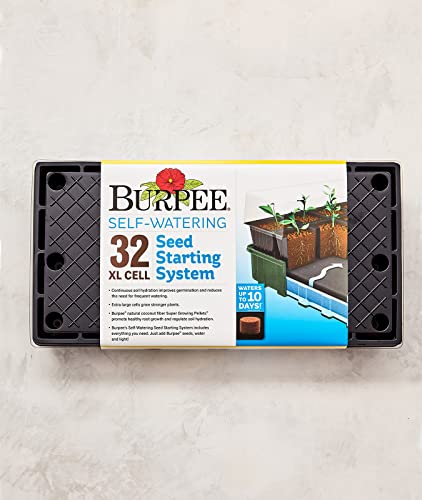
Burpee Self Watering Seed Starting Kit
A reservoir feeds a capillary mat that draws moisture up into every cell, so compost stays evenly damp without daily watering from above. That consistency is the part of seed starting most people struggle with. Owners report better germination rates than hand watering, especially for tiny seeds that wash out of position under a watering can.
Pros
- Even moisture without daily attention
- Keeps small seeds from washing out of position
- Dome included for germination humidity
Cons
- Mat needs regular cleaning to prevent algae
- Constant moisture invites damping off if unventilated

Jiffy 72 Pellet Greenhouse Seed Starter Kit
Seventy two compressed peat pellets expand when watered, so there is no compost to buy or mix separately. A tray and dome are included, making this the simplest possible entry into seed starting. Remove the netting around each pellet at planting time, since owners report roots can get restricted if it stays on.
Pros
- No compost mixing or measuring required
- Plants go out in their pellet with minimal disturbance
- Cheapest way to try seed starting
Cons
- Netting must be removed or roots can be restricted
- Tray and dome rarely survive a second year

Hydrofarm Germination Station with Heat Mat
A 72 cell insert, a tall vented dome and a seedling heat mat come bundled together, giving peppers, tomatoes and eggplants what they actually need to germinate in a cool house. Bottom heat is the single most effective upgrade for warm season crops. Owners report dramatically faster germination on peppers than an unheated windowsill manages.
Pros
- Bottom heat transforms warm season germination
- Tall dome gives seedlings headroom
- Everything needed comes in one package
Cons
- Heat mat needs a separate thermostat for precise control
- Cell insert is thinner than dedicated reusable trays

MIXC Seed Starter Tray Kit
Several cell trays arrive with domes, base trays and plant labels, enough capacity for a full season of successional sowing without buying separate kits one at a time. Plastic gauge is thin but adequate with careful handling. Owners report solid value for the volume, with the caveat that these trays will not outlast heavy gauge alternatives.
Pros
- Plenty of capacity for successional sowing
- Domes and labels included in the set
- Cheap enough to expand a setup quickly
Cons
- Thin plastic flexes when lifted full
- Unlikely to survive many seasons

iPower Seedling Starter Tray
Plain standard size trays sold in multi packs work as drip trays, propagation bases or a home for your own cell inserts. Nothing fancy is included, but the sizing correctly fits standard 1020 accessories. Owners report they hold up for a season or two provided they are supported underneath when carried full.
Pros
- Cheapest way to cover a bench
- Standard size fits common inserts and domes
- Useful as drip trays under pots
Cons
- Flex badly if lifted without support
- Crack after a season or two of use
How to choose
Plastic thickness is the real thing you are buying The 1020 tray is a standard size, and nearly every insert, dome and heat mat on the market is built around it. What varies is the gauge of plastic. Thin trays cost little and split the first time you lift one full of wet compost, usually right across the middle. Heavy gauge trays like the Bootstrap Farmer 1020 cost several times more but last for years, which works out cheaper for anyone sowing every season. If thin trays are all you have, always carry them on a rigid board.
Cell depth decides when you have to transplant Shallow cells, common in cheap kits, force a transplant within two or three weeks or the seedling stalls and becomes root bound. Deeper cells, like those in the Epic Gardening inserts, buy considerably more time, which matters when your last frost date keeps shifting. Tomatoes, peppers and squash benefit most from the extra depth. Small seeds such as lettuce and brassicas are perfectly happy in shallower cells and give more plants per tray.
Bottom heat matters more than light at germination Seeds respond to soil temperature first, not light, and most warm season crops want soil between seventy five and eighty five degrees Fahrenheit. A cool windowsill often falls well short, which is why pepper seeds can sit doing nothing for weeks. A heat mat, included with the Hydrofarm Germination Station, fixes this directly. Once seedlings emerge, priorities flip: they need strong light right away or they stretch, and the heat mat should come off.
Watch drainage and airflow to avoid damping off Damping off is a fungal problem that kills healthy looking seedlings overnight at soil level, and it thrives in constantly wet, still air. Every cell needs a drainage hole, watering from below helps, and a humidity dome should get vented once seeds have sprouted rather than staying sealed. Reused trays should be disinfected with a dilute bleach solution between seasons, since spores overwinter in old compost residue tucked into cell corners.
The lineup, side by side
| # | Model | Size | Best for | Score | Price |
|---|---|---|---|---|---|
| 1 | Bootstrap Farmer 1020 Extra Strength Trays | Standard 1020 footprint | Best overall | 9.4 | Check price |
| 2 | Epic Gardening 6 Cell Seed Starting Trays | 6 cells per insert, deep profile | Best cell design | 9.2 | Check price |
| 3 | Burpee Self Watering Seed Starting Kit | Reservoir with capillary mat | Best for even moisture | 9.0 | Check price |
| 4 | Jiffy 72 Pellet Greenhouse Seed Starter Kit | 72 compressed peat pellets | Best complete kit | 8.8 | Check price |
| 5 | Hydrofarm Germination Station with Heat Mat | Tray, 72 cell insert, dome and heat mat | Best for heat loving seeds | 8.6 | Check price |
| 6 | MIXC Seed Starter Tray Kit | Multiple cell trays with domes and bases | Best value multipack | 8.3 | Check price |
| 7 | iPower Seedling Starter Tray | Standard 1020 footprint | Best budget | 8.0 | Check price |
Common questions
What size seed starting tray should I get?
Standard 1020 trays, roughly ten by twenty inches, are the sensible default because every dome, insert and heat mat is built to that footprint. Cell count within the tray is the real decision: 72 cells suits lettuce and brassicas, 36 or fewer suits tomatoes, peppers and squash that need root room.
Do seed trays need drainage holes?
Cell inserts do, so excess water can escape and roots get air. The base tray underneath is often solid on purpose, so it can hold water for bottom watering. Many trays, including the Bootstrap Farmer range, sell in both versions for exactly this reason.
Can seed starting trays be reused?
Yes, provided the plastic is thick enough. Heavy gauge trays last many seasons. Wash off compost residue and disinfect with a dilute bleach or hydrogen peroxide solution before each new season, since fungal spores that cause damping off survive in old debris.
Should I use a humidity dome during germination?
Yes, since it keeps the surface moist while seeds are sprouting. Once most seedlings have emerged, start venting it and remove it within a few days. A sealed dome left on established seedlings creates the still, damp conditions damping off needs.
What compost should go in seed trays?
A dedicated seed starting mix, which is fine textured and very low in nutrients. Rich potting mixes are too strong for germinating seeds and can burn young roots. Once true leaves appear, begin dilute feeding or pot on into a standard potting mix.
How deep should seeds be sown in a tray?
A common rule is roughly twice the seed’s diameter. Very fine seeds such as lettuce and snapdragons need light to germinate and should sit on the surface rather than get covered. Always check the seed packet, since a few species have specific requirements.
Is a heat mat necessary for seed starting?
Not for cool season crops like brassicas, lettuce and peas, which germinate happily at room temperature. It makes a much bigger difference for peppers, eggplants and tomatoes, which can otherwise sit for weeks in a cool house. A thermostat prevents overheating the root zone.
When should seedlings move out of the tray?
Once roots begin circling the bottom of the cell, or the plant has two to three sets of true leaves, whichever comes first. Deep cells buy extra time before that point. Harden seedlings off over a week of increasing outdoor exposure rather than moving them outside all at once.
Which seed tray works best for tomatoes and peppers?
Epic Gardening 6 Cell Trays give warm season crops the depth they need before roots circle the cell. Pair either with the Hydrofarm Germination Station’s heat mat, since peppers in particular germinate far faster with warm soil than at room temperature.
Are pellet kits like Jiffy better than cell trays for beginners?
Pellet kits remove compost mixing entirely, which makes them the easiest starting point for a first season. Cell trays give more control over depth and are cheaper to refill season after season. Many gardeners start with pellets and move to reusable trays once they sow regularly.
Final word
Bootstrap Farmer 1020 Extra Strength Trays are worth the extra cost for anyone sowing seeds every year, since thicker plastic is the difference between a tray that lasts a decade and one that splits in March. Epic Gardening 6 Cell Trays suit deeper rooted crops that need longer in the cell, and the Hydrofarm Germination Station earns its place if peppers and tomatoes have never germinated well on a windowsill.
Sierra Daniels
Sierra's background is in landscape design and nursery retail. She focuses on lawn and garden equipment, outdoor furniture and gear durability, weighing published specs against how materials actually hold up outside.

