How to Pick a Security Light That Deters Intruders
LEPOWER’s 2500LM twin head fixture leads this comparison for its adjustable beam and wide coverage. Ring’s Floodlight Cam Wired Plus pairs similar brightness with built in 1080p recording. Baxia’s solar light needs no wiring at all, making it the practical pick for sheds, gates and fence lines far from an outlet.
A driveway needs even coverage, not one blinding hot spot in the middle. LEPOWER’s adjustable twin head fixture spreads brightness across the whole approach, which is why it tops this list. Ring’s wired camera model adds recording on top of light, and Baxia’s solar unit works where no outlet exists at all.
Lumen ratings alone do not predict real coverage on a wall or a fence line. We compared beam angle, sensor range, colour temperature and wiring type across seven current listings, then weighed owner feedback on reliability after months outdoors. A sensor that stops triggering by winter defeats the entire purpose of buying one.
What we recommend

LEPOWER 2500LM LED Security Light
Two heads swivel independently, so one can aim down a driveway while the other covers a side path. The motion sensor moves on its own separate joint, letting you fine tune detection angle without shifting the lamps. Installation means hardwiring into a junction box, and first setup usually needs a sensitivity adjustment to stop false alarms.
Pros
- Independently adjustable twin heads
- Sensor aims separately from the lamps
- Wide 180 degree beam spread
Cons
- Needs a hardwired junction box
- Sensitivity requires tuning after install

Ring Floodlight Cam Wired Plus
Motion triggers 2000 lumens of flood light plus 1080p video, two way talk and a built in siren from one fixture. Custom motion zones in the Ring app filter out cars passing on the street below. Continuous video history sits behind a subscription, which adds an ongoing cost beyond the hardware itself.
Pros
- Combines flood light, camera and siren
- Adjustable motion zones cut false alerts
- Integrates with Alexa routines
Cons
- Cloud video storage needs a subscription
- Installation is hardwired only
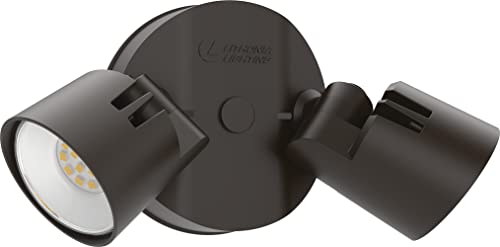
Lithonia Lighting OLF 2RH LED Flood Light
Lithonia builds commercial lighting, and the OLF series carries that sealed housing and mechanical simplicity into a residential fixture. Two round heads swing wide to cover a broad arc without an app or a login involved. Fewer parts than a smart floodlight means fewer things that can fail after years spent outdoors.
Pros
- Commercial grade sealed housing
- No app, login or firmware to manage
- Long rated LED lifespan
Cons
- Offers no smart or camera features
- Plainer look than consumer fixtures

SANSI 30W LED Security Motion Sensor Light
SANSI swaps the usual aluminium heat sink for ceramic, which owners report keeps the LEDs running cooler through hot summers. Output reaches 3600 lumens from three adjustable heads, enough for a full yard from one mounting point. That third head does add bulk on the wall compared with twin head competitors.
Pros
- 3600 lumens for the outlay
- Ceramic cooling aids long term life
- Three heads adjust independently
Cons
- Bulkier profile than twin head lights
- Detection range trails other picks

RAB Lighting STL360HW Super Stealth Motion Sensor
RAB sells this as a standalone sensor rather than a complete fixture, meant to pair with lights you already own. Detection spans 360 degrees across roughly 1000 square feet, wider than any complete fixture in this comparison. Physical dials set time, sensitivity and daylight cutoff without needing an app.
Pros
- Widest detection coverage compared here
- Physical dials for precise adjustment
- Upgrades an existing light fixture
Cons
- Ships without any light source
- Requires hardwiring into the fixture

Mr. Beams MB360XT Wireless LED Spotlight
Four screws and no electrician get this spotlight onto a shed, fence or doorway in minutes. Output tops out at 200 lumens, enough for a path or entryway rather than a driveway. Battery life runs several months, according to the listing, depending on how often motion triggers it.
Pros
- Installs without wiring or an outlet
- Wide 240 degree detection angle
- Works on sheds, fences or doorways
Cons
- Far dimmer than wired flood lights
- Batteries add an ongoing cost
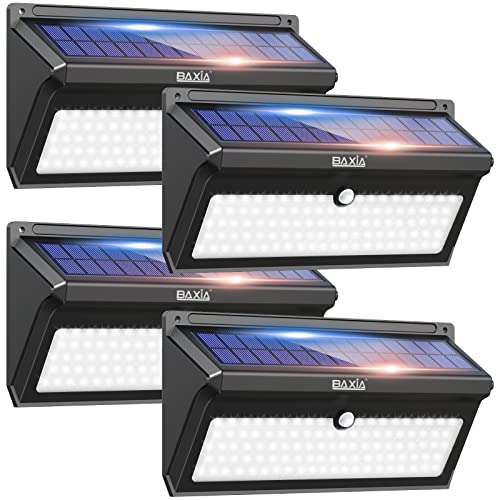
Baxia Technology Solar Security Light
A back gate, shed or fence line often has no nearby outlet, and that is exactly where this solar fixture fits. Its panel charges through the day and the light fires on motion after dark. Based on specifications, output drops during short winter days and long overcast stretches, so treat it as backup rather than a main light.
Pros
- No wiring or electricity cost
- Mounts anywhere with sun exposure
- Suits sheds, gates and fence lines
Cons
- Output fades in winter and overcast weather
- Considerably dimmer than wired options
Side by side
| # | Model | Brightness | Best for | Score | Price |
|---|---|---|---|---|---|
| 1 | LEPOWER 2500LM LED Security Light | 2500 lumens | Best overall | 9.4 | Check price |
| 2 | Ring Floodlight Cam Wired Plus | 2000 lumens | Best with built in camera | 9.2 | Check price |
| 3 | Lithonia Lighting OLF 2RH LED Flood Light | About 2200 lumens | Best for reliability | 9.0 | Check price |
| 4 | SANSI 30W LED Security Motion Sensor Light | 3600 lumens | Best value | 8.8 | Check price |
| 5 | RAB Lighting STL360HW Super Stealth Motion Sensor | 360 degrees, about 1000 square feet | Best sensor upgrade | 8.6 | Check price |
| 6 | Mr. Beams MB360XT Wireless LED Spotlight | 200 lumens | Best battery powered | 8.3 | Check price |
| 7 | Baxia Technology Solar Security Light | About 400 lumens | Best solar option | 8.0 | Check price |
How to pick the right one
Why beam spread matters more than lumens A 5000 lumen fixture aimed at one narrow spot creates a bright island surrounded by deep shadow. Spreading the same output across twin or triple heads removes hiding places along the whole approach instead of lighting one square of driveway. Check beam angle and head count before comparing lumen numbers between listings, since two lights rated the same can cover very different areas.
Getting the motion sensor right Passive infrared sensors read heat crossing their field, so someone walking across the beam triggers reliably while someone walking straight toward it can slip past. Mounting height of eight to ten feet, with the sensor angled down and across the path, gives the most consistent detection. A road, a heat pump exhaust or a neighbour’s walkway sitting in the field usually causes nuisance triggers, and re-aiming fixes it faster than lowering sensitivity.
Choosing wired, battery or solar power Hardwired fixtures deliver the highest, steadiest output and never need charging, which is why the brightest lights in any lineup tend to be wired. Battery powered units suit doorways, sheds and spots where running a new circuit is not worth the hassle. Solar performs well from spring through autumn in sunny climates but loses runtime on short winter days, so it works better as a secondary light than a main entrance fixture.
Colour temperature, glare and neighbours Daylight white around 5000K renders faces and licence plates clearly on camera footage and reads as more alert to passersby. Warm white near 3000K is gentler where light spills toward a bedroom window or a neighbouring yard. Shielding and downward aiming matter as much as brightness, since light trespassing across a property line can draw complaints or run against local ordinances.
Common questions
How many lumens do you need for a security light?
Around 2000 to 3000 lumens spread across two or three heads covers a typical driveway well. Doorways and side paths need less, usually 700 to 1500 lumens total.
Do motion sensor lights work well in cold weather?
Yes, passive infrared sensors often detect motion slightly more reliably in cold air because body heat contrasts more against a colder background. Battery powered fixtures do lose some runtime once temperatures drop.
Why does my security light turn on for no reason?
False triggers usually trace back to a road, an exhaust vent, swaying branches or reflected heat entering the sensor’s field. Angling the sensor down and away from those sources solves it more reliably than turning down sensitivity.
Can you install a security light yourself?
Swapping an existing hardwired fixture is manageable for a confident DIYer once the circuit is switched off. Running a brand new circuit, or any wiring you are unsure about, is worth handing to a licensed electrician.
Are solar security lights bright enough for a driveway?
For gates, sheds and garden paths, solar output is enough. A driveway or main entrance benefits more from a wired fixture, since solar output and runtime both drop in winter.
Should a security light stay on all night or trigger on motion?
Motion triggered lighting is the stronger deterrent, since the sudden change draws attention and uses far less power over a year. Dusk to dawn lighting suits situations where constant visibility matters more, such as feeding a security camera.
Do security lights actually stop break-ins?
Owners and law enforcement guidance generally treat lighting as one useful layer among several, especially paired with a visible camera. Its clearest benefit is making activity near your home visible to you and to neighbours.
What weather rating should outdoor security lights have?
Look for IP65 or a wet location listing on any fixture mounted where rain or snow can reach it directly. IP44 fixtures are fine only under a soffit or a covered porch.
Security light vs floodlight camera: which is better?
A floodlight camera like the Ring Floodlight Cam Wired Plus adds recording and two way talk on top of illumination, useful for evidence as well as deterrence. A standalone floodlight such as the LEPOWER costs less and skips the subscription that video storage requires.
How high should you mount a motion sensor light?
Eight to ten feet is the usual sweet spot, high enough to avoid pets and low branches but still within reliable detection range. Angling it slightly downward across the approach path improves accuracy further.
Our take
LEPOWER’s adjustable twin heads and independently aimed sensor solve the coverage problem that raw brightness cannot, which earns it the top spot here. Anyone who wants recording alongside deterrence should look at the Ring Floodlight Cam Wired Plus, accepting the subscription that comes with it. Where no outlet exists, the Baxia solar light remains a sensible answer for gates, sheds and fence lines.
Marcus Chen
Marcus covered consumer electronics for enthusiast tech publications for six years before joining ChoiceCrest. He specializes in translating manufacturer spec sheets into plain-language buying advice, with a focus on audio, computing accessories and smart-home gear.


