How to Pick an All in One Printer for Home or Office
Epson EcoTank ET-2850 makes the most sense long term, swapping cartridges for refillable bottles. HP OfficeJet Pro 9125e prints faster and scans both sides unattended, which suits shared offices. Brother MFC-L2750DW is the mono laser to buy when printing means contracts, forms and homework.
Epson EcoTank ET-2850 is the all in one to buy for a home office. Higher volumes suit the HP OfficeJet Pro 9125e. Anyone printing mostly black text should skip inkjets entirely and take the Brother MFC-L2750DW. All three print, scan, copy and connect wirelessly.
Purchase price predicts very little about what a printer costs over three years. Cartridge machines start cheap and stay expensive to feed. Tank models reverse that. Laser sits elsewhere again, depending entirely on page count. We compared published page yields, print speeds, duplex and scanner specifications, then weighed owner reports about clogging, driver support and long term reliability.
The shortlist, ranked

Epson EcoTank ET-2850
Refillable tanks replace cartridges here, and the ink supplied in the box covers thousands of pages before you buy more. That single change turns printing from something you ration into something you simply do. Automatic duplex printing is included, though output is slower than office machines and the scanner is a plain flatbed.
Pros
- Cost per page far below any cartridge model
- Large ink supply included at purchase
- Prints both sides without manual reloading
Cons
- Slower than office class machines
- Flatbed scanner with no document feeder
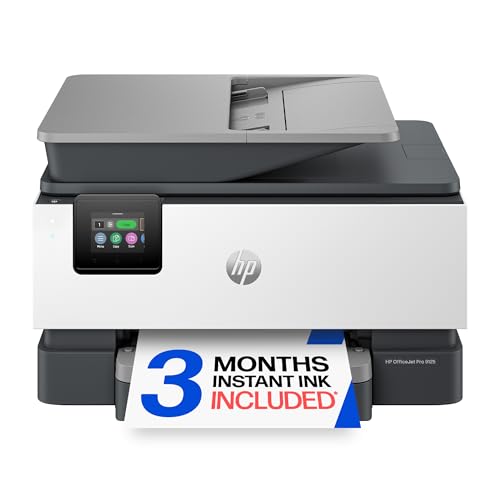
HP OfficeJet Pro 9125e
Built for volume, the 9125e turns out quick colour pages and scans a stack of double sided sheets without anyone standing over it. Ethernet sits alongside Wi-Fi, which matters where several people share one machine. Owners report running cost only makes sense on an ink subscription, so factor that into the decision.
Pros
- Genuinely quick for a home class machine
- Feeder scans both sides unattended
- Mobile app handles cloud scanning well
Cons
- Cartridge cost climbs without a plan
- Larger footprint than compact models

Brother MFC-L2750DW
Contracts, forms and school work call for a mono laser, and this Brother is the standard recommendation. Toner is a dry powder, so nothing clogs after weeks of sitting idle, which is how most household inkjets die. A duplexing document feeder handles stacks, and replacement cartridges are stocked everywhere.
Pros
- Survives weeks of disuse without clogging
- Very low cost per page on text
- Crisp, fast black output
Cons
- No colour printing at all
- Photo scans are functional rather than good

Canon PIXMA TR4720
Small enough for a shelf, this covers occasional printing, scanning and copying without dominating a desk. A 20 sheet document feeder is unusual at this level and saves feeding forms page by page. Cartridge cost is the catch, which makes it a light use machine rather than a weekly workhorse.
Pros
- Fits on a shelf or a small side table
- Document feeder at an entry level outlay
- Setup is straightforward for non technical users
Cons
- Highest cost per page here
- Slower and noisier than the rest

Brother MFC-J4335DW
A large starter ink supply and reasonable colour speed suit households that need occasional colour but do not want tanks to fill. Duplex printing is built in and paper handling is solid. It slots neatly between the cheap cartridge machines and the EcoTank, and Ethernet is available if Wi-Fi is unreliable.
Pros
- Generous ink supplied at purchase
- Colour documents look clean and consistent
- Wireless connection stays stable
Cons
- Photo output trails dedicated photo printers
- Still a cartridge system long term
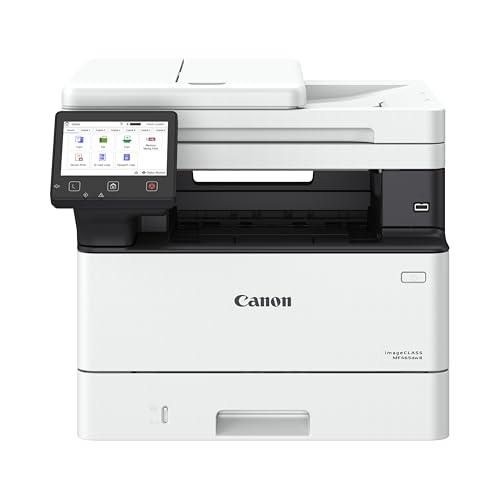
Canon imageCLASS MF453dw
This is a proper small business laser, with a high monthly duty cycle, fast mono output and a large main tray so nobody refills it twice a day. Cost per page is the lowest here. It is more machine than a household needs, and the weight makes a sturdy surface essential.
Pros
- Handles hundreds of pages a month without complaint
- Large tray cuts refill trips
- Lowest cost per printed page in this group
Cons
- Big and heavy for a home desk
- Mono only, no colour output

HP Envy Inspire 7955e
A dedicated photo tray sits below the main one, so 4 by 6 prints need no paper swapping mid session. Colour output suits fridge prints and scrapbooks, and everyday documents come out fine too. Photo printing consumes ink quickly by nature, so expect colour cartridges to be a regular purchase.
Pros
- Best photo quality in this roundup
- Second tray removes paper swapping
- Bluetooth assisted setup is quick
Cons
- Photo printing burns through colour ink
- Document speed is only average
The lineup, side by side
| # | Model | Ink system | Best for | Score | Price |
|---|---|---|---|---|---|
| 1 | Epson EcoTank ET-2850 | Refillable EcoTank bottles | Best overall | 9.4 | Check price |
| 2 | HP OfficeJet Pro 9125e | Print, scan, copy, fax | Best for busy offices | 9.2 | Check price |
| 3 | Brother MFC-L2750DW | Monochrome laser | Best for documents | 9.0 | Check price |
| 4 | Canon PIXMA TR4720 | Print, scan, copy, fax | Best budget | 8.8 | Check price |
| 5 | Brother MFC-J4335DW | Colour inkjet | Best for mixed use | 8.6 | Check price |
| 6 | Canon imageCLASS MF453dw | Monochrome laser | Best for high volume | 8.3 | Check price |
| 7 | HP Envy Inspire 7955e | Photo and everyday printing | Best for photos | 8.0 | Check price |
What matters most
How many pages do you actually print a month? That single number chooses the technology. Under roughly fifty pages, a cheap cartridge machine such as the Canon PIXMA TR4720 never becomes painful. Between fifty and three hundred, an ink tank model pays back its higher entry cost within a year. Above three hundred, or where nearly every page is plain text, laser wins on both cost and reliability. Check your last twelve months of paper purchases if you are guessing.
Which ink system costs least to run? Tank systems, once volume passes a few hundred pages. Bottled ink refills a reservoir for a fraction of what equivalent cartridges cost, which is the whole argument for the EcoTank ET-2850. Cartridge machines invert that trade. Toner sits between the two and has the longest shelf life, since dry powder does not evaporate. Look up the quoted page yield of the consumable, not the price of the printer itself.
Inkjet or laser: which should you buy? Print irregularly and an inkjet head dries out, then wastes ink clearing itself. Laser has no liquid ink, so it works after months idle. Choose laser for text, volume and long gaps between jobs, which covers the Brother MFC-L2750DW and Canon imageCLASS MF453dw. Choose inkjet when colour photos or graphics matter, and print something small every week or two to keep the nozzles clear.
What scanner features are worth paying for? A flatbed alone means lifting the lid for every page, which is fine for a passport but miserable for a twenty page contract. An automatic document feeder takes a stack. A duplexing feeder, fitted to the HP OfficeJet Pro 9125e and Brother MFC-L2750DW, captures both sides in one pass. For anyone digitising receipts, forms or school paperwork, that saves far more time than any print speed figure.
Questions worth asking
Is an ink tank printer cheaper than cartridges?
Over any real volume, yes. Tanks cost more to buy and far less to refill, and the ink in the box typically covers thousands of pages. Below about fifty pages a month, the payback takes years.
Should I buy an inkjet or a laser printer?
Laser suits mostly black text, irregular use and high volume. Inkjet suits colour photos and graphics. Laser also avoids the clogging that comes with letting an inkjet sit idle for weeks.
Do all in one printers need a computer?
No. Most set up over Wi-Fi through a phone app and print from mobile devices directly. A computer is only needed for advanced scanning software and some driver level settings.
What is a duplex document feeder?
A feeder that scans or copies both sides of a stack without you turning pages over. For anyone digitising forms or contracts, it is the most useful feature on the scanner side.
Why do inkjet printers clog?
Ink dries in microscopic nozzles when the machine sits unused. Printing a page every week or two keeps it moving. Cleaning cycles clear most blockages but consume a surprising amount of ink each run.
Are third party cartridges safe to use?
They work in many machines, though some trigger warnings and a firmware update can reject them. Tank and laser systems sidestep the issue by making official consumables cheap in the first place.
How much print speed do you actually need?
Anything above roughly ten pages per minute is plenty for a household, since the bottleneck is walking to the printer. Speed starts to matter once several people share one machine or long reports are routine.
Can these printers scan directly to cloud storage?
Most current models scan to email or a cloud service through the maker’s app. Supported services differ, so check the list if you rely on one specific platform for document storage.
Which all in one printer is best for a home office?
Epson EcoTank ET-2850 for most people, thanks to refillable tanks and duplex printing. Move to the HP OfficeJet Pro 9125e once several people share the machine and scanning stacks becomes routine.
How long does printer toner last compared with ink?
Toner powder keeps for years in a sealed cartridge and does not dry out in the machine. Liquid ink degrades and evaporates, which is why an unused inkjet often needs a cleaning cycle before its first page.
The bottom line
Epson EcoTank ET-2850 is the all in one that makes the most financial sense for a home office, because refillable tanks remove the running cost that sours most printer purchases. Pick the HP OfficeJet Pro 9125e when several people share the machine and speed matters. For text documents and long idle spells, the Brother MFC-L2750DW simply never clogs.
Marcus Chen
Marcus covered consumer electronics for enthusiast tech publications for six years before joining ChoiceCrest. He specializes in translating manufacturer spec sheets into plain-language buying advice, with a focus on audio, computing accessories and smart-home gear.
You might also need

How to Pick a WiFi Router That Actually Covers Your Home
How to Set Up a Home Office That Actually Boosts Focus

How to Pick a Cross Cut Shredder for Home or Office
