How to Pick a Portable RV Inverter for Off-Grid Power
BESTEK’s 3000W pure sine wave inverter leads this comparison, balancing continuous output with clean power for sensitive electronics. Renogy’s 2000W model brings strong value through hardwire terminals built for a permanent install. GoWISE Power’s 1000W unit suits smaller rigs running a laptop, fan, or CPAP machine overnight.
BESTEK’s 3000W pure sine wave inverter tops this comparison for RV owners running laptops, CPAP machines, and small kitchen appliances off a battery bank. Clean sine wave output protects sensitive electronics, though the unit needs solid ventilation space and heavy-gauge cable to the battery.
Wattage ratings, wave type, and battery draw interact differently for every rig, which makes inverter shopping confusing fast. We compared continuous and peak wattage, wave type, outlet counts, and owner feedback on heat management and voltage drop under load.
What we recommend
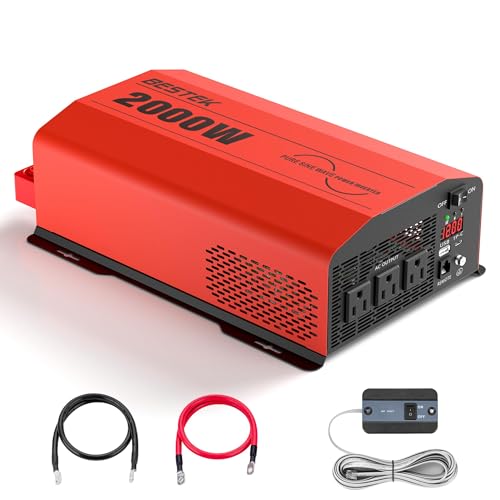
BESTEK 3000W Pure Sine Wave Power Inverter
Pure sine wave output powers laptops, CPAP machines, and kitchen blenders without the buzzing modified sine wave inverters can cause. Dual cooling fans and an LED display track voltage and load in real time. A remote control cable lets owners mount the switch near the dash while the inverter sits closer to the battery bank.
Pros
- Two AC outlets and two USB ports handle a laptop, phone, and CPAP machine at once
- LED display shows real-time voltage and battery percentage
- Remote control cable allows dash-mounted on/off switching
Cons
- Runs warm under sustained loads above 2500W, so ventilation space matters
- Hardwiring requires 1/0 gauge cable not included in the box

Renogy 2000W Pure Sine Wave Inverter
Hardwire terminal blocks give this inverter a permanent install option instead of battery clamps. Two AC outlets and a single USB port cover phones, a laptop, and a small fan. Owners report stable voltage under loads up to 1800W.
Pros
- Hardwire terminals suit a permanent RV electrical setup
- LED fault indicators flag overload, low voltage, and overheating separately
- Priced below other 2000W pure sine models with similar output
Cons
- Only one USB port limits simultaneous device charging
- No remote control cable included for dash mounting
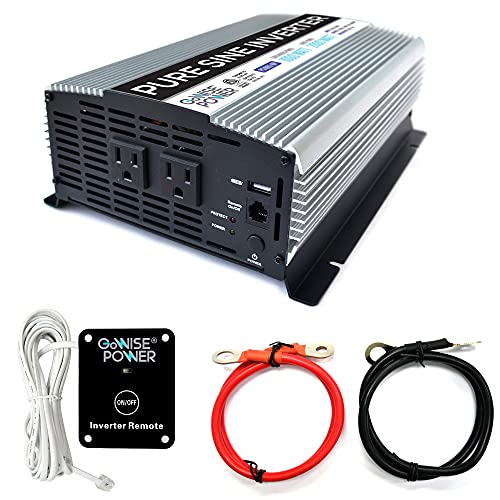
GoWISE Power 1000W Pure Sine Wave Inverter
Smaller RVs and teardrop trailers suit this 1000W unit, which runs a laptop, CPAP machine, or fan overnight. Two AC outlets and one USB port cover light-duty needs without the bulk of a 3000W unit. An optional wired remote switch, sold separately, mounts near the dinette or dash.
Pros
- Compact housing fits under a dinette seat or small storage cubby
- Pure sine output protects CPAP machines and laptop chargers
- Lower continuous wattage draws less from a single battery bank
Cons
- 1000W continuous power cannot run a microwave or coffee maker
- Single USB port charges only one device at a time

AIMS Power 3000W Pure Sine Inverter
A 9000W surge rating lets this inverter start a microwave compressor or a corded power tool. GFCI-protected AC outlets meet code for wet-location use near an RV bathroom or kitchen sink. Hardwire terminals accept larger cable for owners running the inverter close to the main battery bank.
Pros
- High surge rating starts appliances with heavy startup draw, like microwaves and drills
- GFCI outlets add shock protection near sinks and showers
- Metal housing withstands vibration during towing
Cons
- Heavier unit adds weight compared to smaller portable inverters
- Higher continuous wattage pulls down battery reserves faster under full load

Krieger 2000W Pure Sine Wave Inverter
A wireless remote ships with this 2000W inverter, so owners can switch power on or off from the driver’s seat. Two AC outlets and two USB ports cover phones, a laptop, and a small television. Dual cooling fans cycle based on load instead of running constantly.
Pros
- Wireless remote skips the wiring a hardwired remote cable needs
- Two USB ports plus two AC outlets cover more devices than base 2000W competitors
- Load-based fan cycling reduces constant fan noise at idle
Cons
- Wireless remote range drops inside a metal RV frame or storage bay
- Battery cables sold separately add to setup cost

POTEK 3000W Modified Sine Wave Inverter
High continuous power handles basic resistive loads like lights, fans, and a coffee maker during boondocking. Modified sine output costs less than pure sine at the same wattage, trading some compatibility with sensitive electronics for a lower price. Two AC outlets and one USB port round out the connections.
Pros
- High continuous wattage at a lower cost than comparable pure sine units
- Handles basic boondocking loads like lights, fans, and small kitchen appliances
- Metal case with dual fans manages heat during extended dry-camping use
Cons
- Modified sine wave can cause humming or reduced runtime in variable-speed motors
- Not recommended for CPAP machines or sensitive audio and video equipment

Energizer 1100W Power Inverter
A compact footprint suits RVs with limited storage near the battery. An LCD screen displays input voltage and output load without a separate meter. Two AC outlets and two USB ports cover phones, a laptop, and a small fan on quick stops.
Pros
- Compact size stores easily in a small basement bay or under a seat
- Built-in LCD display removes the need for a separate voltage meter
- Two USB ports charge phones and tablets without an adapter
Cons
- Modified sine wave output is not ideal for CPAP machines or sensitive electronics
- 1100W continuous power cannot run larger appliances like microwaves
Side by side
| # | Model | Continuous Power | Best for | Score | Price |
|---|---|---|---|---|---|
| 1 | BESTEK 3000W Pure Sine Wave Power Inverter | 3000W | Best overall | 9.4 | Check price |
| 2 | Renogy 2000W Pure Sine Wave Inverter | 2000W | Best value | 9.1 | Check price |
| 3 | GoWISE Power 1000W Pure Sine Wave Inverter | 1000W | Best budget | 8.9 | Check price |
| 4 | AIMS Power 3000W Pure Sine Inverter | 3000W | Best for large appliances | 8.6 | Check price |
| 5 | Krieger 2000W Pure Sine Wave Inverter | 2000W | Best with wireless remote | 8.4 | Check price |
| 6 | POTEK 3000W Modified Sine Wave Inverter | 3000W | Best for boondocking backup power | 8.2 | Check price |
| 7 | Energizer 1100W Power Inverter | 1100W | Best compact and portable | 8.0 | Check price |
What to look for
What to look for in an RV inverter Continuous wattage matters most, since that number covers what the inverter runs all day, not just for a few seconds. Add up the wattage of devices likely to run at once, from a laptop charger to a small fan, then leave headroom for startup surges. Wave type, outlet count, and mounting method matter almost as much as raw wattage.
Pure sine wave vs modified sine wave for RV appliances Pure sine wave inverters produce power that closely matches utility electricity, which keeps CPAP machines, laptop chargers, and variable-speed motors running cleanly. Modified sine wave units cost less for the same wattage but can cause humming in speakers or reduced efficiency in motors. Owners running only lights, fans, and basic tools often find modified sine wave sufficient.
Sizing an inverter for boondocking and dry camping Boondocking puts the full load on battery reserves, so wattage choices directly affect how many days a battery bank lasts between charges. A 1000W to 2000W inverter covers lights, device charging, and a fan for most weekend trips. Extended dry camping with a coffee maker or space heater calls for 3000W and a larger battery bank to match.
Running microwaves, CPAP machines, and power tools off an inverter Microwaves and power tools draw a startup surge well above their rated wattage, so peak power ratings matter more here than continuous wattage. A 3000W inverter with a 9000W surge rating starts a microwave compressor that a 3000W unit with only 6000W peak might trip. CPAP machines need pure sine wave output specifically, since modified sine wave can interfere with the machine’s internal power supply.
Common questions
How many watts does an RV need from a power inverter?
Most RVs running a laptop, phone chargers, and a fan need 1000W to 2000W continuous. Adding a microwave, coffee maker, or power tools pushes that requirement to 3000W or higher.
What size inverter do I need to run a microwave in an RV?
A typical RV microwave draws 900W to 1200W running but can surge higher on startup. A 2000W to 3000W continuous inverter with at least double that in peak power handles most RV microwaves.
Can a modified sine wave inverter damage RV electronics?
Modified sine wave power can cause CPAP machines, some laptop chargers, and audio equipment to run inefficiently or make noise. It rarely damages basic resistive loads like lights, fans, or a coffee maker.
Is a pure sine wave inverter worth it for a CPAP machine?
Yes, most CPAP manufacturers recommend pure sine wave power specifically. Modified sine wave can interfere with the machine’s internal power supply and shorten its lifespan.
Which portable inverter works best for boondocking?
A 1000W to 2000W pure sine wave inverter covers lights, device charging, and small appliances for most boondocking trips. Owners running larger loads like a coffee maker typically step up to a 3000W modified or pure sine model.
Do RV inverters drain the battery when nothing is plugged in?
Most inverters draw a small standby current, often under 1 amp, even with no load connected. Switching the inverter off between uses prevents this idle draw from slowly depleting the battery.
Can I hardwire a portable inverter into my RV’s electrical panel?
Inverters with hardwire terminal blocks, like Renogy’s or AIMS Power’s models, connect directly to a battery bank and can feed select circuits. Battery-clamp inverters are designed for temporary connections rather than permanent panel wiring.
What gauge wire do I need to connect an inverter to my RV battery?
A 3000W inverter typically needs 1/0 or 2/0 gauge cable to handle the current without excessive voltage drop. Smaller 1000W inverters can often use 4 gauge or 6 gauge cable over short runs.
Pure sine wave vs modified sine wave inverter, which is better for an RV?
Pure sine wave suits sensitive electronics like CPAP machines, laptops, and variable-speed motors, while modified sine wave costs less for basic loads like lights and fans. Most RVers running a mix of devices choose pure sine for broader compatibility. Modified sine wave still works well for boondocking setups focused on lighting and charging.
How long will a battery bank last running an inverter?
Runtime depends on battery capacity and the wattage drawn, not the inverter’s rated size. A 100Ah battery running a 200W laptop and CPAP setup lasts roughly 4 to 5 hours before recharging. Larger loads like a coffee maker or microwave shorten that runtime significantly.
Final word
BESTEK’s 3000W pure sine wave inverter is the strongest overall pick for RVers who mix laptops, CPAP machines, and small kitchen tools on one circuit. Owners who mainly need lights, fans, and basic boondocking power can save money with POTEK’s 3000W modified sine model instead. RVers planning a permanent power system should look at Renogy’s 2000W unit for its hardwire terminal block and value.
Tony Russo
Tony trained as an automotive technician and spent years in service and parts retail before moving into writing. He focuses on garage tools, car care products and accessories from a hands-on maintenance perspective.


