Which portable battery tester belongs in your kit
FOXWELL BT705 suits a working bay best, reading 100 to 2000 CCA on 12V batteries and checking 24V charging systems, then printing the slip. TOPDON BT100 covers the same core tests on 12V only. ANCEL BA101 fits a glovebox for quick winter checks.
FOXWELL BT705 is the pick for a shop that tests batteries daily. Coverage runs 100 to 2000 CCA on 12V batteries, plus 12V and 24V charging systems. One clamp hookup steps through health, cranking voltage and alternator ripple. Thermal paper is the catch, because printing becomes a running consumable.
Battery faults hide well. A cell can be shorted while the meter still shows 12.6V after a charge. Conductance testers estimate capacity instead, and clamp contact, cable length and surface charge all move the number. We compared published CCA ranges, chemistry menus, cranking and ripple coverage, clamp construction and how each unit hands off a result, then read owner reports on repeatability with AGM batteries.
The shortlist, ranked
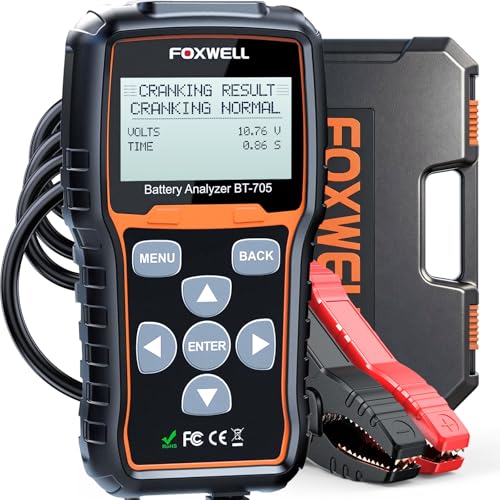
FOXWELL BT705 Battery Load Tester
Health, cranking voltage and alternator output run as one sequence from a single hookup. Ripple testing flags a shorted rectifier diode before it cooks the replacement battery. Its thermal printer puts a dated slip in the customer’s hand, which ends most replacement arguments.
Pros
- Prints a dated result slip for the customer
- Covers cranking and alternator ripple in one hookup
- Lithium sits on the chemistry menu with lead acid
Cons
- Thermal paper rolls are a running consumable
- Bulkier than pocket testers

Autel MaxiBAT BT506 Battery and Electrical System Analyser
Adaptive Conductance reads state of health directly rather than leaning on a static conductance table, which helps with batteries still bolted into the car. Bluetooth pushes results to an Autel MaxiSys tablet, so the reading files alongside the fault codes from the same job. Standalone use works fine through its own colour screen, including 6V batteries.
Pros
- Tests in place without pulling the battery
- Results attach to an existing MaxiSys job record
- Starter draw and alternator checks included
Cons
- Costs more than standalone units if you own no tablet
- Firmware updates need an Autel account

TOPDON BT100 12V Battery Tester
Three tests cover what a driveway diagnosis needs: battery health, cranking voltage and charging output. Its 100 to 2000 CCA span reaches from a small hatchback up to a V8 pickup. Clamp jaws are heavier than the category norm, which is what keeps repeat readings close together.
Pros
- Heavy copper clamps hold a stable contact
- Reverse polarity protection built into both leads
- Draws power from the vehicle, no internal cells
Cons
- Skips 24V, so commercial vehicles are out
- No printer or data export

Schumacher BT-100 Battery Load Tester
Nothing here is estimated. A 100 amp carbon pile draws real current while the analogue needle shows how far voltage sags. Weak cells that slip past a conductance reading tend to show up under that load, and 6V coverage brings classic cars and garden machinery into range.
Pros
- Applies a real load rather than estimating
- Handles 6V batteries for older vehicles
- No firmware, cells or updates to manage
Cons
- Heats up quickly during repeated tests
- Gives no numeric CCA figure or printout

KONNWEI KW208 Battery Tester
State of health and state of charge appear together on one colour screen, which speeds up triage between jobs. Range covers 100 to 2000 CCA on 12V batteries, with AGM and gel on the menu. Owners flag the short lead as the real limit when a battery hides under a seat or in a boot well.
Pros
- Health and charge readable at a glance
- Cranking and charging tests included
- Slim enough for a toolbox drawer
Cons
- Short cable struggles with boot mounted batteries
- Limited to 12V systems

ANCEL BA101 Battery Tester
Stripped to a backlit LCD and three tests, this answers the one question most drivers ask before winter. Readings span 100 to 2000 CCA on 12V batteries and flag a failing cell rather than guessing from voltage. Clamp both leads backwards and it beeps instead of blowing a fuse.
Pros
- Light enough to live in a glovebox
- Reverse polarity protection on both clamps
- Runs from one menu with no setup
Cons
- Small jaws bite poorly on side post terminals
- No printing or logging

FOXWELL BT100 Pro 6V/12V Battery Tester
Support for 6V opens up vintage bikes, ride on mowers and older yard machinery. Car batteries stay covered too, since the range still runs to 2000 CCA. Cranking results mean less on small engines, because a light starter never pulls the current the test expects.
Pros
- 6V range suits bikes and older equipment
- Compact jaws reach tight motorcycle terminals
- Menu offers several rating standards including EN and DIN
Cons
- Cranking test reads poorly on small engines
- No 24V coverage
What matters most
What a battery tester should actually measure Voltage on its own settles nothing. An hour after charging, a battery with a shorted cell still shows 12.6V. Three readings carry the diagnosis: measured CCA against the rated figure, cranking voltage under starter load, and charging output with ripple. Ripple exposes a failed diode in the rectifier pack, which will boil a brand new battery inside a few weeks. Match the CCA ceiling to what you service, since most passenger cars sit between 500 and 800 CCA.
Conductance testers vs carbon pile load testers Conductance units send a small alternating signal through the plates and convert the response into an estimated CCA. Readings take seconds and nothing gets hot. Schumacher BT-100 works the older way, pulling 100 real amps while the needle drops. Physical loading is harder to argue with when a battery passes electronically and then dies overnight. Speed and repeatability favour conductance for all day use, which is why many bays keep one of each.
AGM, EFB, gel and lithium: why the setting changes the grade Internal resistance differs between chemistries rated at the same CCA. Choose the wrong menu entry and a healthy AGM battery can read a full grade low. Stop start cars almost always run AGM or EFB, so any tester missing those settings will misreport them. Lithium appears on the FOXWELL BT705 menu, which now matters for powersports packs and auxiliary batteries in camper conversions.
Best tester for a home garage, a mobile van or a full bay Home use rarely justifies paper. ANCEL BA101 or TOPDON BT100 answers the only question that comes up before winter. Mobile mechanics gain most from the Autel MaxiBAT BT506, since a Bluetooth result lands in the same MaxiSys job as the fault codes. Counter staff benefit from printing, because a slip reading 320 CCA against a 650 CCA rating ends the discussion. Working alone on your own cars? Skip both extras and put the money toward better clamps, since contact quality moves readings more than any feature on the box.
How they stack up
| # | Model | Coverage | Best for | Score | Price |
|---|---|---|---|---|---|
| 1 | FOXWELL BT705 Battery Load Tester | 12V batteries, 12V and 24V systems | Best overall | 9.4 | Check price |
| 2 | Autel MaxiBAT BT506 Battery and Electrical System Analyser | 6V and 12V batteries, 12V and 24V systems | Best for shops running scan tools | 9.2 | Check price |
| 3 | TOPDON BT100 12V Battery Tester | 12V batteries and charging systems | Best value | 9.0 | Check price |
| 4 | Schumacher BT-100 Battery Load Tester | 6V and 12V batteries | Best true load test | 8.8 | Check price |
| 5 | KONNWEI KW208 Battery Tester | 12V batteries | Best for quick checks on the ramp | 8.6 | Check price |
| 6 | ANCEL BA101 Battery Tester | 12V batteries | Best budget | 8.3 | Check price |
| 7 | FOXWELL BT100 Pro 6V/12V Battery Tester | 6V and 12V batteries | Best for motorcycles and powersports | 8.0 | Check price |
Frequently asked questions
What is the best portable battery tester for mechanics?
FOXWELL BT705 fits a working shop best. It reads 100 to 2000 CCA, covers 24V charging systems, includes lithium on the chemistry menu and prints a slip for the customer file.
How does a conductance battery tester work?
A small alternating signal passes through the plates and the tester measures the response. That figure converts to an estimated CCA. Nothing discharges the battery, unlike a carbon pile load test.
Can you test a car battery without removing it?
Yes, and that is the normal method. Switch off every load first. If the car has just been driven or charged, wait several minutes for surface charge to settle or the result reads high.
Which battery testers support AGM and stop start batteries?
Look for explicit AGM and EFB menu entries. FOXWELL BT705, Autel MaxiBAT BT506 and TOPDON BT100 all list them. Running an AGM battery on the flooded setting can shift the grade.
Do I need a 24V battery tester?
Only for trucks, buses, agricultural machinery or marine work. FOXWELL BT705 and Autel MaxiBAT BT506 handle 24V charging systems. Cars and light vans need nothing beyond the 12V units here.
Is a carbon pile load tester better than a digital one?
Neither wins outright. Load testing gives physical evidence a customer can watch. Digital conductance is faster, repeatable and safe to run dozens of times a day. Busy shops usually own both.
Why does the same battery give different CCA readings?
Clamp contact is the usual culprit, especially through corrosion or on lead side posts. Surface charge, battery temperature and the selected chemistry setting each move the number too.
Can a battery tester check the alternator as well?
Most do. A charging test reads output voltage with the engine running. Better units such as the BT705 add a ripple check, which catches a failed diode in the rectifier pack.
Should you test a battery right after charging it?
Not immediately. Surface charge inflates the reading. Turn on the headlights for about 30 seconds to bleed it off, or leave the car sitting for 15 minutes before clamping on.
Are cheap battery testers accurate enough?
For a pass or fail decision, yes. Units like the ANCEL BA101 and KONNWEI KW208 use the same conductance method as costlier models. Short leads and small jaws are the real compromise, not the measurement.
Our take
Buy the FOXWELL BT705 if batteries cross your bench every week, because 24V coverage, a lithium setting and a printed slip turn a reading into a record you can hand over. Home users and mobile mechanics who only meet 12V cars get the same core diagnosis from the TOPDON BT100. Add a Schumacher BT-100 when you want a physical load test to back up a borderline conductance result.
Tony Russo
Tony trained as an automotive technician and spent years in service and parts retail before moving into writing. He focuses on garage tools, car care products and accessories from a hands-on maintenance perspective.


