RV Battery Monitors That Track Amp Hours, Not Just Volts
The Victron SmartShunt suits lithium and lead-acid banks with app-based tracking, the Renogy One Core adds solar data for boondockers, and the Bogart TriMetric gives dashboard readouts without a phone. Shunt accuracy and chemistry support separate these from basic voltage gauges.
The Victron SmartShunt reads state of charge accurately across lithium and lead-acid banks. The Renogy One Core folds solar input data into the same app for off-grid rigs. Dashboard readouts without a phone come from the Bogart TriMetric.
Voltage sags under load, so it cannot show true remaining capacity on its own. We compared shunt-based monitors that measure actual amp hours in and out, plus owner reports on Bluetooth range and setup time.
The shortlist, ranked

Victron SmartShunt 500A/50mV
A precision shunt tracks state of charge, amp hours consumed, and time remaining through the VictronConnect app. Lithium and lead-acid presets adjust to the battery’s programmed capacity. Owners cite the app’s history graphs for catching slow parasitic drains before they drain a bank overnight.
Pros
- Accurate amp-hour tracking across chemistries
- App history helps catch parasitic drains
- No separate display panel needed
Cons
- Requires a smartphone for readouts
- Initial setup needs battery capacity programmed manually
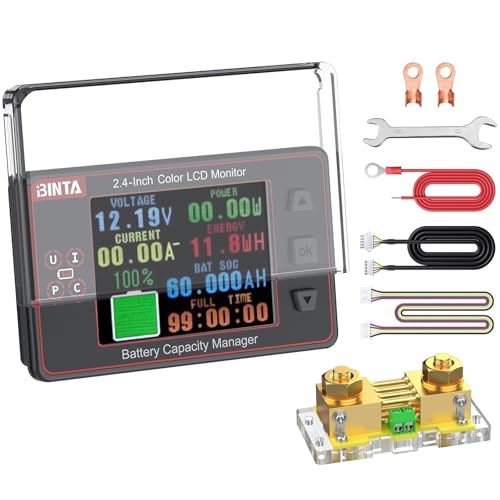
Renogy One Core Battery Monitor
Solar charge controller data merges with battery state of charge inside the Renogy One app when paired with compatible Renogy components. Real-time charge and discharge current sit next to weeks of historical logs. Full functionality still depends on other Renogy-branded hardware in the system.
Pros
- Combines battery and solar data in one app
- Historical logging tracks charge trends over weeks
- Works standalone or with a Renogy solar ecosystem
Cons
- Best features require other Renogy-branded gear
- App interface has a steeper learning curve
Bogart Engineering TriMetric 2030RV
A dashboard-mounted digital display replaces the phone app, which suits RVers who want a physical dial-style readout. Voltage, current, and amp hours run through a shunt installed at the battery bank. Wiring from the shunt to the display panel adds an extra install step.
Pros
- No smartphone required for daily readouts
- Panel mounts permanently on an RV dashboard
- Reliable shunt-based amp hour tracking
Cons
- Wiring the display panel adds install complexity
- Lithium compatibility needs an additional accessory

AiLi Battery Monitor with Shunt
A 500A shunt pairs with a small LCD display at a lower cost than app-based systems. Voltage, current, and remaining capacity read out without Bluetooth or a phone. Owners note the display backlight helps readability in dim storage compartments.
Pros
- Affordable entry into shunt-based monitoring
- Backlit screen readable in low light
- No smartphone dependency
Cons
- No Bluetooth or remote monitoring option
- Fewer configuration presets than app-based monitors
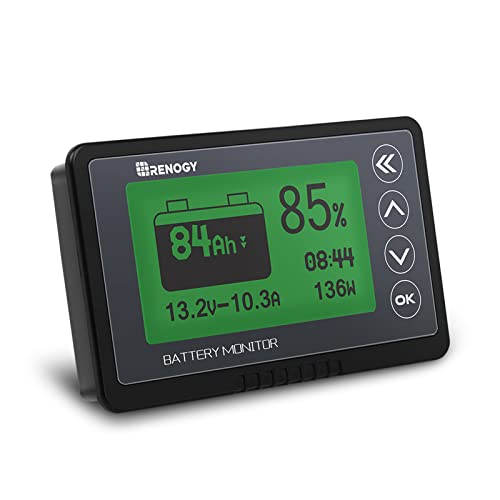
Renogy 500A Battery Monitor with Shunt
Shunt-based readings reach the Renogy BT app without needing the full Renogy One ecosystem. Voltage, current, and state of charge cover a single battery bank. Solar integration from the pricier Renogy One Core is absent here.
Pros
- Simple Bluetooth setup without extra hardware
- Lower cost than full Renogy One ecosystem
- Covers single battery bank monitoring reliably
Cons
- No solar controller data integration
- App lacks the historical depth of premium options

Xantrex LinkLite Battery Monitor
A compact panel display paired with a shunt gives straightforward voltage and amp readings, common in older RV electrical setups. App connectivity is skipped in favor of a permanent physical gauge. Installation follows the same steps as other hardwired shunt monitors.
Pros
- Simple, proven design for basic monitoring needs
- No app or Bluetooth pairing required
- Compact panel fits small dash spaces
Cons
- No lithium-specific presets
- Lacks historical data logging features
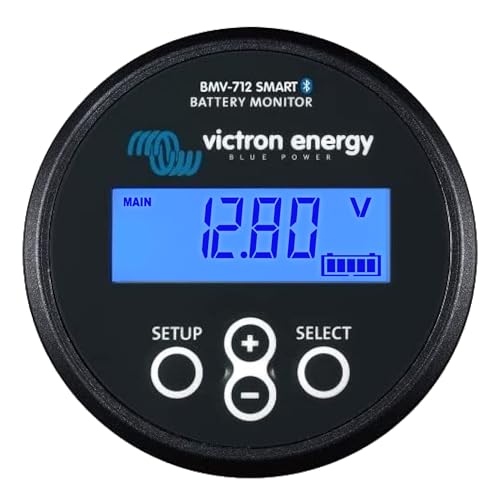
Victron BMV-712 Smart Battery Monitor
A physical display sits alongside Bluetooth app connectivity, giving both an at-a-glance panel and detailed history in VictronConnect. A second input tracks a starter battery voltage separately from the house bank. Extra hardware raises the price over the plain SmartShunt.
Pros
- Combines dashboard display with app-based history
- Second voltage input tracks a starter battery too
- Detailed historical data on charge cycles
Cons
- Higher cost than shunt-only monitors
- Panel installation adds wiring steps
What to look for
What to look for in an RV battery monitor A shunt-based monitor measures current flowing in and out of the battery, which beats reading voltage alone for state of charge. Check that the shunt’s amp rating clears your system’s peak draw, typically 500A for most RV setups. Confirm lithium compatibility if the RV runs LiFePO4 batteries.
Best for solar and off-grid setups Boondockers relying on solar gain from a monitor that also tracks charge controller output, like the Renogy One Core. Seeing solar input and battery drain side by side makes it easier to judge whether panel capacity matches daily power use. Standalone monitors like the SmartShunt still work but need a separate solar app.
Best for RVers who skip smartphone apps Not everyone wants to check a phone for battery status. Hardwired display panels like the Bogart TriMetric, AiLi, or Xantrex LinkLite mount permanently on a dashboard for a glance-and-go readout. These trade phone convenience for a dedicated, always-visible screen.
Best for multiple battery banks or starter batteries RVs running both a house bank and a separate starter battery benefit from a monitor with two inputs, such as the Victron BMV-712. One system tracks both voltages instead of installing two separate monitors. That helps diagnose a weak starter battery before it strands the rig.
How they stack up
| # | Model | Rating | Best for | Score | Price |
|---|---|---|---|---|---|
| 1 | Victron SmartShunt 500A/50mV | 500A / 50mV shunt | Best overall | 9.4 | Check price |
| 2 | Renogy One Core Battery Monitor | 300A shunt | Best for solar setups | 9.0 | Check price |
| 3 | Bogart Engineering TriMetric 2030RV | 500A shunt | Best for dedicated display | 8.8 | Check price |
| 4 | AiLi Battery Monitor with Shunt | 500A shunt | Best value | 8.3 | Check price |
| 5 | Renogy 500A Battery Monitor with Shunt | 500A shunt | Best for basic Bluetooth tracking | 8.2 | Check price |
| 6 | Xantrex LinkLite Battery Monitor | 500A shunt | Best for simple dash readouts | 8.0 | Check price |
| 7 | Victron BMV-712 Smart Battery Monitor | 500A shunt | Best for advanced data logging | 8.0 | Check price |
Good to know
What is a shunt in an RV battery monitor?
A shunt is a precision resistor installed in the battery’s negative cable that measures current flow, letting the monitor calculate amp hours used instead of just reading voltage.
Do I need Bluetooth on an RV battery monitor?
Bluetooth lets you check battery status from a phone without walking to the compartment, but hardwired panel monitors work fine for anyone who prefers a fixed display.
Can a battery monitor work with lithium RV batteries?
Yes, the Victron SmartShunt and most Renogy models include lithium presets, though older monitors like the Xantrex LinkLite focus on lead-acid only.
How accurate is a voltage-only battery gauge compared to a shunt monitor?
Voltage-only gauges can be off by 20 percent or more on remaining capacity since voltage sags under load, while shunt monitors track actual amp hours used.
Victron SmartShunt vs BMV-712, what’s the difference?
The BMV-712 adds a physical display and a second voltage input for a starter battery, while the SmartShunt relies entirely on the smartphone app.
How do I install an RV battery monitor shunt?
The shunt installs in-line on the battery’s negative cable, with sense wires connected according to the manufacturer’s wiring diagram.
What size shunt do I need for my RV?
Most house battery banks use a 500A shunt, which covers peak draws from inverters and appliances without exceeding the rating.
Can I monitor solar charging and battery status together?
Yes, monitors like the Renogy One Core combine data from compatible solar charge controllers with battery readings in one app.
Is a portable RV battery monitor hard to move between rigs?
Bluetooth models like the SmartShunt travel easily since only the shunt and wiring stay behind, while hardwired panel monitors are more permanent installs.
Which RV battery monitor works best without any app at all?
The Bogart TriMetric and Xantrex LinkLite both use dedicated LCD panels, so daily readouts never require a smartphone.
The verdict
The Victron SmartShunt earns the top spot for accurate lithium and lead-acid tracking through a dependable app. Solar-heavy setups get more value from the Renogy One Core’s combined data, while RVers who want a fixed dashboard readout over a phone screen should pick the Bogart TriMetric instead.
Tony Russo
Tony trained as an automotive technician and spent years in service and parts retail before moving into writing. He focuses on garage tools, car care products and accessories from a hands-on maintenance perspective.