Portable Battery Stations That Actually Power an RV
Jackery Explorer 1000 v2 offers the most balanced capacity and portability for typical RV trips. Bluetti AC200MAX suits owners who want expandable solar charging for boondocking, while EcoFlow Delta Pro handles rooftop air conditioners and fridges during extended off-grid stays. Anker 521 fits weekend campers who need a light backup.
RV power needs range from charging phones to running a rooftop air conditioner. Jackery Explorer 1000 v2 covers most weekend trips, while EcoFlow Delta Pro handles high-draw appliances during extended stays. Capacity, continuous wattage, and solar compatibility separate the seven models below.
Picking the wrong unit means a dead fridge overnight or a battery too heavy to carry to a campsite. We compared manufacturer specifications, owner feedback on Amazon listings, and real RV use cases like fridge runtime and rooftop AC compatibility to narrow the field.
What we recommend

Jackery Explorer 1000 v2
A 1070Wh LiFePO4 pack pairs with a 1500W inverter, enough for a mini fridge, CPAP, and laptop on one trip. Wall-outlet charging reaches roughly 80 percent in about an hour. Bluetooth lets owners check output from inside the camper.
Pros
- 1500W continuous output covers most RV appliances
- LiFePO4 cells rated for thousands of charge cycles
- Fast AC recharge shortens downtime between drives
Cons
- No built-in wheels despite the 26.4 lb weight
- Solar input tops out at 200W

Bluetti AC70
1000Wh of storage costs less than flagship models with similar capacity. An 800W inverter runs a 12V RV fridge and small electronics through a full night. Dual AC and solar charging restores power faster than single-input competitors in its price range.
Pros
- Dual AC and solar charging cuts recharge time
- Lighter and less costly than higher-capacity Bluetti models
- LiFePO4 chemistry suits frequent RV cycling
Cons
- 800W output cannot start most RV air conditioners
- No expansion battery option like larger Bluetti units

Jackery Explorer 300 Plus
At 7.7 lb, this unit fits the smallest RV storage compartments. Its 288Wh pack charges phones, LED lights, and a laptop for a weekend without hookups. Owners typically treat it as backup for essentials rather than a primary RV power source.
Pros
- Compact enough for a glove box or side pocket
- Runs small electronics for a full weekend
- LiFePO4 cells avoid the faster wear of older lithium-ion packs
Cons
- 300W output rules out fridges or heated CPAP machines
- Short runtime limits it to short trips
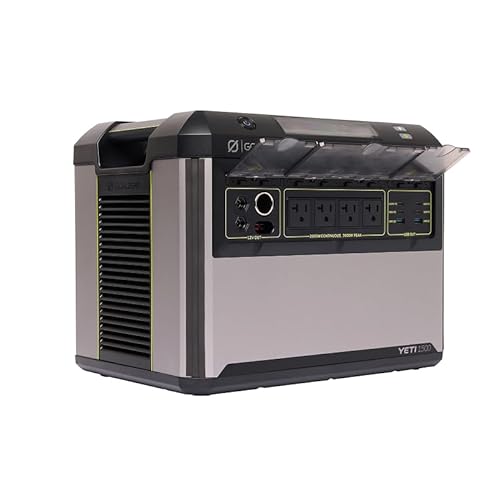
Goal Zero Yeti 3000X
3032Wh of storage runs a 12V fridge and lighting for several days without sun. Yeti Tank batteries link on for extended boondocking, stretching runtime further. Its 2000W inverter starts most single-zone RV air conditioners on a soft-start compressor.
Pros
- 3032Wh capacity supports multi-day off-grid stays
- Expansion tanks add runtime without buying a second unit
- 2000W inverter handles high-draw kitchen appliances
Cons
- 64 lb weight requires two hands or a cart to move
- Recharges slower than LiFePO4 competitors on solar alone

Bluetti AC200MAX
Dual MC4 ports accept up to 900W of solar input, among the fastest recharge rates in its class. Two B230 or B300 expansion batteries push total capacity to 8192Wh for boondocking without a generator. A 2200W inverter runs a residential-style fridge alongside smaller devices.
Pros
- 900W solar input recharges the pack in a few hours of sun
- Expansion batteries scale capacity for longer trips
- 2200W output covers most RV kitchen equipment
Cons
- Expansion batteries add significant cost beyond the base unit
- 61.5 lb weight makes solo transport difficult

Anker 521 Portable Power Station
Weighing 7.5 lb, this station carries easily between a truck bed and a tent. Its 256Wh pack keeps phones, fans, and string lights running for a weekend. A built-in flashlight adds a practical touch for nighttime campsite setup.
Pros
- 7.5 lb weight suits a backpack or small RV cabinet
- LiFePO4 battery handles frequent short trips well
- Built-in flashlight doubles as a camp light
Cons
- 200W output cannot run a fridge or space heater
- Small capacity needs daily recharging on longer trips
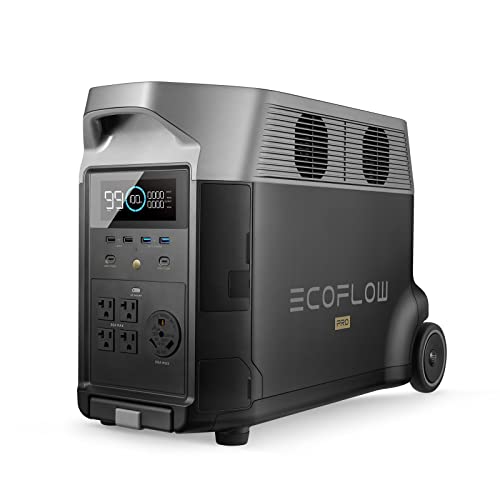
EcoFlow Delta Pro
3600W of continuous output starts a rooftop RV air conditioner alongside a fridge and microwave. X-Boost mode pushes surge output to 7200W for compressor startup loads. Extra battery packs raise total storage to 25kWh for full-time off-grid RV living.
Pros
- 3600W output starts rooftop AC units directly
- Expandable to 25kWh for full-time off-grid RV use
- 1600W solar input recharges the pack in about two hours of peak sun
Cons
- 99 lb weight requires a dedicated storage spot with wheels
- Highest-capacity configuration adds substantial bulk to an RV
How to choose
What should you look for in an RV power station? Capacity in watt-hours determines how long a station runs your gear between charges. Continuous output in watts decides which appliances it can start, especially compressors in fridges and air conditioners. LiFePO4 battery chemistry withstands more charge cycles than older lithium-ion packs, a common trait in RV-focused models. Weight and physical dimensions matter more in an RV than a house, since storage space stays limited.
How much capacity does your RV actually need? A 12V RV fridge typically draws 40 to 60 watts continuously, so even a 300Wh unit like the Jackery Explorer 300 Plus can run one overnight. Rooftop air conditioners need a surge of 1800 to 3000 watts to start the compressor, ruling out smaller stations. CPAP machines with heated humidifiers pull 40 to 80 watts, well within range of most mid-size units. Microwaves and coffee makers spike above 1000 watts briefly, so continuous output ratings matter more than average draw.
Is solar charging worth it for boondocking trips? Boondocking away from hookups depends on solar input speed as much as battery size. Bluetti AC200MAX accepts up to 900W across dual solar ports, cutting recharge time to a few hours of direct sun. Panels rated below 200W work with smaller units like the Bluetti AC70 but recharge more slowly. Cloud cover and panel angle both reduce real-world input well below the rated maximum.
Which power station fits a small trailer or compact RV? Smaller travel trailers and truck campers often lack space for a 60-plus pound station like the Goal Zero Yeti 3000X. Compact options such as the Anker 521 or Jackery Explorer 300 Plus fit in a cabinet or under a dinette seat. Larger units usually include wheels or handles, but two-person lifting is still common above 50 lb. Owners moving a station between a tow vehicle and a campsite should weigh portability against capacity.
How they stack up
| # | Model | Capacity | Best for | Score | Price |
|---|---|---|---|---|---|
| 1 | Jackery Explorer 1000 v2 | 1070Wh | Best overall for RV camping | 9.3 | Check price |
| 2 | Bluetti AC70 | 1000Wh | Best value for weekend RV trips | 8.8 | Check price |
| 3 | Jackery Explorer 300 Plus | 288Wh | Best budget option for light RV use | 8.2 | Check price |
| 4 | Goal Zero Yeti 3000X | 3032Wh | Best for extended off-grid boondocking | 9.0 | Check price |
| 5 | Bluetti AC200MAX | 2048Wh (expandable to 8192Wh) | Best for solar charging and expansion | 9.4 | Check price |
| 6 | Anker 521 Portable Power Station | 256Wh | Best compact option for small RVs | 8.4 | Check price |
| 7 | EcoFlow Delta Pro | 3600Wh (expandable to 25kWh) | Best for running RV air conditioners and fridges | 9.5 | Check price |
Good to know
How many watt-hours do I need to run an RV fridge?
A 12V compressor fridge draws roughly 40 to 60 watts continuously, so a station in the 300 to 500Wh range covers about 8 to 12 hours of runtime. Larger fridges or extended trips benefit from 1000Wh or more.
Can a portable power station run a rooftop RV air conditioner?
Only high-output models like the EcoFlow Delta Pro or Goal Zero Yeti 3000X can start the compressor surge, which often exceeds 1800 watts. Units under 1000W continuous output typically cannot start rooftop AC units.
What size solar panel charges an RV power station fastest?
Match the panel’s rated wattage to the station’s maximum solar input listed in its specifications. Bluetti AC200MAX accepts up to 900W, while smaller units like the Anker 521 cap near 100W.
Is LiFePO4 better than standard lithium-ion for RV batteries?
LiFePO4 cells generally last 2000 to 3500 charge cycles, compared to 500 to 1000 for older lithium-ion packs. Most current RV-focused stations, including the Jackery and Bluetti models here, use LiFePO4 for that reason.
Do portable power stations work in cold RV storage over winter?
Lithium batteries lose capacity and charge more slowly below freezing, so manufacturers recommend storing units above 32 degrees Fahrenheit when possible. Some models include low-temperature charge protection that pauses charging until the cells warm up.
How long does a 1000Wh power station last in an RV?
Runtime depends on what is plugged in. A 1000Wh unit like the Bluetti AC70 can power a fridge and lighting for roughly 18 to 24 hours, but a rooftop AC would drain it in under an hour.
Can I recharge a power station while driving to the campsite?
Most RV-ready stations accept a 12V car charging cable in addition to AC and solar input, though car charging is typically slower than a wall outlet. Check the station’s listed car-charging wattage before relying on it as a primary method.
Are portable power stations worth it compared to a generator for RV trips?
Power stations run silently and produce no exhaust, which matters at campgrounds with quiet hours or generator bans. Generators still win for unlimited runtime, since a power station’s capacity is fixed until recharged.
Jackery Explorer 1000 v2 vs Bluetti AC200MAX: which fits boondocking better?
Jackery Explorer 1000 v2 suits weekend trips with lighter gear and faster wall-outlet charging. Bluetti AC200MAX carries more solar input and expands to 8192Wh, better suited to multi-day boondocking without hookups.
Our pick
Jackery Explorer 1000 v2 remains the most balanced choice for typical RV trips, covering fridges, electronics, and occasional power tools. Extended boondocking or a rooftop air conditioner call for the Bluetti AC200MAX or EcoFlow Delta Pro instead. Weekend campers with limited storage space get the most value from the Anker 521 or Jackery Explorer 300 Plus.
Tony Russo
Tony trained as an automotive technician and spent years in service and parts retail before moving into writing. He focuses on garage tools, car care products and accessories from a hands-on maintenance perspective.


