Battery Testers Built to Read 24V Truck Banks
TOPDON BT600 leads for truck bays, reading 12V and 24V systems to 2000 CCA and printing a slip on the spot. FOXWELL BT705 matches that range and adds lithium iron phosphate support. ANCEL BST500 pairs a colour screen with an integrated printer for fleet rows.
TOPDON BT600 is the tester for a truck bay, because it reads the 24V series pairs in Class 7 and Class 8 rigs and tops out at 2000 CCA. Printing happens on board, so a driver leaves with a record of voltage, CCA and state of health. Bulk is the trade: this one lives on a bench or cart, not in a door pocket.
Selection gets muddled because listings advertise 12V ranges that stop well below commercial cranking figures. Two group 31 batteries in series also need a tool that reads the individual battery and the pack. We compared stated system voltages, CCA ceilings, cranking and alternator ripple tests, and supported chemistries including AGM, EFB and lithium iron phosphate. Owner reports on clamp bite through corroded posts broke the ties.
The shortlist, ranked

TOPDON BT600 Battery Tester
System voltage is the dividing line between car tools and truck tools, and BT600 covers 12V batteries plus 12V and 24V systems. Its 2000 CCA ceiling clears paired group 31 commercial batteries. Beyond state of health and charge, it runs cranking, charging and ripple tests, then prints a receipt from the built in thermal head.
Pros
- Reads the 24V series pairs used in heavy trucks
- Prints a customer copy with no second device
- Covers flooded, AGM, EFB and gel chemistries
Cons
- Too bulky to carry on a roadside call
- Thermal paper becomes another consumable to stock
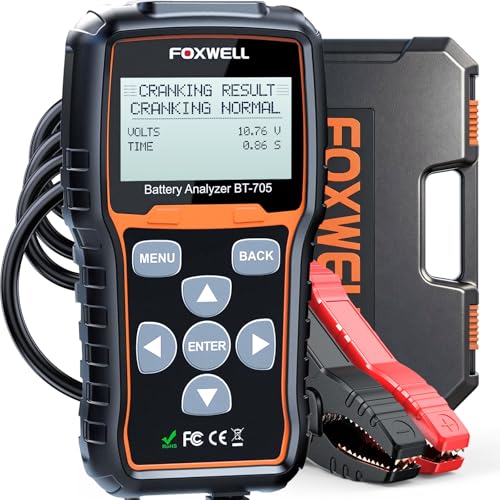
FOXWELL BT705 Battery Analyzer
Independent shops seeing mixed fleets are the target for BT705. Coverage runs 12V and 24V across a 100 to 2000 CCA span, with flooded, AGM, EFB, gel and lithium iron phosphate all selectable. Records leave over USB to a PC, or through an optional printer where a paper slip is needed.
Pros
- Lithium iron phosphate setting is uncommon at this level
- Colour display stays legible under bay lighting
- USB export builds a digital service history per unit
Cons
- Printing needs a separate accessory
- Menu tree takes a few jobs to memorise

ANCEL BST500 Battery Load Tester
Walking a row of parked trucks is where BST500 earns its place, since the thermal printer sits inside the case. Voltage, internal resistance and state of health land on one colour screen, which cuts note taking between vehicles. Coverage spans 12V and 24V with a 2000 CCA ceiling.
Pros
- Single screen shows voltage, resistance and health together
- Documents a result immediately without a bench trip
- Rubber housing survives being set on a frame rail
Cons
- Heavier than pocket sized analysers
- Firmware updates arrive infrequently

Autel MaxiBAS BT506 Battery and Electrical System Analyzer
Rather than a standalone gauge, BT506 acts as a wireless module paired to an Autel tablet or the mobile app. Adaptive conductance keeps results usable on batteries still connected in the vehicle. Shops already running Autel diagnostics get battery data inside the same job record, which is the real argument for it.
Pros
- Writes results straight into an Autel job record
- Wireless module removes a cable run across the bay
- Adaptive conductance handles in vehicle testing
Cons
- Requires a tablet or phone to function at all
- Pays off mainly in shops already using Autel tools

ANCEL BA101 Battery Load Tester
BA101 reduces the job to a 12V check across 100 to 2000 CCA using three buttons and a monochrome screen. Drivers and roadside technicians favour that, because a reading takes seconds with no menus to navigate. Twenty four volt banks fall outside its range, which limits it to light and medium duty trucks.
Pros
- Quickest unit here for a straight pass or fail call
- Copper jaws cut through light post corrosion
- Small enough to live in a service truck bin
Cons
- No 24V range for heavy duty series pairs
- Monochrome screen carries less detail per test

Schumacher BT-100 Battery Load Tester
Schumacher takes the older route, applying a genuine 100 amp load instead of calculating conductance. Weak cells that electronic testers wave through tend to show up under that draw. An analogue needle displays voltage under load directly, and the steel case tolerates a concrete floor.
Pros
- Real load exposes weak cells conductance maths can miss
- Nothing to charge, update or configure
- Steel housing survives years of workshop handling
Cons
- Heats quickly and needs cooling between tests
- No 24V range and no printed record
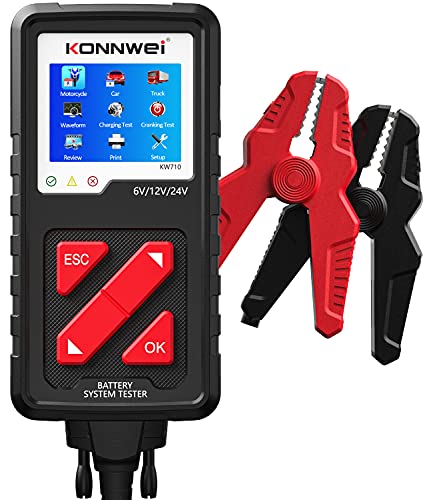
KONNWEI KW710 Battery Tester
KONNWEI puts 12V and 24V coverage into a tool built closer to consumer standards than shop standards. Its 100 to 2000 CCA span matches the premium units on paper, though the screen and casing do not. For an owner operator checking a pair of batteries before a long haul, that trade holds up.
Pros
- Reads 24V banks at entry level outlay
- Three step workflow needs no training
- Light enough to ride in a cab storage bin
Cons
- Short leads make under cab battery boxes awkward
- Clamp jaws are smaller than shop grade testers
Compared at a glance
| # | Model | System support | Best for | Score | Price |
|---|---|---|---|---|---|
| 1 | TOPDON BT600 Battery Tester | 12V batteries, 12V and 24V systems | Best overall | 9.4 | Check price |
| 2 | FOXWELL BT705 Battery Analyzer | 12V and 24V | Best value professional | 9.2 | Check price |
| 3 | ANCEL BST500 Battery Load Tester | 12V and 24V | Best for fleet workshops | 9.0 | Check price |
| 4 | Autel MaxiBAS BT506 Battery and Electrical System Analyzer | 12V batteries, 24V cranking and charging | Best for diagnostic integration | 8.7 | Check price |
| 5 | ANCEL BA101 Battery Load Tester | 12V only | Best simple handheld | 8.4 | Check price |
| 6 | Schumacher BT-100 Battery Load Tester | 100 amp carbon pile load | Best analogue load test | 8.2 | Check price |
| 7 | KONNWEI KW710 Battery Tester | 12V and 24V | Best budget | 8.0 | Check price |
How to choose
What separates a truck tester from a car tester Heavy trucks carry two, three or four batteries wired in series or parallel to turn a large diesel. Series pairs produce a 24V starting system that a 12V only tool cannot read at all. Commercial group 31 batteries also reach cranking figures above the 1000 CCA ceiling common on consumer units. Two numbers settle any listing: supported system voltage and the top of the CCA range. Anything stopping at 12V and 1000 CCA belongs in a car bay.
Conductance testing vs a carbon pile load test Electronic analysers such as the TOPDON BT600 and FOXWELL BT705 measure internal conductance, then calculate health from it. Each reading takes seconds, draws almost no current and still works on a partly discharged battery. Carbon pile units like the Schumacher BT-100 pull a real 100 amp load and show the voltage sag on a needle. That method takes longer and heats the tool, but it catches a collapsing cell conductance sometimes reports as healthy. Fleets get the best of both by screening with conductance and confirming borderline results under load.
Checking the charging system, not just the battery Repeat battery failures on trucks usually trace back to the alternator or a poor ground path. Cranking tests capture the lowest voltage during start, which exposes a tired starter or a corroded cable. Charging and ripple tests then read output voltage and diode condition at idle and at raised revs. Every electronic unit above performs those checks, and the ripple figure matters most on rigs running reefer units or inverters. Log the number each service so a slow decline shows up before a no start.
Clamps, lead length and testing batteries in the box Truck battery boxes sit low behind the steps, usually crusted with road salt and lead sulphate. Jaws have to reach past that to clean metal, so copper toothed clamps outperform plated steel. Lead length decides whether a battery can stay in the box, and short leads are the main complaint owners raise about the KONNWEI KW710. Clean badly corroded posts before any reading, because surface resistance skews the result toward failure. Side terminal batteries need adapters, which most kits leave out.
Good to know
What battery tester works on 24V truck systems?
TOPDON BT600, FOXWELL BT705, ANCEL BST500 and KONNWEI KW710 all read 24V. Plenty of consumer testers, the ANCEL BA101 among them, handle 12V only and will not report on a series pair.
How many CCA does a heavy truck battery tester need to read?
Commercial group 31 batteries commonly sit between 900 and 1200 CCA each, and banks climb from there. A 2000 CCA ceiling covers nearly every over the road application.
Is a conductance tester accurate enough for commercial fleets?
For screening, yes. Conductance flags batteries that have lost capacity in a few seconds per unit. Confirm anything borderline under a real load before condemning an expensive commercial battery.
Can you test truck batteries without removing them?
Yes. Electronic analysers read batteries in the box, though breaking the ground or separating the bank gives a cleaner result on series pairs. Wire brush the terminals first.
Load tester vs conductance tester: which should a shop buy?
Conductance suits volume work because it is fast, safe and records data. Carbon pile testers catch weak cells that conductance can pass. Many shops keep a Schumacher BT-100 on the bench purely as a second opinion.
Do these testers work on AGM and lithium truck batteries?
Flooded, AGM, EFB and gel appear on most chemistry menus here. Lithium iron phosphate is rarer, and the FOXWELL BT705 is the unit listing it. Select the chemistry before testing or the health figure will mislead you.
Why does my truck battery test good but still fail to start?
A sound battery behind a bad ground strap, corroded cable or failing starter produces exactly that pattern. Run a cranking test, note the lowest voltage, then measure voltage drop across each cable end.
Is a printer worth it on a battery tester?
For shops, yes. A printed slip carrying voltage, CCA and health backs up a warranty claim and satisfies a sceptical customer. Owner operators testing their own trucks rarely need one.
Which tester suits an owner operator rather than a workshop?
KONNWEI KW710 reads 24V banks and fits a cab bin, which covers a pre trip check. Drivers of light and medium duty trucks can drop to the ANCEL BA101 and its faster 12V workflow.
Our pick
Shops turning mixed commercial work should buy the TOPDON BT600, since 24V support, a 2000 CCA ceiling and on board printing close out the whole job in one tool. Choose the FOXWELL BT705 instead when lithium iron phosphate packs come through the door or records need to land on a PC. Keep a Schumacher BT-100 beside either one, because a carbon pile load is still the cheapest way to settle a borderline health reading before scrapping a group 31 battery.
Tony Russo
Tony trained as an automotive technician and spent years in service and parts retail before moving into writing. He focuses on garage tools, car care products and accessories from a hands-on maintenance perspective.


