How to Choose a Paint Thickness Gauge for Auto Detailing
DeFelsko’s PosiTest DFT Combo is the most dependable all-round paint thickness gauge, switching between steel and aluminum automatically. Professional inspectors lean toward the Elcometer 456 Basic Model B for repeatable, standards-compliant readings. Used car shoppers get solid results from the Nicety CM8801FN at a fraction of the outlay.
Car buyers, detailers and body shops get the most consistent results from the DeFelsko PosiTest DFT Combo. The Elcometer 456 Basic Model B takes over for formal inspection reports, and the Nicety CM8801FN handles occasional used car checks.
Two meters quoting the same micron range can behave very differently on a curved fender or a thin aluminum hood, which makes coating gauges tricky to compare. Substrate switching, probe design and calibration shift results more than headline accuracy figures suggest. We compared published specifications, probe types and owner feedback on repeatability to rank these seven.
The best picks, ranked

DeFelsko PosiTest DFT Combo
PosiTest DFT Combo automatically recognizes steel versus aluminum and switches between magnetic and eddy current measurement without any input. That single feature removes the most common source of bad readings on mixed-material vehicles. DeFelsko builds it as a sealed, one-piece instrument that shrugs off shop conditions.
Pros
- Automatic substrate switching avoids user error
- Fast, repeatable readings
- Rugged sealed housing
Cons
- No data logging in this model
- Costly for occasional users
Elcometer 456 Basic Model B
Elcometer built the 456 around repeatability under real inspection conditions. A fast reading rate pairs with a display that stays legible in bright sun. Separate ferrous, non-ferrous or dual probe options match the instrument to your substrate, and owners report it holds calibration well across long jobs.
Pros
- Excellent repeatability across long sessions
- Bright, readable display
- Standards compliant for reporting
Cons
- Probe choice must be made at purchase
- Costly for casual use

DeFelsko PosiTector 6000 FNS1
PosiTector’s platform separates the gauge body from the probe, so one instrument can grow with your work. Its FNS1 probe covers both ferrous and non-ferrous substrates and adds memory, statistics and connectivity the simpler PosiTest skips. Choose it when you need records, not just a number on screen.
Pros
- Interchangeable probes future proof the purchase
- Stores readings and statistics
- Same trusted DeFelsko accuracy
Cons
- More menu depth than beginners need
- Probe and body sold as a system
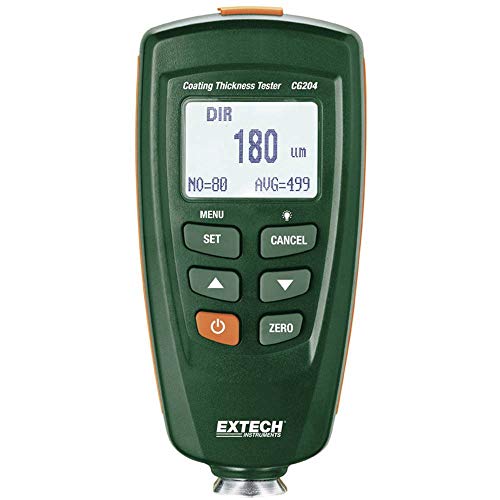
Extech CG204
Extech’s CG204 sits in a useful middle ground, covering both substrate types with accuracy close enough for used car inspection and refinishing checks. Calibration foils ship in the box, which matters because an unverified gauge is a gauge you cannot trust. Readings settle quickly, and the backlit display helps in dim garages.
Pros
- Calibration foils supplied in the box
- Handles both substrate types
- Clear backlit readout
Cons
- Slower to settle than premium meters
- Plastic body feels less durable

REED Instruments R7900
REED aims the R7900 at inspectors who need a record rather than a glance, with onboard memory, statistics and a straightforward transfer routine. A split probe on a cable reaches into door shuts and around trim where an all-in-one gauge will not fit. Accuracy is respectable for the class, based on specifications.
Pros
- Cabled probe reaches awkward panels
- Useful memory and statistics
- Solid accuracy for the class
Cons
- Cable adds bulk to carry
- Interface feels dated
TIME TT220
TIME’s TT220 is a workhorse gauge built for industrial coating checks rather than car buying. A sturdy body and probes rated for repeated daily use back that up. Its measuring range extends well past automotive paint into powder coat and galvanizing, and owners report it survives shop abuse that ends lighter meters.
Pros
- Very durable for daily shop use
- Wide range covers industrial coatings
- Simple two point calibration
Cons
- Bulkier than automotive focused meters
- Manual substrate selection on some probes
Nicety CM8801FN
Spotting a resprayed quarter panel before buying a used car does not require a professional-grade gauge. Nicety’s CM8801FN reads both steel and aluminum and includes basic calibration foils for a fraction of the outlay. Expect more variation between repeat readings than premium gauges, so take several measurements per panel and compare rather than trusting one number.
Pros
- Very affordable entry into coating checks
- Pocket size suits car shopping
- Covers both substrate types
Cons
- More variation between repeat readings
- Basic calibration accessories
What matters most
What is a normal paint thickness reading? Factory paint on most cars measures roughly 90 to 160 microns. Some European models run slightly thicker from the factory. A panel reading 250 microns or more usually points to a respray, and anything above 400 often means filler underneath. Consistency matters most: compare every panel against the roof and door shuts, since those areas are rarely repainted.
Ferrous vs non ferrous: why substrate detection matters Magnetic induction reads coatings over steel. Eddy current reads over aluminum instead. Modern cars mix both metals in the same body, so a gauge that switches automatically avoids the classic mistake of measuring an aluminum hood with a steel setting. Check the substrate with a magnet first if your gauge is manual.
How calibration keeps readings honest Every gauge drifts over time. Zero the instrument on the supplied bare metal plate, then verify against a calibration foil of known thickness before an important inspection. Foils cost little and take under a minute to use. Treat readings as a rough guide, not evidence, if a gauge cannot be verified against a known standard.
Does technique change the number? Hold the probe square to the surface and let it settle rather than pressing and dragging. Curved surfaces, edges and panels under half a millimeter thick all pull readings off target. Take at least three measurements per panel, ignore obvious outliers, and record the middle value. Most disputed readings trace back to technique rather than the instrument, according to owner reports.
Side by side
| # | Model | Substrates | Best for | Score | Price |
|---|---|---|---|---|---|
| 1 | DeFelsko PosiTest DFT Combo | Ferrous and non ferrous, automatic | Best overall | 9.4 | Check price |
| 2 | Elcometer 456 Basic Model B | Ferrous, non ferrous or dual | Best for professional inspection | 9.2 | Check price |
| 3 | DeFelsko PosiTector 6000 FNS1 | Ferrous and non ferrous, automatic | Best for mixed substrates | 9.0 | Check price |
| 4 | Extech CG204 | Ferrous and non ferrous | Best value | 8.8 | Check price |
| 5 | REED Instruments R7900 | Cabled probe for tight access | Best for field data logging | 8.6 | Check price |
| 6 | TIME TT220 | 0 to 1250 microns standard probe | Best for workshop durability | 8.3 | Check price |
| 7 | Nicety CM8801FN | Ferrous and non ferrous | Best budget pick | 8.0 | Check price |
Good to know
What paint thickness is normal on a car?
Most factory finishes measure 90 to 160 microns. Consistency across panels matters more than the exact number, since some manufacturers run thicker from the factory than others.
What reading suggests body filler?
Readings above roughly 400 microns usually point to filler beneath the paint. Many gauges struggle to read at all over thick filler, so treat a sudden jump on one panel as a reason to inspect further.
Do I need a gauge that reads aluminum?
Yes, if you are checking modern vehicles. Hoods, doors and fenders are frequently aluminum while the rest of the shell is steel, and a steel only gauge will not read those panels.
How do I calibrate a paint thickness gauge?
Zero it on the bare metal plate supplied, then place a calibration foil of known thickness on that plate and adjust until the display matches. Repeat before any inspection that matters.
Can these gauges read over plastic bumpers?
No. Both magnetic and eddy current methods need a metal substrate. Ultrasonic gauges handle plastic and composite panels, but they cost considerably more.
Why do repeat readings differ?
Probe angle, surface curvature and panel thickness all shift results. Hold the probe perpendicular, let it settle, and average three readings on a flat area of each panel.
Is a cheap gauge good enough to buy a used car?
For spotting an obvious respray, yes. Budget meters reliably show the difference between 120 and 350 microns, which is the comparison that matters most when shopping.
Does temperature affect readings?
Extreme heat or cold can shift readings slightly. Let the gauge and the vehicle reach a similar temperature, and avoid measuring a panel sitting in direct summer sun.
Which is better, magnetic or eddy current?
Magnetic gauges read only over steel and iron. Eddy current gauges read over aluminum and other non ferrous metals. A dual or automatic switching gauge covers both without you needing to know which metal sits underneath.
Final word
DeFelsko’s PosiTest DFT Combo suits most buyers, because automatic substrate switching removes the single biggest source of bad readings. Step up to the Elcometer 456 Basic Model B for inspection reports, or the PosiTector 6000 FNS1 when stored readings and statistics matter. Even the budget Nicety CM8801FN catches a resprayed panel before you hand over money for a used car.
Jake Monroe
Jake worked as a residential contractor for over a decade before shifting to full-time writing. He evaluates power tools, hand tools and workshop gear through the lens of someone who has actually used them on job sites, not just read the box.