How to Choose a Rivet Gun for Sheet Metal or Auto Work
Milwaukee 2550-20 M12 Rivet Tool is the top overall pick for one handed cordless pulling. Astro Pneumatic 1442 Hand Riveter is the best value manual option. Neiko 02037A Heavy Duty Hand Riveter covers occasional jobs on a tight budget.
Setting more than a handful of rivets makes the Milwaukee 2550-20 M12 Rivet Tool the obvious pick, since cordless one handed pulling removes the fatigue that wears out hand riveters on a long run of fasteners.
Capacity claims confuse buyers because they usually cover aluminum only, and a tool that handles a quarter inch rivet in soft metal can stall completely on stainless steel. We compared stated diameter capacity by material, pulling force, nosepiece sets and mandrel collection design, alongside owner reports on access in tight panel work.
How to pick the right one
Hand, air or cordless: which type of rivet gun fits your work? A hand riveter costs little, needs no power source and lives in any toolbox, though setting fifty rivets by hand tires your grip and accuracy suffers as it fades. Air riveters win on speed for bench and production work, provided a compressor and hose are already part of the setup. Cordless tools cost the most but combine one handed operation with portability, which explains why they have taken over on roofs, ladders and vehicle repairs where holding the workpiece matters.
Does rivet gun capacity depend on the material, not just size? A tool rated for a quarter inch rivet usually means a quarter inch in aluminum specifically. The same tool may drop to three sixteenths in steel and less again in stainless, since harder mandrels need far more force to snap. Check the capacity table by material before buying. Structural steel or stainless work calls for sizing the tool up rather than trusting the headline number.
Nosepieces, jaws and keeping a riveter working The nosepiece has to match the rivet diameter, since an oversized one is the most common cause of a crooked rivet or a mandrel that will not release. Keep the supplied set together, because individual nosepieces are easy to lose. Jaws that grip the mandrel wear over time, filling with aluminum dust until they start slipping. A wire brush and a drop of oil restores most tools, and better models allow the whole jaw set to be swapped.
Matching drill size and grip range to the rivet A rivet needs a hole only slightly larger than its shank, and an oversized hole leaves a loose joint that works its way free over time. Match the drill bit to the manufacturer’s stated hole size before drilling. Grip range, the total material thickness a rivet can clamp, matters just as much: too long leaves the joint loose, too short prevents the blind head from forming properly. Measure the stack thickness before choosing rivet length.
What we recommend
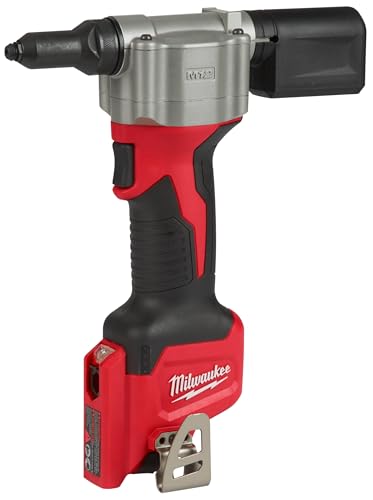
Milwaukee 2550-20 M12 Rivet Tool
A trigger squeeze pulls the rivet, freeing one hand to hold the panel steady while the other sets the fastener. An onboard mandrel catcher collects the broken stems instead of scattering them across the shop floor. Owners report several hundred rivets from a single charge on light gauge work.
Pros
- True one handed operation with no hose
- Runs on the shared M12 battery platform
- Collects mandrels cleanly instead of scattering them
Cons
- Battery and charger often sold separately
- Head shape is bulky in tight corners

DEWALT DCF403B 20V MAX Rivet Tool
Roughly 4500 pounds of pulling force puts quarter inch steel structural rivets within reach rather than a struggle. An onboard LED lights the work area, and the stroke cycles fast enough to keep pace on production runs. It shares the widely used 20V MAX battery platform, useful if you already own DEWALT tools.
Pros
- Handles larger structural rivets with ease
- Shares a common 20V MAX battery platform
- Fast repeat cycle for production work
Cons
- Heavier than compact cordless rivet tools
- Sold as a bare tool without battery
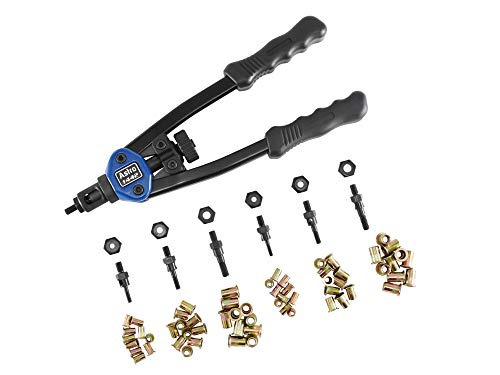
Astro Pneumatic Tool 1442 Hand Riveter
A swivel head pivots through a wide arc, reaching a rivet from an angle where a straight riveter simply will not fit. Four nosepieces cover the common diameters and store inside the handle. That swivel earns its place in wheel arches and door skins during automotive panel work.
Pros
- Reaches awkward angles a straight tool cannot
- Nosepieces store neatly in the handle
- No power source or compressor needed
Cons
- Grip fatigue builds up over long runs
- Tops out below quarter inch rivets
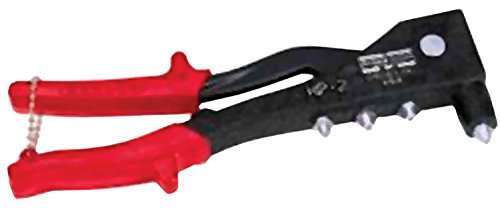
Marson HP-2 Professional Hand Riveter
Long forged handles and a compound linkage let the HP-2 set larger rivets by hand than most compact riveters manage. Jaws are serviceable rather than sealed, so a worn set gets replaced instead of scrapping the whole tool. It remains the manual riveter to reach for when compressed air is not an option.
Pros
- Best leverage among the manual tools here
- Worn jaws can be replaced separately
- Solid forged construction holds up over years
Cons
- Long handles need swing clearance to use
- Heavy to hold overhead for long periods
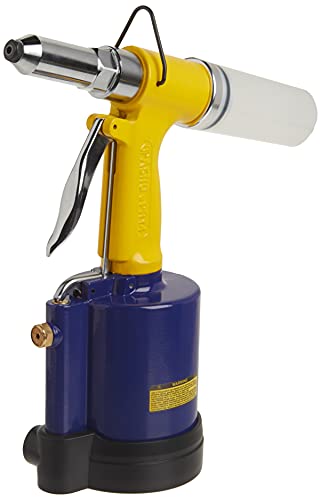
Astro Pneumatic Tool PR14 Air Riveter
A compressor turns the PR14 into the fastest way to set a long row of fasteners without wrecking your forearms. Its slim body reaches into panel channels, and a sealed bottle at the rear collects spent mandrels. Modest air volume needs keep even a small workshop compressor keeping pace.
Pros
- Fast cycle time on repeat production work
- Slim body reaches into tight panel channels
- Low operator fatigue over a long shift
Cons
- Requires a compressor and hose to run
- Awkward to carry up a ladder or roof

Arrow RH200 Professional Rivet Tool
A compact steel body and four interchangeable nosepieces give the RH200 enough leverage for aluminum rivets in gutters, screen doors and light brackets. It stores easily in a drawer, which suits how rarely most homeowners reach for a riveter. Stainless or heavy steel rivets are outside what it can set.
Pros
- Light enough to store in a drawer
- Covers the rivets most homeowners actually use
- Nosepiece changes are quick and straightforward
Cons
- Limited to softer aluminum rivets
- Needs two hands to operate the handles

Neiko 02037A Heavy Duty Hand Riveter
A rotating head and a set of nosepieces make the Neiko a serviceable riveter at the lowest outlay in this group. Finish quality trails the professional manual tools, and the jaws wear faster under repeated use. A few dozen rivets a year will not expose that weakness.
Pros
- Lowest cost tool in this lineup
- Rotating head helps with awkward access
- Ships with a usable nosepiece set
Cons
- Jaws wear noticeably faster than premium tools
- Struggles with harder rivet materials over time
The lineup, side by side
| # | Model | Power | Best for | Score | Price |
|---|---|---|---|---|---|
| 1 | Milwaukee 2550-20 M12 Rivet Tool | M12 battery platform | Best overall | 9.4 | Check price |
| 2 | DEWALT DCF403B 20V MAX Rivet Tool | 20V MAX battery platform | Best for heavy rivets | 9.2 | Check price |
| 3 | Astro Pneumatic Tool 1442 Hand Riveter | Manual hand riveter | Best value | 9.0 | Check price |
| 4 | Marson HP-2 Professional Hand Riveter | Manual hand riveter | Best manual leverage | 8.8 | Check price |
| 5 | Astro Pneumatic Tool PR14 Air Riveter | Compressed air | Best for production runs | 8.6 | Check price |
| 6 | Arrow RH200 Professional Rivet Tool | Manual hand riveter | Best for household repairs | 8.3 | Check price |
| 7 | Neiko 02037A Heavy Duty Hand Riveter | Manual hand riveter | Best budget | 8.0 | Check price |
Common questions
What is the difference between a rivet gun and a riveter?
In everyday use they mean the same blind rivet tool. Strictly speaking, a rivet gun can also mean the pneumatic hammer used with solid aircraft rivets and a bucking bar, a different tool entirely.
Should I buy a cordless or a hand riveter?
Occasional household use is fine with a hand riveter, since it costs far less. Regular work on vehicles, gutters or sheet metal pays back a cordless tool quickly through reduced fatigue and a free hand to hold the workpiece.
What size drill bit do I need for a rivet?
Match the bit to the rivet shank so it sits as a snug slip fit, typically an eighth inch bit for an eighth inch rivet. Oversized holes are the most common reason a riveted joint loosens.
Can a rivet gun set stainless steel rivets?
Only if it carries a stainless rating. Stainless mandrels need substantially more pulling force than aluminum, so a tool rated for a quarter inch aluminum rivet may only manage an eighth inch in stainless.
How do I remove a rivet?
Drill out the center of the rivet head with a bit matching the shank size, staying square to the surface. The head separates, and the remaining body pushes through. Go slowly to avoid enlarging the hole in the parent material.
What is grip range and why does it matter?
Grip range is the combined material thickness a rivet can clamp. Too long and the blind head forms in open air, leaving the joint loose. Too short and it will not form at all, so measure the stack and choose a rivet whose range brackets it.
Why does my riveter keep slipping on the mandrel?
Worn or dirty jaws are almost always the cause. Aluminum dust packs into the serrations and stops them biting. Clean the jaws with a wire brush, add a drop of light oil, and replace the set if the teeth look rounded.
Are rivet nuts the same as blind rivets?
No. A rivet nut sets a threaded insert into sheet metal so you can bolt into thin material, and it needs a dedicated tool with a threaded mandrel. Standard blind rivet guns cannot set them.
Is an air riveter worth it without a large compressor?
Yes, within limits. The PR14 runs on modest air volume, so a small shop compressor keeps pace on light to medium work, though large structural rivets still favor a higher output compressor.
Final word
Milwaukee 2550-20 M12 Rivet Tool is worth buying for anyone setting rivets regularly, since one handed cordless operation speeds up panel work noticeably. DEWALT DCF403B brings the force needed for heavier structural rivets, while Astro Pneumatic 1442 remains the best manual riveter thanks to a swivel head that reaches where straight tools cannot.
Jake Monroe
Jake worked as a residential contractor for over a decade before shifting to full-time writing. He evaluates power tools, hand tools and workshop gear through the lens of someone who has actually used them on job sites, not just read the box.