How to Choose an Angle Grinder for Metalwork and Masonry
DEWALT DWE402 leads for everyday cutting and grinding, pairing an 11 amp motor with a tool free guard. Makita XAG04Z is the cordless pick, running a brushless motor on the 18V LXT platform. Bosch GWS8-45 covers light work in a slimmer body.
DEWALT DWE402 suits most buyers, with an 11 amp motor and a guard that adjusts without tools. Makita XAG04Z is worth the step up when an outlet is not nearby. Bosch GWS8-45 handles rust removal and short cuts in a body that stays controllable one handed.
Angle grinders are hard to compare because amperage, disc diameter, motor type and guard design each change the tool differently under load. A high amp figure means little if the body is unbalanced. We compared published specifications across 4-1/2 inch and larger models, alongside motor construction and what owners consistently report about vibration, gear housing wear and switch reliability.
What we recommend

DEWALT DWE402
An 11 amp motor sits in a body balanced well enough to stay steady during long weld cleanup passes. Guard rotation needs no tools, which matters when a job alternates between cutting and grinding. Owners consistently point to smooth power delivery under load rather than raw peak output.
Pros
- Holds speed through sustained grinding passes
- Guard rotates without reaching for a wrench
- Balance keeps the tool tracking straight one handed
Cons
- Cord limits reach on ladders and outdoors
- Some versions omit a paddle switch lock off

Makita XAG04Z
Brushless construction on the 18V LXT platform stretches runtime per charge and reduces heat inside the housing. An electric brake stops the disc quickly after the trigger releases. Sold bare, so it slots into an existing LXT battery collection without paying twice for cells.
Pros
- Brushless motor runs cooler and longer per charge
- Electric brake halts the disc after release
- Shares cells with the wider LXT range
Cons
- Battery and charger are not in the box
- Runtime swings with cell capacity

Bosch GWS8-45
A 7.5 amp motor covers rust removal, short cuts and light weld dressing without fuss. Slim housing means a smaller hand still wraps the body properly, which reduces fatigue across a session. Owners choose it as a homeowner tool rather than a fabrication workhorse.
Pros
- Narrow body suits smaller hands
- Light enough for overhead work
- Reliable on routine household metalwork
Cons
- Bogs down where higher amp rivals keep cutting
- Feature list stops at the basics
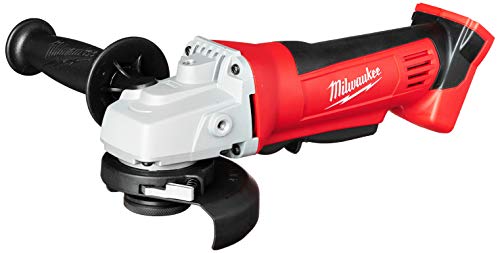
Milwaukee 2680-20 (M18)
Built around job site abuse, with a housing that tolerates being dropped into a gang box daily. Running on M18 means one battery platform covers the grinder alongside drills, saws and lights. Motor construction here is brushed, so efficiency trails the newer brushless tools.
Pros
- Housing stands up to daily site handling
- Shares batteries across the M18 range
- Cordless format suits work away from power
Cons
- Brushed motor draws more current than brushless
- Battery and charger sold separately

Metabo HPT G12SR4
A 6.2 amp motor and a compact grip cover rust removal, small cuts and paint stripping. This design has been sold for years, so replacement brushes and guards are easy to find. Owners keep it as a first grinder or as a second body loaded with a wire cup.
Pros
- Lowest outlay for a corded grinder here
- Compact body handles overhead work comfortably
- Long production run means parts stay available
Cons
- Low amperage limits heavy material removal
- Comfort and safety extras are minimal

Ryobi P423 (18V ONE+ Brushless)
Brushless internals on the 18V ONE+ platform give a homeowner cordless reach without a separate battery ecosystem. Garage jobs such as cutting bolts, trimming rebar and cleaning welds sit well within its range. Continuous heavy fabrication is outside what this housing was designed for.
Pros
- Uses the same cells as dozens of ONE+ tools
- Brushless motor improves runtime per charge
- Well suited to garage and yard jobs
Cons
- Bare tool with no battery included
- Not built for back to back heavy cutting

Makita GA7021
Fifteen amps drive a 7 inch disc, which strips material at a rate no 4-1/2 inch tool matches. Labyrinth construction routes dust away from the bearings and armature during masonry work. Weight and torque both demand two hands and a firm stance.
Pros
- Removes material far faster than a small grinder
- Labyrinth sealing keeps grit out of the motor
- Sized for fabrication and masonry sessions
Cons
- Heavy enough to tire the arms quickly
- Far too much tool for small household jobs
How to choose
What to look for in an angle grinder Start with disc diameter, since it sets everything else. A 4-1/2 inch tool covers the widest range of household and light trade work. Motor amperage or battery voltage tells you how hard the tool can pull before it slows. After that, check guard adjustment, side handle positions and whether the switch has a lock off. Those three details decide how the grinder feels across an hour rather than a minute.
Corded or cordless: which should you buy? Corded motors hold steady output for as long as the job runs, which suits weld dressing and long cuts. Cordless tools go up ladders, into crawl spaces and out to a fence line with no extension lead. Brushless designs such as the Makita XAG04Z have closed much of the runtime gap. Heavy metal removal still favours a corded body, mainly because heat and sustained draw are what drain packs fastest.
Which safety features actually matter? Restart protection stops a grinder spinning up by itself after a power cut, which is the single most useful feature on the list. A paddle switch with lock off reduces accidental starts when the tool is set down. Tool free guard adjustment gets used far more often than buyers expect, because guard position changes between cutting and grinding. An anti vibration side handle earns its place once sessions run past twenty minutes.
Matching disc type and grinder size to the job Cut off wheels slice steel, flap discs smooth welds, wire cups strip paint and rust, and diamond blades handle tile and masonry. Every disc carries a maximum RPM rating that must meet or exceed the grinder’s no load speed. Larger 7 inch tools spin slower precisely because edge speed rises with diameter. Check the accessory range for your platform before committing, since disc availability shapes what the tool can do.
How they stack up
| # | Model | Amps | Best for | Score | Price |
|---|---|---|---|---|---|
| 1 | DEWALT DWE402 | 11 Amp | Best overall | 9.4 | Check price |
| 2 | Makita XAG04Z | 18V LXT | Best cordless | 9.2 | Check price |
| 3 | Bosch GWS8-45 | 7.5 Amp | Best value | 9.0 | Check price |
| 4 | Milwaukee 2680-20 (M18) | 18V (M18) | Best for professionals | 8.8 | Check price |
| 5 | Metabo HPT G12SR4 | 6.2 Amp | Best budget corded | 8.6 | Check price |
| 6 | Ryobi P423 (18V ONE+ Brushless) | 18V ONE+ | Best for DIY homeowners | 8.3 | Check price |
| 7 | Makita GA7021 | 15 Amp | Best for heavy-duty work | 8.0 | Check price |
Frequently asked questions
What size angle grinder is best for beginners?
A 4-1/2 inch model is the sensible starting point. It offers enough cutting depth for most steel sections while staying controllable in one hand. Larger 7 inch grinders belong on fabrication and masonry jobs where the extra weight is justified.
Are cordless angle grinders powerful enough?
Brushless cordless models such as the Makita XAG04Z handle most cutting and grinding, based on published specifications and owner feedback. Continuous heavy metal removal still drains packs quickly. A corded tool remains the better choice for long sessions at a bench.
What can an angle grinder be used for?
Cutting steel, tile and masonry, dressing welds, stripping rust and paint, sharpening garden tools and polishing all fall within range. Each task needs its own disc type. Fitting the wrong accessory is the most common cause of disc failure.
How important is restart protection on a grinder?
Very. Without it, a grinder left switched on will spin up the instant power returns after an interruption. Pair it with a lock off paddle switch to reduce accidental starts when the tool is put down.
Which discs do I need for cutting metal?
Thin cut off wheels rated for steel do the actual slicing. Flap discs then clean the edge afterwards. Confirm every disc carries a maximum RPM rating at or above your grinder’s no load speed before fitting it.
Why does no load RPM matter?
Smaller discs need higher RPM to reach a useful edge speed. Larger discs reach that same edge speed at lower RPM, which is why a 7 inch grinder spins slower than a 4-1/2 inch one. Never fit a disc rated below the tool’s speed.
Do I need a variable speed angle grinder?
Only for polishing, wire wheel work or delicate surfaces where full speed causes damage. General cutting and grinding runs at maximum speed anyway. Single speed models cover most DIY use without compromise.
Can I use an angle grinder to cut tile and concrete?
Yes, with a diamond blade rated for the material. Dust becomes the main issue, so wet cutting or a dust shroud is worth arranging indoors. Masonry work is where a larger tool like the Makita GA7021 pays for itself.
DEWALT DWE402 vs Makita XAG04Z: which is right for me?
Pick the DEWALT for bench work and long grinding sessions where an outlet is close by. Pick the Makita when jobs move around the property or up a ladder. Owners who do both often keep a corded body in the shop and a cordless one in the truck.
The bottom line
DEWALT DWE402 remains the best all round choice, balancing an 11 amp motor with a body that stays controllable through long passes. Makita XAG04Z is the cordless upgrade worth making once jobs move away from an outlet. Budget buyers get dependable service from the Bosch GWS8-45 and Metabo HPT G12SR4, while heavy fabrication calls for the Makita GA7021.
Jake Monroe
Jake worked as a residential contractor for over a decade before shifting to full-time writing. He evaluates power tools, hand tools and workshop gear through the lens of someone who has actually used them on job sites, not just read the box.