How to Choose a Belt Sander for Fast Material Removal
Makita 9903 leads on control, pairing a variable speed dial with auto tracking that holds the belt centered. DEWALT DWP352VS removes stock faster on framing and deck work. Metabo HPT SB8V2 brings a 9 amp motor to the same 3 by 21 inch format. Weight climbs with power in every case.
Makita 9903 is the belt sander most workshops should buy, thanks to variable speed and a belt that tracks itself. Heavy stock removal on site suits the DEWALT DWP352VS better. Metabo HPT SB8V2 delivers the strongest motor of the three at a mid range position.
Belt sanders are unforgiving because the same power that flattens a door will dish a table top in seconds, so control features matter as much as amperage. We compared published specifications for belt size, motor draw, speed range, weight and dust collection. Owner reports about tracking drift and handling over long sessions decided the order.
The shortlist, ranked

Makita 9903 Belt Sander
A variable speed dial spans 690 to 1,440 feet per minute, so veneer and construction lumber each get an appropriate belt speed. Auto tracking keeps the belt centered without stopping to turn a knob. Owners report low noise for the class and a dust bag that fills rather than leaks.
Pros
- Speed dial covers veneer through rough stock
- Auto tracking holds the belt centered
- Quiet for an 8.8 amp sander
Cons
- Heavier than compact 6 lb models
- Belt changes take practice to do quickly

DEWALT DWP352VS Belt Sander
Framing, decking and stair work reward a sander that keeps cutting under load, and the DWP352VS is built around that job. Its tracking system adjusts under power, which saves stopping mid pass. At 10.4 lb it is the heaviest 3 by 21 here, and that shows on vertical or overhead surfaces.
Pros
- Holds speed under heavy stock removal
- Tracking adjusts while the belt runs
- Built for daily job site use
Cons
- Heaviest model here for overhead work
- Louder than the Makita at full speed

Metabo HPT SB8V2 Belt Sander
Sold as a Hitachi until the brand change, the SB8V2 carries the strongest motor of the 3 by 21 group at 9 amps. Top belt speed reaches 1,475 feet per minute, useful when stripping old finish from decking. Its tracking knob responds to very small turns, so dial the belt in gradually.
Pros
- Strongest motor among the 3 by 21 models
- Soft grip front handle steadies long passes
- Dust collection holds up for the class
Cons
- Tracking knob is sensitive to small turns
- Dust bag fills quickly on coarse grits
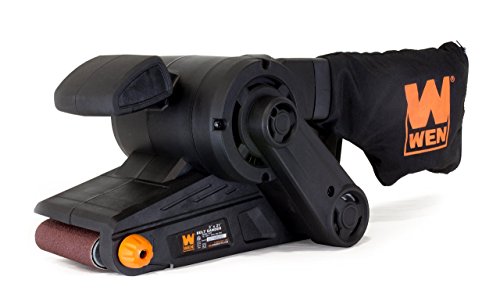
WEN 6321 Belt Sander
At 6.4 lb this is the lightest full size sander in the group, which makes one handed edge work realistic. A 7 amp motor drives the belt at a fixed 13 feet per second, so there is no dial to match speed to material. Tracking needs checking between belts, but a dust bag comes in the box.
Pros
- Lightest full size sander here at 6.4 lb
- Easy to steer on edges and narrow stock
- Dust bag included rather than optional
Cons
- Single fixed speed with no dial
- Tracking needs manual checking between belts
BLACK+DECKER DS321 Dragster Belt Sander
A front roller sits almost flush with the housing, so the belt reaches into corners and up against a stop that other noses cannot touch. Cabinet backs, stair stringers and window frames are where that pays. One speed and a small bag limit it to shorter sessions rather than floor sanding.
Pros
- Reaches into corners and up to edges
- Low profile nose fits confined framing
- Light enough for extended detail work
Cons
- Fixed single speed
- Small dust bag needs frequent emptying

Makita 9403 Belt Sander
A 4 by 24 inch belt covers roughly a third more surface per pass than a 3 by 21, which shows on table tops, doors and floorboards. The 11 amp motor sustains 1,640 feet per minute without bogging in hardwood. Rated at 84 dB, it is quieter than most tools in this power class, though its mass makes fine control hard.
Pros
- Widest belt here clears big panels fast
- Quiet at 84 dB for an 11 amp tool
- Large dust bag cuts emptying stops
Cons
- Mass makes detail control difficult
- Runs at one fixed speed

SKIL 7510-01 Sandcat Belt Sander
Pressure control signals when you push too hard, which is the exact habit that dishes a workpiece. Automatic tracking removes the other beginner trap of a belt walking off the roller. A 3 by 18 inch belt and 6 amp motor cap it at lighter tasks like shelves, chair parts and small repairs.
Pros
- Pressure control warns before gouging starts
- Belt tracks automatically with no knob
- Light 6.6 lb body suits first projects
Cons
- Smallest belt area in this group
- 6 amp motor stalls in dense hardwood
How they stack up
| # | Model | Belt size | Best for | Score | Price |
|---|---|---|---|---|---|
| 1 | Makita 9903 Belt Sander | 3 x 21 in | Best overall | 9.4 | Check price |
| 2 | DEWALT DWP352VS Belt Sander | 3 x 21 in | Best for professionals | 9.2 | Check price |
| 3 | Metabo HPT SB8V2 Belt Sander | 3 x 21 in | Best value | 9.0 | Check price |
| 4 | WEN 6321 Belt Sander | 3 x 21 in | Best budget | 8.7 | Check price |
| 5 | BLACK+DECKER DS321 Dragster Belt Sander | 3 x 21 in | Best for tight spaces | 8.5 | Check price |
| 6 | Makita 9403 Belt Sander | 4 x 24 in | Best for large surfaces | 8.2 | Check price |
| 7 | SKIL 7510-01 Sandcat Belt Sander | 3 x 18 in | Best for beginners | 8.0 | Check price |
Before you buy
What size belt sander do you need? Belt measurements read as width by length, and width sets the tool’s character. A 3 by 21 inch belt handles doors, shelves, edges and general shop work, which is why most sanders use it. Step up to 4 by 24 only for table tops, floors and glued panels, since the extra width also adds several pounds. Narrower 3 by 18 belts suit small parts and anyone still learning.
How much motor power does a belt sander need? Amperage indicates how well a sander resists slowing under pressure. Six and seven amp tools cover occasional shelves, painted doors and hobby projects. Eight to nine amps is the working range for daily use in hardwood. Eleven amp machines exist to feed a wide belt, so pair that power with a 4 by 24 format rather than expecting it to help on small parts.
Why do variable speed and belt tracking matter? Speed control decides whether the same tool can strip a deck and clean up a veneered panel. Slower belt speeds cut heat and burnishing on softwood, pine and thin stock. Tracking keeps the belt sitting square on the rollers, and auto tracking systems correct drift on their own. Manual knobs work fine, but they need a check every time you fit a new belt.
How to sand without gouging: grit, pressure and dust Start the motor before the belt touches wood, and lift it off before releasing the trigger. Let the tool’s own weight supply pressure and keep it moving in overlapping passes along the grain. Work up through grits, roughly 60 or 80 for stock removal, 120 for smoothing, then switch to a random orbit sander for finishing. Wear eye and hearing protection, and connect a shop vacuum when the bag cannot keep up.
Frequently asked questions
What size belt sander is best for general woodworking?
A 3 by 21 inch model. That format balances coverage against steerability and fits the widest range of belts on the shelf. Reserve 4 by 24 sanders for flattening large panels and floors.
Is a belt sander better than an orbital sander?
They handle different stages. Belt sanders level, shape and strip material quickly, while random orbit sanders smooth and prepare a surface for finish. Most shops start with the belt and finish with the orbital.
Why does variable speed matter on a belt sander?
Lower speeds reduce heat and burn marks on softwood, veneer and edges. Higher speeds clear old paint and rough stock faster. Owners report a speed dial makes the tool far more forgiving on delicate work.
How do you stop a belt sander from gouging wood?
Keep it moving in overlapping passes and never let it rest in one place. Apply no downward force beyond the tool’s own weight, and start the belt before contact. Pressure control features, like the one on the SKIL Sandcat, flag the mistake as you make it.
What does belt tracking mean?
Tracking is how the belt stays centered between the front and rear rollers. Auto tracking models correct drift internally. Manual designs use a small knob that moves the front roller a fraction at a time until the belt runs true.
How many amps should a belt sander have?
Six to seven amps suits occasional DIY. Eight to nine amps covers regular hardwood work and job site use. Eleven amps belongs on wide belt machines built for floors and large panels.
Can a belt sander remove paint or rust?
Yes, with a coarse belt around 60 grit. Keep the tool moving so it does not dig into the substrate, then step to a finer grit to clean the surface. Old paint may contain lead, so check the age of the coating before sanding indoors.
Do belt sanders connect to a shop vacuum?
Most have a port behind the bag that accepts a vacuum hose, sometimes with an adapter. A vacuum pulls far more dust than a bag and does not need emptying mid job. Bags fill within minutes on coarse grits.
What grit belt should you start with?
Begin at 60 or 80 grit for stripping and levelling, then move to 120 to remove the scratch pattern. Finer than 150 is work for an orbital sander, since a belt leaves straight scratches that show under finish.
What safety gear do you need for belt sanding?
Safety glasses, hearing protection and a dust mask at minimum, since these tools run past 80 dB and throw fine particles. Clamp the workpiece, keep the cord behind you, and unplug the sander before changing a belt.
The bottom line
Makita 9903 is the belt sander to buy for a mixed workshop, because variable speed and auto tracking cover both rough stock removal and careful work on thin material. Contractors moving through framing and decking all day will get more out of the DEWALT DWP352VS. Metabo HPT SB8V2 packs the strongest motor in the 3 by 21 class, and the Makita 9403 is the one to add when whole table tops need flattening.
Jake Monroe
Jake worked as a residential contractor for over a decade before shifting to full-time writing. He evaluates power tools, hand tools and workshop gear through the lens of someone who has actually used them on job sites, not just read the box.