Laptop Cooling Pads That Actually Lower Temps
Cooler Master NotePal X3 leads on raw airflow from its single 200mm fan and sturdy tilt. Havit HV-F2056 is the value pick with quiet triple fans in a slim frame. TopMate C5 adds five fans and adjustable speed for less outlay.
A cooling pad is the cheapest way to buy back a few degrees and steadier clock speeds on a laptop that runs hot. Cooler Master NotePal X3 wins on raw airflow, Havit HV-F2056 is the smart value choice, and TopMate C5 covers tighter budgets that still want adjustable fan speed.
Cooling pads look interchangeable, yet fan size and placement matter far more than fan count, and a pad that covers your intake vents can make heat worse rather than better. We compared stated airflow, owner reported noise levels, adjustable tilt, and how well each raised platform suits long typing sessions.
What matters most
Fan size beats fan count A single large fan usually moves more air more quietly than a cluster of small ones, since bigger blades push more volume at lower speed. Do not get swayed by pads advertising five or six tiny fans when a well placed 200mm fan is on offer, especially in a quiet room.
Match the pad to your laptop’s vents Cooling pads help most when their airflow lines up with the laptop’s own intake grilles underneath. Check where your machine pulls air, then pick a pad whose fans sit under those areas rather than one that seals them off against a solid panel.
Weigh ergonomics alongside raw cooling Raising the back of a laptop turns any pad into a typing riser too. Adjustable height stops let you find an angle that eases wrist and neck strain during long sessions, so tilt settings deserve as much attention as fan specs.
Watch noise and power draw before buying Most pads draw power from a USB port, which pulls a little battery and adds fan noise. A speed dial lets you run quiet at idle and ramp up only under load, which suits mixed daily use better than a single fixed speed.
What we recommend
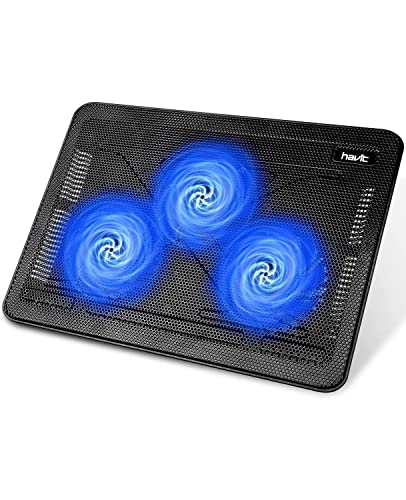
Cooler Master NotePal X3
One 200mm fan moves a lot of air quietly, which is the whole point of a cooling pad. Aluminum mesh on top resists sagging under weight. A speed dial lets you trade noise for cooling depending on the task at hand.
Pros
- Large fan moves air with little noise
- Sturdy metal mesh surface
- Adjustable fan speed dial
Cons
- Only a single tilt height
- Bulkier than slim travel pads
Havit HV-F2056
Three quiet fans sit inside a thin, light frame built for everyday cooling without added bulk. Owners report it slips easily into a bag and runs off a single USB cable through a passthrough port. Two folding heights cover most desk setups.
Pros
- Slim and travel friendly
- Runs quietly at full speed
- Two folding height settings
Cons
- No individual fan control
- Plastic build feels light

TopMate C5
Five fans plus an adjustable speed knob deliver flexible cooling at a low outlay. Five height stops and dual USB ports make it easy to set a comfortable typing angle while keeping a port free. Individual fans push less air than fewer larger ones.
Pros
- Adjustable fan speed control
- Five ergonomic height stops
- Blue LED indicates airflow
Cons
- Small fans push less air each
- Best suited to mid-size laptops

KLIM Ultimate
RGB fans sit under the hottest zones on gaming rigs, and the layout swaps to match different machines. Airflow targets CPU and GPU areas rather than spreading evenly across the base. A grippy ridged surface keeps a heavy gaming laptop from sliding.
Pros
- Targets hot GPU and CPU zones
- Bright RGB lighting
- Grippy surface holds laptop in place
Cons
- Fans are audible on high
- RGB is not fully adjustable

Thermaltake Massive 20 RGB
One oversized 200mm fan spans wide 19 inch laptops that smaller pads leave uncovered. An RGB ring around the fan is fully customizable. Raised rear feet create a comfortable typing incline for desktop replacement machines.
Pros
- Covers very large laptops
- Quiet oversized fan
- Adjustable RGB effects
Cons
- Large footprint on a desk
- Overkill for small ultrabooks

IETS GT300
A turbo blower fan with a foam seal draws heat directly off the laptop base instead of just blowing ambient air. Sealed contact plus an adjustable turbo dial gives it stronger cooling than most open fan pads. Setup takes more fiddling to seat the foam correctly.
Pros
- Strong targeted cooling
- Sealed foam boosts efficiency
- Adjustable turbo speed
Cons
- Turbo mode is loud
- Setup takes more fiddling

Kootek Laptop Cooling Pad
Five fans, dual USB ports and two height settings cover the basics without extra cost. Owners like it as a straightforward desk cooler for browsing, streaming and light office work. Airflow stays modest once a heavier app pushes the laptop hard.
Pros
- Simple plug and play use
- Two comfortable typing angles
- Wide laptop compatibility
Cons
- No fan speed control
- Modest airflow under heavy load
How they stack up
| # | Model | Fan setup | Best for | Score | Price |
|---|---|---|---|---|---|
| 1 | Cooler Master NotePal X3 | One 200mm fan | Best overall | 9.4 | Check price |
| 2 | Havit HV-F2056 | Three fans | Best value | 9.1 | Check price |
| 3 | TopMate C5 | Five fans | Best budget | 8.7 | Check price |
| 4 | KLIM Ultimate | Configurable RGB fans | Best for gaming laptops | 8.9 | Check price |
| 5 | Thermaltake Massive 20 RGB | One 200mm RGB fan | Best for large laptops | 8.8 | Check price |
| 6 | IETS GT300 | Turbo blower fan | Best for maximum cooling | 8.6 | Check price |
| 7 | Kootek Laptop Cooling Pad | Five fans | Best simple everyday pad | 8.3 | Check price |
Frequently asked questions
Do laptop cooling pads actually work?
Yes, within limits. A good pad can lower surface and internal temperatures by a few degrees, often enough to reduce thermal throttling and hold clock speeds steadier under sustained load, based on airflow specifications and owner reports.
Should the fans blow up or down?
Most pads blow up into the laptop’s underside intake vents to feed cooler air to the internal fans. A few sealed blower designs pull heat out instead. Check your laptop’s vent layout and match the airflow direction to it.
Will a cooling pad drain my laptop battery?
Pads that draw power from a USB port use a small amount of battery, and a passthrough port usually keeps the same number of ports free. That draw is minor next to the strain of a laptop running hot.
How many fans does a cooling pad need?
Fan count matters less than fan size and placement. One large fan can outperform several small ones for both airflow and noise. Focus on where the air lands under your laptop rather than the number printed on the box.
Are cooling pads good for gaming laptops?
They help gaming laptops that throttle during long sessions by supplementing the internal cooling. Look for a pad with strong airflow aimed at the CPU and GPU zones, since those areas generate the most heat under load.
Do I need a cooling pad for normal office work?
Most laptops stay cool enough without one for light browsing and documents. A pad becomes worthwhile once you run demanding apps, work in a warm room, or notice the chassis getting uncomfortably hot during everyday tasks.
Can a cooling pad damage my laptop?
No, cooling pads only add airflow as a passive accessory. The main thing to avoid is a pad that blocks your intake vents and traps heat, so choose one whose fans align with your laptop’s underside grilles.
What size cooling pad should I buy?
Pick a pad rated for your screen size or slightly larger so the laptop sits fully supported. Oversized pads suit large desktop replacement laptops, while slim models suit ultrabooks and easier travel.
Cooling pad vs laptop stand, which helps more with heat?
A plain stand raises airflow slightly by lifting the base off a desk, but a cooling pad adds active fans that push far more air through the vents. For a laptop that already runs hot, the pad does more work.
Final word
For most people the Cooler Master NotePal X3 hits the sweet spot with strong, quiet airflow from its single large fan and a solid metal surface. Choose the Havit HV-F2056 for slim, travel friendly cooling, or the TopMate C5 when adjustable fan speed on a budget matters most.
Marcus Chen
Marcus covered consumer electronics for enthusiast tech publications for six years before joining ChoiceCrest. He specializes in translating manufacturer spec sheets into plain-language buying advice, with a focus on audio, computing accessories and smart-home gear.
You might also need
Drones That Beginners Can Actually Learn to Fly

Does a Cooling Stand Really Help Your Console Run Quieter?
