What Makes a Gaming Microphone Worth Buying?
Shure’s MV7+ leads this list with a dynamic capsule and dual USB plus XLR output that tames noisy rooms. The HyperX QuadCast S suits streamers who want built-in shock mounting and tap-to-mute. FIFINE’s AmpliGame A6T covers entry-level setups without a boom arm.
Shure’s MV7+ makes voice chat and stream audio sound deliberate rather than accidental, which is why it tops this list. The HyperX QuadCast S follows close behind for plug-and-play streaming, and the FIFINE AmpliGame A6T covers the low-cost entry point.
Most gaming rooms are the worst possible recording spaces, full of fan noise, mechanical keyboards and bare walls. We compared published specifications, polar pattern behavior, mounting hardware and onboard controls, then weighted the ranking toward mics that stay clean without acoustic treatment.
The shortlist, ranked

Shure MV7+
A dynamic capsule paired with a tight cardioid pattern suits an untreated gaming room. USB-C handles simple setups, and XLR takes over once you add an interface. Owners report keyboard clatter and PC fans fade once you speak close to the grille.
Pros
- Dynamic capsule rejects room noise better than condensers
- USB and XLR outputs grow with your setup
- Built-in denoiser cuts post-processing work
Cons
- Needs close mic technique to sound full
- Most listings skip a desk stand

HyperX QuadCast S
A tap-to-mute top plate and internal shock mount handle live streaming without extra gear. Four selectable polar patterns cover solo commentary, interviews and room capture. RGB lighting doubles as a mute indicator visible at a glance.
Pros
- Tap-to-mute with a visible indicator suits live use
- Four patterns cover most recording situations
- Shock mount and stand included
Cons
- Condenser design picks up more room noise than dynamic mics
- Takes up noticeable desk space

Elgato Wave:3
Wave Link software routes game audio, chat and mic to separate channels without a hardware mixer. A clipguard circuit catches sudden shouts before they distort. The capsule itself is a straightforward cardioid condenser, with the real advantage sitting in the routing software.
Pros
- Multichannel routing skips a hardware mixer
- Clipguard prevents distortion on loud reactions
- Compact footprint for small desks
Cons
- Best value depends on using the Elgato ecosystem
- Cardioid condenser still hears a loud keyboard

Logitech for Creators Blue Yeti
Four pattern modes let one mic handle solo streams, guest interviews and podcast-style recordings. No drivers are required, so setup takes minutes. A headphone jack gives zero-latency monitoring while you record.
Pros
- Four patterns handle guests and podcasts alike
- No drivers or interface required
- Widely supported with plenty of setup guides
Cons
- Heavy desk stand transmits vibration without a shock mount
- Picks up room reflections in bare rooms

Rode NT-USB Mini
One cardioid pattern, one gain dial and a headphone jack cover what most players actually need. A magnetic desk stand keeps the mic stable and lifts off in a second. An internal pop filter handles plosives at normal speaking distance.
Pros
- Very small footprint on a crowded desk
- Magnetic base attaches and detaches quickly
- Built-in pop filter and monitoring jack
Cons
- Only one polar pattern available
- No mute button on the body
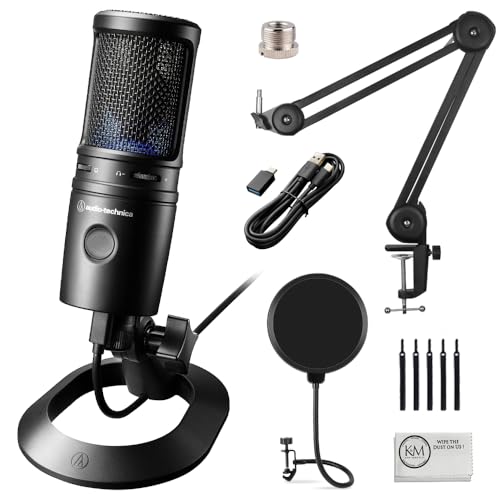
Audio-Technica AT2020USB-X
This USB version of a studio staple sounds more neutral than most gaming-branded mics. A touch mute pad, mix control and headphone volume keep the controls simple. Owners report it rewards a boom arm and pop filter more than the supplied tripod.
Pros
- Neutral tone suits voiceover and gaming alike
- Touch mute operates silently
- Solid metal build quality
Cons
- Supplied tripod sits too short for seated use
- Sensitive to room echo

FIFINE AmpliGame A6T
A cardioid condenser, tap-to-mute pad, gain dial and headphone jack cover the basics a first mic needs. RGB lighting is decorative, but the mute indicator proves genuinely useful mid-game. It is a clear step up from a headset boom mic, with no boom arm required.
Pros
- Clear upgrade over a headset microphone
- Tap-to-mute with a visible indicator
- Ships ready to use with its own stand
Cons
- Plastic build feels less solid than pricier rivals
- Room noise rejection trails dynamic mics
How to choose
Should you buy a dynamic or condenser mic for gaming? This decision matters more than any other spec. Condenser mics capture more detail, which flatters a treated room and exposes a mechanical keyboard and gaming PC in an untreated one. Dynamic mics like the Shure MV7+ need you to speak closer but reject far more of what happens behind you. Pick dynamic and sit close if you cannot control your room.
Which polar pattern do you actually need? Most gamers use cardioid and nothing else, since it listens forward and ignores the sides and rear. Bidirectional suits a face-to-face interview, omni captures a whole table, and stereo works for room ambience or instruments. Multi-pattern mics earn their price only if those situations are real for you.
Why does microphone mounting matter more than people expect? A mic sitting on a desk stand hears every keystroke and mouse thump traveling through the desk. A boom arm paired with a shock mount removes most of that noise and positions the capsule near your mouth without hunching. Check the thread size before buying an arm, since many mics ship a 3/8 inch adapter for a 5/8 inch thread that is easy to lose.
What onboard controls actually matter? Onboard gain lets you fix a quiet or clipping signal without alt-tabbing out of a match. A headphone jack with zero-latency monitoring tells you immediately if the mic is muted or clipping. Owners report using a silent physical mute most, since it lets you cough or answer the door without editing it out later.
Compared at a glance
| # | Model | Capsule type | Best for | Score | Price |
|---|---|---|---|---|---|
| 1 | Shure MV7+ | Dynamic | Best overall | 9.4 | Check price |
| 2 | HyperX QuadCast S | Condenser, three capsules | Best for streamers | 9.2 | Check price |
| 3 | Elgato Wave:3 | Condenser | Best for mixing and hotkeys | 9.0 | Check price |
| 4 | Logitech for Creators Blue Yeti | Condenser, three capsules | Best value | 8.8 | Check price |
| 5 | Rode NT-USB Mini | Condenser | Best for small desks | 8.6 | Check price |
| 6 | Audio-Technica AT2020USB-X | Condenser | Best for voice recording | 8.3 | Check price |
| 7 | FIFINE AmpliGame A6T | Condenser | Best budget | 8.0 | Check price |
Good to know
Is a USB microphone good enough for streaming?
For most streamers, yes. Modern USB mics use the same capsules as their analog counterparts and skip the cost of an interface. XLR only becomes necessary once you need multiple microphones, long cable runs or hardware processing.
Why does my microphone pick up my keyboard?
Usually it is a sensitive condenser capsule combined with distance from your mouth and a stand that conducts desk vibration. Move closer, drop the gain, and mount the mic on a boom arm with a shock mount before blaming the microphone itself.
Do you need a pop filter for a gaming microphone?
If you sit within a hand span of the capsule, a pop filter or foam windscreen softens plosive sounds on p and b. Several mics here include internal filtering, but an external filter still helps at close range.
What is the difference between cardioid and omnidirectional?
Cardioid listens mainly in front of the mic and rejects sound from behind, which suits one person at a desk. Omnidirectional listens equally in all directions, useful for group recording but unhelpful in a noisy room.
Should you buy a boom arm with your microphone?
It is the single most valuable accessory for a desk mic. A boom arm frees desk space, positions the capsule consistently and isolates the mic from typing vibration. Confirm the arm’s weight rating and thread size against your chosen mic first.
Can one microphone handle gaming, podcasting and music?
A neutral cardioid condenser like the AT2020USB-X or a dynamic like the MV7+ covers voice work well. Music recording benefits from XLR and an interface, which is why the MV7+’s dual output design appeals to people expecting their needs to change.
Does RGB lighting affect microphone audio quality?
No, lighting is purely cosmetic. Many mics tie the lighting to mute status though, which is genuinely useful since you can see at a glance whether you are live without checking your streaming software.
How close should you sit to a gaming microphone?
For dynamic mics, sit roughly a hand width away or closer, since they are built for close work. For condensers, a forearm’s length usually balances detail against room noise. Adjust gain after settling on distance, not before.
Our pick
Shure’s MV7+ is the microphone worth buying for an untreated gaming room, since a dynamic capsule solves the noise problem that software only partly fixes. Streamers wanting tap-to-mute, four patterns and a shock mount in one box will prefer the HyperX QuadCast S. First-time upgraders from a headset boom get most of the improvement from the FIFINE AmpliGame A6T for very little outlay.
Marcus Chen
Marcus covered consumer electronics for enthusiast tech publications for six years before joining ChoiceCrest. He specializes in translating manufacturer spec sheets into plain-language buying advice, with a focus on audio, computing accessories and smart-home gear.


