What Makes a Gaming Monitor Worth Upgrading To?
The LG UltraGear 27GP850-B leads for its 1440p Nano IPS panel and 165Hz refresh rate. Players chasing contrast should consider the Alienware AW3423DWF for its QD-OLED ultrawide panel, while the AOC 24G2 remains the smart budget pick for 1080p esports builds.
Most buyers should start with the LG UltraGear 27GP850-B, a monitor that covers competitive shooters and single player games without draining a budget. Players who prioritize contrast fit better with the Alienware AW3423DWF, and the AOC 24G2 handles entry level 1080p builds.
A headline refresh rate rarely tells the full story on its own. A 240Hz panel goes to waste if a graphics card only renders 90 frames per second, and quoted response times get measured under settings few owners actually use. We compared published specifications, panel types and aggregated owner reviews, weighting complaints about overshoot, backlight uniformity and firmware quirks over marketing numbers.
The shortlist, ranked

LG UltraGear 27GP850-B
1440p sharpness meets a 165Hz refresh rate on this 27 inch Nano IPS panel, a combination most mid range graphics cards can genuinely drive. Setting overdrive to Fast rather than Faster avoids the inverse ghosting some IPS panels show, according to owner reports. Height, tilt, swivel and pivot adjustment on the stand is unusual at this price.
Pros
- Strong colour coverage for an IPS gaming panel
- Fully adjustable stand including pivot
- Two HDMI ports plus DisplayPort 1.4
Cons
- HDR performance is limited by edge lit backlighting
- IPS glow is visible in dark rooms

Alienware AW3423DWF
Per pixel lighting on this QD-OLED panel produces genuinely black blacks rather than dark grey, and a 34 inch curve at 21:9 fills peripheral vision in racing and role playing games. Pixel response lands near instant, with owners reporting no visible smearing. Its 3440 x 1440 resolution does ask a lot of the graphics card behind it.
Pros
- Effectively infinite contrast for dark scenes
- Extremely fast pixel response
- Three year coverage that includes burn in
Cons
- Ultrawide aspect ratio is not ideal for competitive esports
- Text fringing is noticeable in desktop work

Samsung Odyssey G7 LC32G75TQSNXZA
A 32 inch VA panel runs at 240Hz here with an aggressive 1000R curve, suited to players who sit close to a single screen. VA contrast reaches far deeper than IPS, so night maps and horror titles keep their shadow detail intact. Adjusting to the curve takes a few days, and firmware updates have resolved most early scanline complaints from owners.
Pros
- Deep native contrast compared with IPS rivals
- 240Hz headroom for competitive titles
- Height, tilt and pivot adjustment included
Cons
- Aggressive curve is divisive for office use
- Dark scene smearing is typical of VA panels

Gigabyte M27Q
Pricing undercuts most 1440p 170Hz rivals here, and a built in KVM switch lets one keyboard and mouse drive both a gaming desktop and a work laptop through the same screen. A BGR subpixel layout softens small text slightly, though few owners notice it during actual games. USB-C input with power delivery keeps the whole setup down to a single cable.
Pros
- KVM switch is rare at this level
- USB-C input simplifies laptop docking
- Wide colour gamut coverage
Cons
- BGR subpixel layout softens small text
- Stand offers height and tilt only

ASUS TUF Gaming VG27AQ
Backlight strobing runs alongside adaptive sync on this panel through ASUS ELMB Sync, sharpening moving detail in a way most monitors cannot manage with variable refresh active. A 27 inch 1440p IPS panel at 165Hz pairs with a fully adjustable stand. Strobing does cost some brightness, so a dim room suits it better than a bright one.
Pros
- Strobing and adaptive sync can run together
- Ergonomic stand with pivot and height range
- Reliable factory colour setup
Cons
- Brightness drops noticeably with strobing on
- HDR mode is largely cosmetic

Acer Nitro XV272U
Wide sRGB coverage alongside a high refresh rate targets people editing photos in the afternoon and gaming that evening. Flat styling and a neutral look suit an office desk better than the aggressive gaming designs seen elsewhere on this list. Owners report solid panel uniformity, though the on screen menu system takes some patience to navigate.
Pros
- Neutral design that suits a work desk
- Good out of box colour balance
- Height adjustable stand
Cons
- Menu navigation is fiddly
- Speakers are weak and best ignored
AOC 24G2
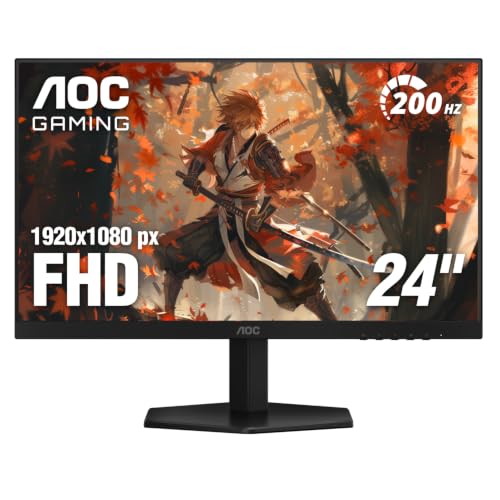
Entry level builds have leaned on this monitor for years, pairing a 24 inch 1080p IPS panel with a 144Hz refresh rate and a genuinely adjustable stand. Its size keeps the whole screen inside your field of view, useful for competitive shooters. Owners report it pairs well with older graphics cards unable to sustain 1440p frame rates.
Pros
- Very low demand on the graphics card
- Full height, pivot and swivel adjustment
- Wide viewing angles for an entry level panel
Cons
- 1080p looks soft on a 24 inch panel up close
- Modest peak brightness
What matters most
Why resolution should follow your graphics card, not your ambition The most common regret owners report is buying a 1440p or ultrawide panel their graphics card cannot actually feed. Entry level cards run happiest at 1080p, mid range cards handle 1440p at high refresh rates, and only top tier cards comfortably push 3440 x 1440 above 120 frames per second in demanding titles. Check your current frame rates in the games you play most, then buy a panel whose refresh rate sits slightly above that number for headroom.
How panel type decides what the picture actually looks like IPS delivers accurate colour and wide viewing angles but washes out blacks in a dark room. VA pushes contrast much deeper at the cost of some smearing in dark, fast scenes. OLED and QD-OLED add per pixel lighting and near instant response, which is why they top most picture quality rankings, though static desktop elements carry burn in risk on these panels. No option wins universally, so match the tradeoff to the room you actually play in.
What quoted response time numbers really mean Manufacturers measure grey to grey response times with the most aggressive overdrive setting, which usually introduces visible inverse ghosting. Owners consistently report that a middle overdrive setting looks cleaner than the fastest one. Treat a one millisecond figure as a marketing ceiling, not a description of normal use, and weigh independent motion measurements alongside owner comments about smearing at your intended refresh rate.
Why the stand and ports deserve a check before buying A monitor stuck below eye level costs neck comfort every evening. Confirm height adjustment specifically, since tilt only stands remain common at lower prices and turn VESA mounting into a second purchase. On connectivity, verify DisplayPort 1.4 or HDMI 2.1 support for full refresh rate at your chosen resolution, and consider USB-C input if a laptop docks at the same desk.
How they compare
| # | Model | Panel | Best for | Score | Price |
|---|---|---|---|---|---|
| 1 | LG UltraGear 27GP850-B | 27 inch Nano IPS | Best overall | 9.4 | Check price |
| 2 | Alienware AW3423DWF | 34 inch curved QD-OLED | Best for immersive single player | 9.2 | Check price |
| 3 | Samsung Odyssey G7 LC32G75TQSNXZA | 32 inch curved VA | Best high refresh VA | 9.0 | Check price |
| 4 | Gigabyte M27Q | 27 inch SS IPS | Best value | 8.8 | Check price |
| 5 | ASUS TUF Gaming VG27AQ | 27 inch IPS | Best for motion clarity | 8.6 | Check price |
| 6 | Acer Nitro XV272U | 27 inch IPS | Best for mixed work and play | 8.3 | Check price |
| 7 | AOC 24G2 | 24 inch IPS | Best budget | 8.0 | Check price |
Questions worth asking
Is 1440p worth it over 1080p for gaming?
For most players on a 27 inch screen, yes. Pixel density at 1080p on a 27 inch panel runs low enough that text and distant detail look soft. The catch is that 1440p roughly raises rendering load by 75 percent, so confirm your graphics card can sustain your target frame rate first.
How much refresh rate do I actually need for gaming?
Going from 60Hz to 144Hz produces the single most noticeable jump and suits nearly everyone. Beyond that, 240Hz and higher mainly benefit competitive shooter players whose systems can genuinely sustain those frame rates. A card rendering 100 frames per second is already well covered by a 165Hz panel.
Does G-Sync Compatible work as well as native G-Sync?
For most owners the difference stays invisible. G-Sync Compatible certification means Nvidia validated a FreeSync panel for tear free variable refresh. Native G-Sync modules add a wider variable refresh range and variable overdrive, which matters most below roughly 48 frames per second.
Should I worry about OLED burn in on a gaming monitor?
It is a real consideration, not a reason to avoid OLED outright. Static taskbars, game HUDs and desktop icons carry the highest risk. Current panels include pixel shifting and refresh routines, and several manufacturers now cover burn in under warranty, a sign of their own confidence.
Is an ultrawide monitor good for competitive games?
Not especially. Many competitive titles either letterbox 21:9 or widen the field of view enough to shrink enemies on screen, and some anti cheat systems restrict aspect ratio changes. Ultrawide shines instead in racing, flight, strategy and story driven games where immersion outweighs reaction time.
Do I need HDMI 2.1 for a gaming monitor?
Only if a current generation console needs to connect and hit 4K at 120Hz. For PC use, DisplayPort 1.4 handles 1440p at 165Hz and above without trouble, making HDMI 2.1 more of a console feature than a PC requirement on the panels here.
What size monitor should I buy for a normal desk?
At typical viewing distance, 27 inches suits 1440p and 24 inches suits 1080p. A 32 inch panel works well at 1440p for anyone sitting further back or wanting a cinematic feel, though it can overwhelm a shallow desk where you sit close to the screen.
Is the built in HDR on gaming monitors actually useful?
Mostly not. Entry and mid range gaming monitors carry basic HDR certification without the local dimming zones or peak brightness needed for real highlight impact, often looking flatter than standard mode as a result. QD-OLED is the exception here, since per pixel lighting delivers genuine HDR contrast.
What is the best gaming monitor for a budget graphics card?
The AOC 24G2 pairs well with older or entry level cards, since 1080p at 144Hz asks far less of a GPU than 1440p or ultrawide resolutions do.
Our pick
The LG UltraGear 27GP850-B stays the sensible choice across the widest range of setups, balancing 1440p sharpness, a 165Hz refresh rate and a genuinely adjustable stand. Contrast and immersion matter more than competitive edge for some players, and the Alienware AW3423DWF fits that case, while the AOC 24G2 suits a modest graphics card paired with a fast, no fuss 1080p panel.
Marcus Chen
Marcus covered consumer electronics for enthusiast tech publications for six years before joining ChoiceCrest. He specializes in translating manufacturer spec sheets into plain-language buying advice, with a focus on audio, computing accessories and smart-home gear.