How to Choose a Clamp Set for Woodworking Projects
IRWIN QUICK-GRIP leads for one handed speed and everyday shop work. Bessey’s clutch style bars deliver up to 600 pounds for hardwood glue ups. WEN’s mixed kit gives hobbyists the widest size range for the money. Between them, those three cover fast holds, heavy force and starter budgets.
Three sets cover most shops. IRWIN QUICK-GRIP wins for fast one handed clamping, Bessey brings up to 600 pounds of force for demanding glue ups, and WEN packs the broadest size assortment into one starter kit.
Force alone does not pick a winner, because too little pressure leaves a glue joint open while too much crushes soft stock. We compared these seven sets on published clamping force, throat depth, jaw padding and how well each assortment covers real bench tasks, checked against long term owner reports.
Our top picks

IRWIN QUICK-GRIP Clamp Set
A squeeze trigger closes each IRWIN QUICK-GRIP with one hand, leaving the other free to steady the workpiece. Resin jaws carry removable non marring pads that protect finished surfaces. Sizes from 6 to 12 inches cover boxes, frames and most household repairs.
Pros
- One handed trigger frees your other hand for positioning
- Removable pads keep finished stock unmarked
- 6 to 12 inch spread handles most bench jobs
Cons
- 140 pounds trails screw and parallel clamps
- Resin jaws flex near maximum load

Bessey Clutch Style Bar Clamp Set
Clutch style heads on the Bessey set lock anywhere along a rigid steel rail, then a wood handled screw applies up to 600 pounds. Rail stiffness keeps wide assemblies from bowing under that pressure. Owners run these clamps through decades of cabinet and hardwood glue ups.
Pros
- 600 pounds closes stubborn hardwood joints
- Steel rails resist deflection across wide stock
- Clutch heads reposition along the rail in seconds
Cons
- Setup needs both hands
- Weight adds up when moving between benches
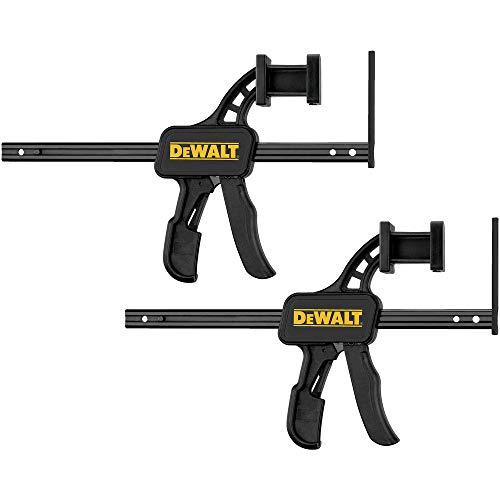
DeWalt DWHT83192 Trigger Clamp Set
Flip the jaw on the DeWalt DWHT83192 and each trigger clamp becomes a spreader that pushes parts apart. Soft pads suit trim, face frames and cabinet doors where surface marks matter. A smooth ratchet lets you creep up on pressure during delicate positioning.
Pros
- Spreader conversion doubles the working range
- Soft pads leave trim and panels clean
- Ratchet action allows fine pressure control
Cons
- 100 pounds limits it to lighter assembly
- Less force than steel bar clamps

Jorgensen Steel Bar Clamp Set
Panel and tabletop glue ups are the Jorgensen set’s territory. Deep throats reach past the edge into wide assemblies, and sliding heads set rough position before the screw applies up to 1000 pounds. Even pressure across the 24 and 36 inch bars helps keep panels flat.
Pros
- Deep throat reaches toward the middle of wide panels
- Up to 1000 pounds of even, distributed pressure
- Sliding heads speed up rough positioning
Cons
- 24 and 36 inch bars demand wall or rack storage
- Excess capacity for small repairs

WEN Clamp Set
One WEN kit stocks a bare bench with everything from spring clamps to mid size bar clamps. Assortment breadth, not raw force, is the selling point for a first shop. Owners report dependable everyday holds across hobby builds and household fixes.
Pros
- Broad size mix in a single purchase
- Sensible starter kit for a new shop
- Covers hold downs, edge banding and light glue ups
Cons
- Force trails premium bar clamps
- Not built for production duty

PONY Spring Clamp Set
Spring tension snaps a PONY clamp onto stock in about a second. Vinyl coated tips grip without denting, and jaw openings run from 1 to 3 inches. Shops keep several within reach for holding stops, fence guides and glue blocks.
Pros
- Fastest attachment of any clamp type
- Vinyl tips protect soft surfaces
- Small enough to hang on pegboard hooks
Cons
- Spring force suits only light holds
- Cannot close a structural glue joint
Pittsburgh Bar Clamp Set
Occasional repairs justify the Pittsburgh set, which pairs 6 and 12 inch ratcheting bar clamps at entry level. Ratchet action is simple and quick for light assembly. Owners treat them as spares beside better clamps rather than daily drivers.
Pros
- Simple ratchet needs no learning curve
- 6 and 12 inch pair covers common repairs
- Useful as backups during big glue ups
Cons
- Plastic components limit heavy loading
- Durability trails premium sets
How they compare
| # | Model | Type | Best for | Score | Price |
|---|---|---|---|---|---|
| 1 | IRWIN QUICK-GRIP Clamp Set | One handed bar clamps | Best overall | 9.4 | Check price |
| 2 | Bessey Clutch Style Bar Clamp Set | Clutch style bar clamps | Best clamping force | 9.2 | Check price |
| 3 | DeWalt DWHT83192 Trigger Clamp Set | Trigger clamps with spreader mode | Best for finish work | 9.0 | Check price |
| 4 | Jorgensen Steel Bar Clamp Set | Steel bar clamps | Best for panel glue ups | 8.8 | Check price |
| 5 | WEN Clamp Set | Mixed bar and spring clamps | Best value | 8.5 | Check price |
| 6 | PONY Spring Clamp Set | Spring clamps | Best for quick holds | 8.3 | Check price |
| 7 | Pittsburgh Bar Clamp Set | Ratcheting bar clamps | Best budget bar clamps | 8.0 | Check price |
What matters most
What should you look for in a clamp set? Four numbers matter most: clamping force, throat depth, bar length and the count of sizes in the kit. Force decides whether a joint closes fully, and it ranges from a few pounds on spring clamps to 1000 pounds on steel bar clamps like the Jorgensen. Throat depth sets how far the jaw reaches into the workpiece. Padding matters too, since bare metal jaws under load will dent softwood and finished surfaces.
Trigger clamps vs bar clamps: which type for which job? Trigger clamps such as the IRWIN QUICK-GRIP close with one hand, so you can hold parts in alignment while clamping solo. Their trade off is force, usually 100 to 140 pounds. Screw driven bar and clutch clamps need two hands but deliver several times that pressure, which hardwood glue ups require. Most shops end up owning both types and grabbing whichever fits the step.
Which clamps work best for panel glue ups? Wide panels and tabletops need long bars, deep throats and even pressure spread across several clamps. Alternate clamps above and below the panel to keep it from cupping. Sets like the Jorgensen with 24 and 36 inch bars suit this job, while adding scrap wood cauls across the width distributes force and protects the surface.
Where do spring clamps fit in a shop? Quick, light holds come up constantly: securing a stop block, holding a straightedge, keeping a glued edge band in place. Spring clamps like the PONY set snap on in a second and cost little enough to own many. None of them replaces a bar clamp for structural joints, so treat them as the third hand of the shop rather than the main event.
Good to know
How much clamping force do I need for a glue up?
Enough to close the joint fully without crushing the wood. Trim and veneer close under the modest pressure of trigger or spring clamps, while hardwood edge joints benefit from several hundred pounds from clutch or steel bar clamps.
What is the difference between bar clamps and spring clamps?
Bar clamps use a sliding head plus a screw or ratchet to apply strong, adjustable force over a long span. Spring clamps snap on instantly with light fixed pressure for temporary holds. They serve different stages of the same project.
How many clamps should a beginner buy?
Start with a mixed kit like the WEN covering small holds through mid size bars, then add a handful of spring clamps. Variety across sizes and types matters more than owning many identical clamps.
What does throat depth mean on a clamp?
Throat depth is the distance from the bar to the jaw tip, and it sets how far into a workpiece the clamp can reach. Deep throat designs like the Jorgensen reach into wide panels, while shallow jaws suit edges and thin stock.
Will clamps dent or mark my workpiece?
Bare metal jaws under high force can. Choose clamps with non marring pads or vinyl tips, and place scrap wood cauls between jaw and surface during heavy glue ups for extra protection.
Are trigger clamps strong enough for hardwood glue ups?
Not on their own. Trigger clamps top out near 140 pounds, which handles light and medium assembly well. Reserve high force bar or clutch clamps for the critical hardwood joints and use triggers for alignment and support.
Can a clamp be used as a spreader?
Some can. Models like the DeWalt DWHT83192 reverse their jaws to push outward, which helps separate parts or apply outward pressure inside a frame. Check the listing, since not every trigger clamp converts.
What size clamp is most useful in a home shop?
Bars in the 12 to 24 inch range cover the widest run of tasks, from box assembly to small panels. Add longer bars for tabletops and a few spring clamps for quick holds.
Are budget clamp sets worth it?
As spares or occasional use tools, yes. Sets like the Pittsburgh handle light projects fine, but daily shop work and heavy glue ups reward premium clamps that hold force longer. Many owners mix a few quality clamps with cheaper backups.
How should I store bar clamps and spring clamps?
Hang bar clamps on a wall rack or dedicated clamp rack, organized by length so the right size comes off the wall fast. Spring clamps and small triggers live happily on pegboard hooks near the bench.
Our pick
IRWIN QUICK-GRIP remains the smartest first purchase, since one handed speed, non marring pads and a useful size spread cover most bench work. Step up to the Bessey when hardwood glue ups demand real force. Pick the WEN if a broad starter assortment matters more than maximum pressure.
Jake Monroe
Jake worked as a residential contractor for over a decade before shifting to full-time writing. He evaluates power tools, hand tools and workshop gear through the lens of someone who has actually used them on job sites, not just read the box.