How to Pick a Shop Vacuum for Sawdust, Water and Debris
RIDGID’s HD1600 16 Gallon vacuum is the strongest all-around pick, combining a 16 gallon tank with a clog-resistant 2.5 inch hose. The Craftsman CMXEVBE17595 matches that capacity for less money. For cars and quick spills, the compact Armor All AA255 handles tight spaces better than a full-size drum.
RIDGID’s HD1600 16 Gallon leads this lineup on tank capacity and hose width. A similarly sized Craftsman model matches that capacity for less money. For car interiors and quick spills, the compact Armor All AA255 works better than either.
Shop vacuums are tricky to compare because a headline horsepower number says little about real cleaning power. Airflow and hose diameter matter more once a hose is jammed with sawdust. We compared tank capacity, airflow where published, hose width, filtration and portability using manufacturer specifications and patterns in long-term owner feedback.
The top picks, ranked

RIDGID HD1600 16 Gallon Wet/Dry Shop Vacuum
RIDGID pairs a 16 gallon drum with a 2.5 inch hose wide enough to swallow wood scraps and drywall chunks. Qwik Lock filters swap in seconds, which matters when switching between dry debris and water. Rolling casters keep the unit stable on concrete, though the size makes it awkward on stairs.
Pros
- Wide 2.5 inch hose resists clogging on bulky debris
- Qwik Lock filter swaps quickly between wet and dry jobs
- Rolls smoothly on casters across a shop floor
Cons
- Heavy and hard to carry up stairs
- Full power setting runs loud

Craftsman CMXEVBE17595 16 Gallon Wet/Dry Shop Vacuum
Craftsman fits a full 16 gallon tank into a body that undercuts several rivals on typical listing price. Onboard hooks hold the hose and cord so nothing drags on the floor. A reusable dry filter ships in the box, though a fine dust version costs extra.
Pros
- Full 16 gallon capacity at a competitive price
- Onboard storage keeps hose and cord organized
- 2.5 inch hose handles construction-size debris
Cons
- Fine dust filter sold separately
- Casters feel less refined than pricier models

Shop-Vac 5981 5 Gallon Wet/Dry Vacuum
Shop-Vac’s 5981 splits the difference between a compact car vac and a full size drum. Five gallons covers routine basement and garage spills without becoming hard to lift. Foam and cartridge filters swap depending on whether debris is wet or dry.
Pros
- Light enough to carry with one hand
- Sized right for everyday household cleanup
- Long-running brand with wide accessory support
Cons
- 1.25 inch hose clogs on larger debris
- Tank fills quickly during bigger projects

DeWalt DXV10P 10 Gallon Wet/Dry Vacuum
DeWalt builds the DXV10P around a 10 gallon stainless steel tank aimed at contractors who haul a vac between job sites. Rear casters tip the drum back for fast emptying. Stainless resists dents better than plastic, though it adds weight to the total unit.
Pros
- Stainless tank withstands jobsite abuse
- 1.875 inch hose pulls strong suction on debris
- Tip-back casters simplify emptying
Cons
- Heavier than comparable plastic-tank vacs
- Ships with fewer bundled attachments

Vacmaster VBV1210 12 Gallon Wet/Dry Vacuum with Blower
Vacmaster’s VBV1210 adds a detachable blower port to a 12 gallon wet/dry drum. Switching to blower mode clears sawdust from a workbench or leaves off a driveway in one pass. Suction stays strong for wet pickup, though the blower moves light debris only, not wet leaves or gravel.
Pros
- Blower function adds a second use beyond suction
- 2.5 inch hose clears bulky debris fast
- 12 gallon tank handles multi-room cleanups
Cons
- Blower struggles with heavy or wet debris
- Swapping attachments takes an extra step
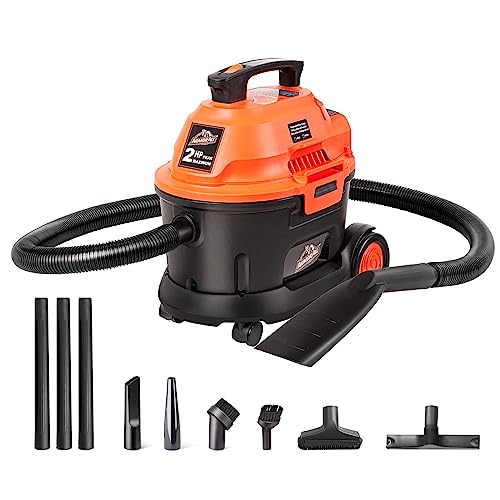
Armor All AA255 2.5 Gallon Wet/Dry Vacuum
Armor All shrinks the shop vac formula into a 2.5 gallon unit built for car interiors and quick indoor spills. A 1.25 inch hose reaches into footwells and cupholders without bulk. Owners note the 10 foot cord limits reach, so an extension cord helps in a garage.
Pros
- Compact enough to store in a trunk or closet
- Narrow hose maneuvers into tight car spaces
- Simple one-hand carry design
Cons
- Small tank needs frequent emptying
- Short 10 foot cord limits working distance

Stanley SL18116P 6 Gallon Wet/Dry Vacuum
Stanley’s SL18116P puts a 6 gallon stainless tank on a budget-friendly frame for first-time buyers. Basic wet and dry attachments ship in the box, covering common garage tasks. Airflow trails higher-tier models, so heavy debris takes longer to clear.
Pros
- Stainless tank at an entry-level price
- 6 gallon size fits most garage storage
- Includes wet and dry attachments to start
Cons
- 1.25 inch hose can clog on bulky debris
- Filtration is basic for fine dust
How to choose
Airflow matters more than peak horsepower Peak horsepower is measured for a fraction of a second under lab conditions, so it says little about everyday performance. Airflow, often listed in cubic feet per minute, combined with sealed suction actually clears debris. Two vacuums with identical tanks can perform very differently if one moves more air through a wider path.
How much tank capacity do you actually need A 16 gallon drum like the RIDGID or Craftsman means fewer stops to empty during a full day of cleanup. Smaller 2.5 to 6 gallon units, including the Armor All AA255 and Stanley SL18116P, store on a shelf and carry with one hand. Buy for the mess you make most weekends, not the rare worst case job.
Hose diameter decides what debris you can clear A 2.5 inch hose, found on the RIDGID, Craftsman and Vacmaster, swallows wood scraps and drywall chunks without jamming. Narrower 1.25 inch hoses, common on compact and budget models, work fine for sawdust and car interiors. Remodeling and woodworking debris calls for the wider option every time.
Filtration, wet pickup and portability for daily use Standard cartridge or foam filters handle general dust, but fine sanding or drywall dust needs a rated fine-dust filter to stop clouding the exhaust. Most units require removing the dry filter before vacuuming water. Weight and caster design decide how easily a vac moves between a garage, a car and a job site, so check both before buying.
How they stack up
| # | Model | Tank capacity | Best for | Score | Price |
|---|---|---|---|---|---|
| 1 | RIDGID HD1600 16 Gallon Wet/Dry Shop Vacuum | 16 gallon | Best overall | 9.4 | Check price |
| 2 | Craftsman CMXEVBE17595 16 Gallon Wet/Dry Shop Vacuum | 16 gallon | Best value | 9.1 | Check price |
| 3 | Shop-Vac 5981 5 Gallon Wet/Dry Vacuum | 5 gallon | Best for general cleanup | 8.9 | Check price |
| 4 | DeWalt DXV10P 10 Gallon Wet/Dry Vacuum | 10 gallon | Best for the jobsite | 8.7 | Check price |
| 5 | Vacmaster VBV1210 12 Gallon Wet/Dry Vacuum with Blower | 12 gallon | Best 3-in-1 with blower | 8.5 | Check price |
| 6 | Armor All AA255 2.5 Gallon Wet/Dry Vacuum | 2.5 gallon | Best compact and portable | 8.3 | Check price |
| 7 | Stanley SL18116P 6 Gallon Wet/Dry Vacuum | 6 gallon | Best budget mid-size | 8.0 | Check price |
Common questions
What size shop vacuum should I buy for a garage?
A 5 to 6 gallon unit balances capacity and portability for most home garages. Buyers who remodel or do woodworking regularly benefit from a 12 to 16 gallon drum like the RIDGID HD1600. Compact 2.5 gallon vacs work better for cars and small spills than for garage duty.
Is peak horsepower a good way to compare shop vacuums?
Not really. Peak horsepower is a brief lab measurement that does not reflect sustained cleaning power. Airflow, sealed suction and hose diameter predict real performance far better, so compare those specs when manufacturers publish them.
Can a wet/dry shop vacuum pick up standing water?
Yes, every model on this list handles wet pickup. Remove the paper or foam dry filter first so it does not clog or tear. Check the tank’s rated liquid capacity in the manual before vacuuming large amounts of water.
What is the difference between a shop vacuum and a regular vacuum?
Shop vacuums use a rugged canister, a wide hose and a motor built for bulky debris, water and heavy dust. Household vacuums stay lighter and suit carpets and everyday fine dust instead. Garages, job sites and workshops call for a shop vac’s tougher build.
Do I need a HEPA filter for a shop vacuum?
Fine drywall dust, sanding residue and allergens call for a HEPA or fine-dust rated filter to keep particles out of the air. Standard cartridge filters handle wood chips and leaves without issue. Confirm whether the fine-dust filter ships included or sells separately.
How wide should a shop vacuum hose be?
A 2.5 inch hose clears bulky construction debris without clogging. A 1.25 inch hose suits detailing and fine dust in tight spaces. Adapters let many vacuums accept standard shop attachments regardless of native hose size.
Can a shop vacuum connect to power tool dust ports?
Many models connect to a tool’s dust port with the right adapter, cutting airborne dust significantly. A dedicated dust collector moves more air for continuous chip collection. Occasional tool use pairs well with a shop vac fitted with a fine-dust filter.
Which shop vacuum works best for a car interior?
Compact 2.5 gallon models like the Armor All AA255 fit into a trunk and reach footwells with a narrow hose. Larger 16 gallon drums are too bulky for regular car detailing. A short, flexible hose matters more than tank size for this job.
Are stainless steel tanks worth the extra weight?
Stainless tanks on models like the DeWalt DXV10P and Stanley SL18116P resist dents and rust through years of jobsite use. Plastic tanks stay lighter and cost less, holding up fine for home use. Rougher environments justify the extra weight of stainless.
How often does a shop vacuum filter need cleaning?
Clean or tap out the filter whenever suction noticeably drops. Fine dust clogs the pleats faster than general debris, so check it more often during sanding jobs. Reusable filters should dry fully before reuse, and heavily loaded ones need replacing.
The bottom line
RIDGID’s HD1600 16 Gallon remains the strongest all-around choice, backed by a wide hose and a tank built for heavy cleanups. Buyers on a budget do just as well with the Craftsman CMXEVBE17595, which matches that capacity for less. Reach for the Armor All AA255 when portability and car interiors matter more than raw capacity.
Jake Monroe
Jake worked as a residential contractor for over a decade before shifting to full-time writing. He evaluates power tools, hand tools and workshop gear through the lens of someone who has actually used them on job sites, not just read the box.


