How to Choose a Quiet Air Pump for Indoor Use
Tetra Whisper Air Pump is the reliable default indoors, with rubber feet and internal damping that stop cabinet buzz. hygger Quiet Mini uses a piston design with a lower pitched hum for nano tanks. Fluval Q2 adds adjustable output across two independently controlled outlets.
Tetra Whisper Air Pump is the safest indoor choice, balancing genuinely quiet running against a long service life. hygger Quiet Mini suits nano tanks and bedrooms, since its piston design produces a lower pitched hum. Fluval Q2 handles larger indoor setups and lets you dial flow down until the noise is acceptable.
Manufacturers advertise output. What ruins a pump indoors is noise, and the two never appear on the same scale. Most of what you hear is vibration transmitted into a wooden cabinet rather than the motor itself, which means placement changes the result as much as the model does. We compared published tank ratings, outlet counts, damping design and adjustability, then set those against the noise complaints that recur across owner reviews.
The top picks, ranked
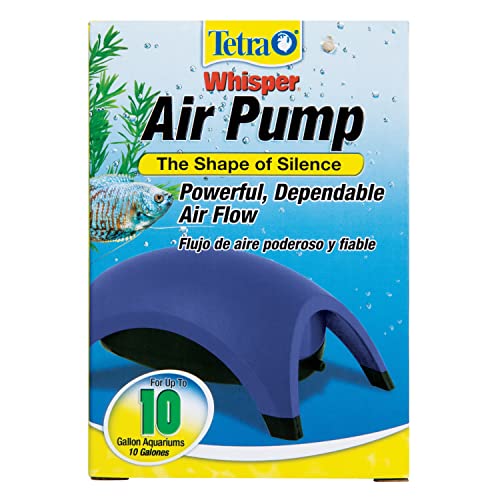
Tetra Whisper Air Pump
Rubber feet and internal damping absorb most of the vibration that makes cheaper pumps buzz through a stand. Years of service without attention is what keeps this the default recommendation on aquarium forums. Output is fixed, so pick the model matched to your tank at purchase rather than adjusting later.
Pros
- Damping keeps it quiet on a wooden cabinet
- Owners report years of continuous service
- Replacement diaphragms are widely stocked
Cons
- No output adjustment at all
- Requires choosing the right size at purchase

hygger Quiet Mini Aquarium Air Pump
Piston construction replaces the usual diaphragm, producing a lower pitched hum that the ear filters out more easily. Owners report sleeping beside one without trouble, which few pumps manage. Size is genuinely small enough to hide behind a nano tank. Output stops short of deep or heavily stocked setups.
Pros
- Lower pitched sound is easier to ignore
- Hides behind a nano tank
- Strongest value at its size class
Cons
- Output falls short on larger tanks
- Limited to shallow water depths

Fluval Q2 Air Pump
An internal sound chamber damps the motor while adjustable output lets you trade flow for quiet. Two outlets carry independent valves, so a sponge filter and an air stone can run at different rates. Extra mass and bulk are the cost, and this one needs real cabinet space.
Pros
- Adjustable output trades flow for quiet
- Two outlets with separate valves
- Enough pressure for deeper aquariums
Cons
- Physically bulkier than rivals here
- Costs more than basic fixed pumps

Marina 200 Air Pump
An integrated rubber mount keeps vibration from reaching the stand, which is the main source of perceived noise indoors. Output sits between the nano pumps and the large adjustable units. Sponge filters are the common pairing at this size, and owners report consistent flow over long runs.
Pros
- Rubber base blocks transmitted vibration
- Steady flow for sponge filter duty
- Simple build with little to fail
Cons
- Single outlet needs a splitter for two devices
- No way to adjust output
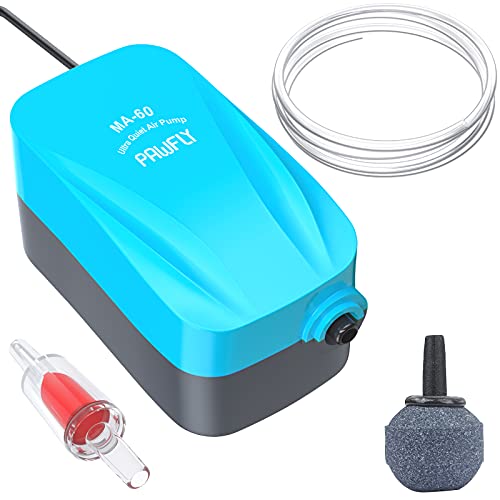
Pawfly MA-60 Aquarium Air Pump
Palm sized and rated to roughly ten gallons, this suits a betta tank, a quarantine setup or a spare on the shelf. Tubing, a check valve and an air stone arrive in the box, so nothing else is needed. Noise is acceptable rather than impressive, and a silent room will pick up the hum.
Pros
- Tubing, check valve and stone included
- Lowest cost for a spare or quarantine tank
- Gentle output suits bettas
Cons
- Audible hum in a silent room
- Restricted to small, shallow tanks
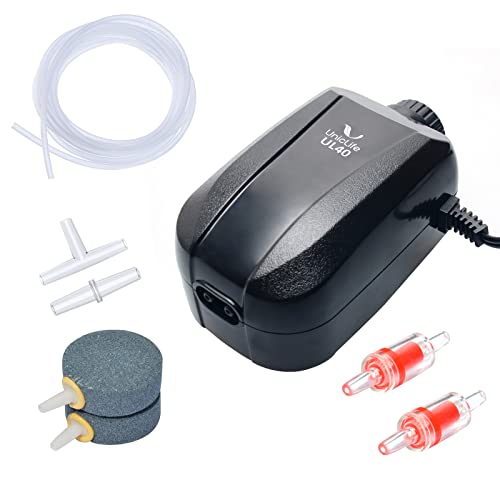
Uniclife Aquarium Air Pump
Two independently adjustable outlets let one pump feed two tanks, or split between a sponge filter and an air stone at different rates. Rubber pads take the edge off vibration. Running noise sits above the Tetra Whisper, so cabinet placement and a foam pad make a real difference.
Pros
- Feeds two tanks from one unit
- Independent valve control per outlet
- Good flexibility for the cost
Cons
- Louder than the Tetra Whisper
- Adjustment valves stiffen over time

EHEIM Air Pump 400
Built for tanks deep enough that ordinary pumps stall before air reaches the substrate. A sound insulated housing keeps that pressure from turning into a racket. Adjustable outlets let you balance multiple lines. On a standard indoor aquarium it is more pump than the setup calls for.
Pros
- Pushes air to the bottom of tall tanks
- Insulated housing controls the noise
- Component quality suits long service life
Cons
- Overpowered for a typical home tank
- Costs the most in this ranking
Before you buy
What to look for in an indoor aquarium air pump Damping matters more than the decibel claim on the box. Rubber feet, a suspended motor or an internal sound chamber all reduce what reaches your furniture. After that, check the rated tank range against your volume and depth, count the outlets you need, and confirm rebuild kits exist. Adjustable output is worth having, because it lets you dial noise down on a quiet evening.
How to make an aquarium air pump quieter in a living room A pump resting directly on a wooden cabinet turns that cabinet into a sounding board. Setting it on a folded towel, a mousepad or a foam block costs nothing and usually beats upgrading to a supposedly quieter model. Hanging the pump from a hook so nothing touches a hard surface works even better. Keep the airline free of sharp kinks, which force the motor to work harder.
Matching output to tank volume and water depth Ratings assume shallow water and a coarse air stone. Depth changes everything, because the pump has to overcome pressure at the outlet. A pump comfortable on a shallow twenty gallon tank may barely bubble at the base of a tall one. Fine pore stones add resistance again. If your tank is deeper than average, size up or choose an adjustable model such as the Fluval Q2.
Check valves, placement and diaphragm replacement Fit a check valve on every line. If power fails while the pump sits below the water line, water siphons back down the airline into the pump body, destroying it and draining part of the tank onto the floor. Position the pump above the rim where the layout allows. Expect the diaphragm to harden within a year or two, at which point output drops and noise rises, so buy brands that sell rebuild kits.
How they compare
| # | Model | Noise | Best for | Score | Price |
|---|---|---|---|---|---|
| 1 | Tetra Whisper Air Pump | Low noise damped design | Best overall | 9.4 | Check price |
| 2 | hygger Quiet Mini Aquarium Air Pump | Piston type | Best value | 9.2 | Check price |
| 3 | Fluval Q2 Air Pump | Two with independent control | Best for large tanks | 9.0 | Check price |
| 4 | Marina 200 Air Pump | Medium tanks | Best for medium tanks | 8.7 | Check price |
| 5 | Pawfly MA-60 Aquarium Air Pump | Small tanks up to around ten gallons | Best budget | 8.5 | Check price |
| 6 | Uniclife Aquarium Air Pump | Two, independently adjustable | Best for running two tanks | 8.2 | Check price |
| 7 | EHEIM Air Pump 400 | Suited to deep tanks | Best for deep tanks | 8.0 | Check price |
Common questions
Do all fish tanks need an air pump?
No. A filter that agitates the surface already handles gas exchange. Pumps matter most for sponge filters, heavily stocked tanks, warm water that holds less oxygen, and setups where you want visible bubble movement.
How do I make my aquarium air pump quieter?
Sit it on foam or a folded cloth so vibration never reaches the furniture, straighten sharp bends in the airline, and replace a clogged air stone. Suspending the pump from a hook removes contact entirely.
What size air pump do I need for my tank?
Start with the volume rating, then account for water depth and how many outlets you plan to drive. Splitting one pump across two stones roughly halves flow at each, so size up before splitting.
Can an air pump run continuously?
Yes. These are designed for continuous duty, and switching them on and off gives no benefit. Constant running also keeps the diaphragm at a steady working temperature.
Where should an aquarium air pump be placed?
Above the water line where possible, on a soft surface, with airflow around it so it does not overheat. If it must sit below the tank, a check valve is mandatory rather than optional.
Why has my air pump got weaker over time?
The rubber diaphragm hardens with age, and air stones clog with mineral deposits and biofilm. Swap the air stone first, since it is cheap, then fit a rebuild kit if output stays low.
Are battery backup air pumps worth it?
In areas with frequent outages, yes, particularly on heavily stocked tanks where oxygen falls within hours. Treat them as a supplement to a mains pump rather than a replacement.
Do bubbles actually add oxygen to the water?
Only slightly from the bubbles themselves. Most of the benefit comes from the surface agitation they create, since that is where gas exchange really happens.
Which air pump is quietest for a bedroom aquarium?
hygger Quiet Mini, thanks to a piston design whose lower pitched hum is easier to sleep through. Tetra Whisper is the next choice, especially placed on a foam pad.
Tetra Whisper vs Fluval Q2: which suits an indoor tank?
Tetra Whisper is simpler, quieter out of the box and cheaper to keep running. Fluval Q2 adds adjustable output and two independent outlets, which suits deeper tanks and setups running several devices.
Our take
Tetra Whisper Air Pump remains the sensible default for an indoor aquarium, being quiet, long lived and easy to service. Choose the hygger Quiet Mini for a nano tank in a bedroom, or the Fluval Q2 when you need adjustable output and two controlled outlets. Whatever you buy, sit it on foam and fit a check valve.
Olivia Hartley
Olivia spent several years working at an animal shelter and a pet-supply retailer before joining the editorial team. She researches pet gear with an emphasis on safety, comfort and the fine print that owners often miss.


