How to Choose an Aquarium Chiller for a Cooler Tank
JBJ Arctica DBA-075 Titanium Chiller leads on controller accuracy and coil material for reef tanks. Active Aqua AACH10HP Water Chiller matches its cooling class for less, provided you supply a pump. Nano keepers should look at Coolworks IceProbe Thermoelectric Aquarium Chiller instead.
JBJ Arctica DBA-075 Titanium Chiller is our first pick for reef and tropical tanks, pairing a titanium exchanger with a tight temperature band. Active Aqua AACH10HP Water Chiller delivers the same cooling class for less outlay. Under ten gallons, Coolworks IceProbe Thermoelectric Aquarium Chiller is the sensible route.
Sizing is where most buyers go wrong. A rating on the box assumes ideal flow, a cool room and a clean condenser, none of which describe a closed cabinet in August. Lights, return pumps and powerheads all add heat the rating ignores. We compared published cooling capacity, coil material, required flow ranges and thermostat behavior, then weighed owner reports on noise, condensation and compressor life.
What matters most
How to size an aquarium chiller Add up total system volume, sump included, then choose a unit rated above that figure rather than at it. Metal halide or strong LED lighting, return pumps and powerheads all dump heat into the water. Closed cabinets trap it. A chiller running constantly wears out far sooner than one that cycles, so headroom is protection rather than luxury.
Titanium vs stainless steel coils in saltwater Stainless corrodes in salt and can leach metals that harm corals and invertebrates. Titanium exchangers avoid that entirely, which is why every aquarium chiller here except the industrial CW-3000 uses one. Freshwater keepers have more freedom, though corrosion resistance still extends service life. Insist on titanium for any marine or reef system.
What flow rate does a chiller need? Chillers cool the water passing through them, so both extremes cause problems. Too little flow means poor heat transfer, and too much means the water leaves before it cools. Check the flow band in the specifications, then choose a pump that lands inside it after head height and tubing losses. Feeding from a sump is far simpler than plumbing into a display tank.
Managing heat, noise and condensation in a cabinet Whatever a compressor removes from the water goes into the room. Sealing one inside a cabinet slowly cooks it, so leave clearance at the vented sides and consider a cabinet fan. Cool tubing sweats in humid rooms, and owners report puddles under the unit during the first hot spell. Insulating the lines solves it, and checking the floor for a week afterwards catches anything missed.
The top picks, ranked

JBJ Arctica DBA-075 Titanium Chiller
A titanium heat exchanger makes this safe for fresh and saltwater alike, with no corrosion risk to invertebrates. Its digital controller holds a narrow band, which is what reef chemistry actually needs. Owners report long service life when the intake screen stays clean.
Pros
- Titanium coil is safe in saltwater and reef systems
- Holds a tight, stable temperature band
- Long standing reputation for longevity
Cons
- Needs ventilation clearance around the vents
- Compressor noise carries in a quiet room

Active Aqua AACH10HP Water Chiller
Built for hydroponics and widely adopted by aquarists, this unit offers full compressor cooling for noticeably less than aquarium branded rivals. Its titanium evaporator handles saltwater without trouble. Budget for a separate pump and tubing, since neither ships in the box.
Pros
- Strongest cooling per unit of outlay here
- Titanium exchanger resists salt corrosion
- Controls are simple to set and read
Cons
- Pump and fittings sold separately
- Fan runs louder than premium units

Hailea HC-150A Aquarium Chiller
Capacity steps up to roughly the quarter horsepower class, covering systems that a 1/10 HP unit cannot hold in a warm room. Titanium coils and a microcomputer thermostat make it a common choice on larger reef builds. A strong feed pump is required to reach its rated performance.
Pros
- Copes with big systems and warm rooms
- Quieter than expected for the capacity
- Thermostat tracks accurately
Cons
- Heavy and needs a dedicated space
- Running costs rise with the capacity

Coolworks IceProbe Thermoelectric Aquarium Chiller
A thermoelectric probe mounts through a sump lid or hangs in the tank, pulling a few degrees out of small volumes. No refrigerant, no external pump and no hose routing keep installation simple. Expect a modest drop rather than the swing a compressor delivers.
Pros
- Fits without plumbing or an external pump
- Compact and near silent in a room
- Straightforward to add to a nano setup
Cons
- Only a few degrees of cooling available
- Needs a separate temperature controller
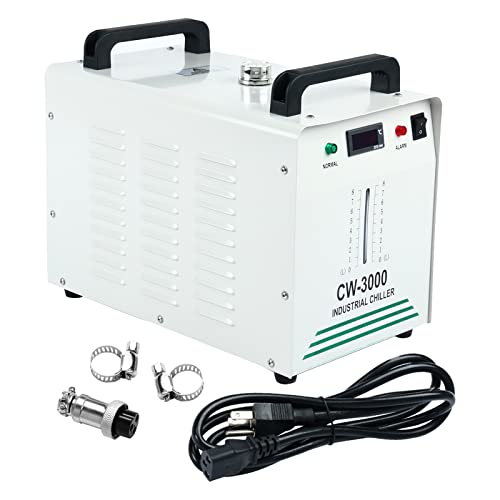
BAOSHISHAN CW-3000 Industrial Water Chiller
Designed for laser and industrial cooling, this circulating unit runs around the clock without complaint. Flow through the six liter reservoir is high, which suits large freshwater systems. Wetted materials are not specified for marine chemistry, so keep it away from saltwater.
Pros
- Rated for continuous running
- Moves a large volume of water
- Lower outlay than aquarium branded units
Cons
- Not intended for saltwater systems
- Industrial styling looks wrong in a living room
Aqua Euro USA Max Chill Aquarium Chiller
A heavy titanium exchanger and a controller that resists drift target keepers who want the unit installed and forgotten. Memory retention means settings survive a power cut without reprogramming. Owners report parts and support arrive without a fight.
Pros
- Heavy duty titanium exchanger
- Settings survive a power interruption
- Parts support is straightforward
Cons
- Sits in the premium bracket
- Large footprint under a cabinet

Poafamx Aquarium Water Chiller
Compressor cooling scaled down for shrimp tanks, planted nanos and axolotl setups where two or three degrees decide everything. Tubing and a simple digital controller are included. Capacity is modest, so match it to small volumes rather than a display reef.
Pros
- Real compressor cooling at the low end
- Small enough to hide in a cabinet
- Basic fittings supplied
Cons
- Capacity runs out on larger tanks
- Fan noise is obvious at close range
Compared at a glance
| # | Model | Cooling class | Best for | Score | Price |
|---|---|---|---|---|---|
| 1 | JBJ Arctica DBA-075 Titanium Chiller | 1/10 HP compressor | Best overall | 9.4 | Check price |
| 2 | Active Aqua AACH10HP Water Chiller | 1/10 HP compressor | Best value | 9.2 | Check price |
| 3 | Hailea HC-150A Aquarium Chiller | Around 1/4 HP | Best for larger tanks | 9.0 | Check price |
| 4 | Coolworks IceProbe Thermoelectric Aquarium Chiller | Thermoelectric probe | Best for nano tanks | 8.8 | Check price |
| 5 | BAOSHISHAN CW-3000 Industrial Water Chiller | Circulating thermolysis chiller | Best for continuous duty | 8.6 | Check price |
| 6 | Aqua Euro USA Max Chill Aquarium Chiller | 1/4 HP compressor | Best build quality | 8.3 | Check price |
| 7 | Poafamx Aquarium Water Chiller | Compact compressor | Best budget compressor unit | 8.0 | Check price |
Good to know
What size chiller do I need for a 55 gallon tank?
Total the display and sump volume, then pick a unit rated above it. A 1/10 HP class chiller such as the JBJ Arctica or Active Aqua covers a 55 gallon system in a normal room. Strong lighting or a warm room pushes the requirement toward the quarter horsepower class.
Are thermoelectric chillers strong enough?
They pull a few degrees out of small volumes only. On nano and shrimp tanks that is often plenty. Anything larger needs a compressor unit.
Do aquarium chillers come with a pump?
Most compressor models do not. Read the required flow range in the specifications and pick a pump that sits inside it once head height is accounted for.
Can a chiller be used with saltwater?
Yes, as long as the exchanger is titanium. Stainless coils corrode in salt and release metals that harm corals and invertebrates.
How noisy are aquarium chillers?
Compressor units produce a refrigerator style hum plus fan noise. Owners describe it as clearly audible in a quiet living room, which is why many site the unit in a vented cabinet or an adjacent room.
Where should an aquarium chiller be installed?
On a level surface with clear space at the vents, ideally below the tank and fed from a sump. Never seal one inside an airtight cabinet.
Can I run a chiller and a heater at the same time?
Yes, and many keepers do. Set the heater a degree or so below the chiller cut in point so a dead band separates them and they never fight.
What maintenance does an aquarium chiller need?
Clean the intake filter and condenser fins regularly, since dust is the main cause of lost capacity. Flush the coil periodically and check tubing for algae growth that restricts flow.
Is a chiller or a cooling fan better?
Fans cool by evaporation and can drop a couple of degrees cheaply, at the cost of faster evaporation and salinity swings. Chillers hold a set temperature regardless of humidity, which matters for reef tanks and axolotls.
Our pick
JBJ Arctica DBA-075 Titanium Chiller is the safest choice for most reef and tropical systems, combining a titanium coil with a controller that holds its band. Active Aqua AACH10HP delivers comparable cooling for less if supplying your own pump is no obstacle. Anyone running a nano tank should try the Coolworks IceProbe before committing to a compressor.
Olivia Hartley
Olivia spent several years working at an animal shelter and a pet-supply retailer before joining the editorial team. She researches pet gear with an emphasis on safety, comfort and the fine print that owners often miss.

