How to Choose the Right Aquarium Water Changer
Python No Spill Clean and Fill Aquarium Maintenance System is the most complete water changer, draining to a sink and refilling through the same hose. Aqueon Aquarium Water Changer offers a 50 foot hose option. Laifoo 25ft Aquarium Siphon Water Changer covers smaller tanks without a tap fitting.
Python No Spill Clean and Fill is worth owning whenever the tank sits within hose reach of a tap, because it drains and refills without a bucket. Aqueon Aquarium Water Changer works the same way and offers a longer hose. Anyone with a smaller tank should look at the Laifoo 25ft siphon instead.
Water changer choices come down to plumbing and tank geometry rather than the device itself. A system that is superb on a 75 gallon tank will pull the substrate out of a 10 gallon nano. We compared hose lengths, tap adapter compatibility, tube diameters, priming methods and manufacturer size guidance, alongside owner reports on leaking connectors and hose kinking.
How to choose
Tap connected systems versus gravity siphons A tap changer creates suction from running mains water, so it can drain uphill to a sink and then refill through the same hose. That transforms maintenance on a large tank, at the cost of tap water used to generate flow and a tap you can screw an adapter onto. Gravity siphons need no plumbing, but they only drain, they want a drain below tank level, and every gallon of new water gets carried back.
Matching the gravel tube to your substrate Wide bore tubes lift heavy gravel debris efficiently on a large tank, and the same tube pulls a nano substrate straight up the pipe. Fine sand needs an even gentler approach, hovering above the surface so detritus lifts and grains settle. Planted tanks with nutrient substrate want a narrow, low flow cleaner that will not strip the bed around root feeders.
How to measure the run before buying a hose Hose length is the most common regret. Measure the actual route from tank to tap, including detours around furniture and up over a worktop, then add several feet of slack. Twenty five feet covers most homes where the tank shares a room with a kitchen. A tank in a back bedroom usually needs fifty feet or an extension kit.
Dechlorinator, temperature and refilling safely A water changer moves water without conditioning it. Dose dechlorinator for the full tank volume when refilling directly from a tap. Mix hot and cold at the tap to match tank temperature rather than shocking fish with a cold flush. Refilling slowly leaves time to check by hand, and roughly a quarter of the volume weekly suits most stocked freshwater tanks.
Our top picks

Python No Spill Clean and Fill Aquarium Maintenance System
Running water through a threaded tap adapter creates suction, pulling waste from the gravel and sending it down the drain. Flipping the valve turns the same hose into a refill line. Buckets disappear entirely, which is why this system has been the hobby reference for decades.
Pros
- Drains and refills without a bucket
- Extension hoses cover long runs
- Replacement parts widely available
Cons
- Uses tap water to generate suction
- Requires a threaded tap to attach to

Aqueon Aquarium Water Changer
Same venturi principle as the Python, with a 50 foot hose option for tanks well away from plumbing. Control sits at the tap end, so switching between drain and fill needs no walk back to the aquarium. Owners report the connectors seal reliably as long as washers get checked each season.
Pros
- Fifty foot option reaches distant rooms
- Valve switches drain to fill at the tap
- Adapter fits common tap threads
Cons
- Bulky to coil and store
- Suction is too strong for nano tanks

Laifoo 25ft Aquarium Siphon Water Changer
Gravity does the work here, with a squeeze bulb to start flow and no tap connection at all. Waste travels to a bucket or a floor drain while the tube vacuums gravel on the way. Tanks under roughly 40 gallons get the essential job done.
Pros
- No tap fitting or adapter needed
- Twenty five feet of hose as standard
- Squeeze bulb primes in seconds
Cons
- Drains only, refilling is manual
- Needs a drain lower than the tank

Eheim Quick Vac Pro Automatic Gravel Cleaner
Batteries drive an internal pump that draws debris into a filter cartridge and returns the water. Because nothing leaves the aquarium, this suits a midweek tidy between proper changes. Consider it a companion to a real water changer rather than a substitute.
Pros
- No hoses or buckets involved
- Quick to deploy for midweek debris
- Works safely over fine substrate
Cons
- Performs no actual water change
- Filter pads need regular replacement
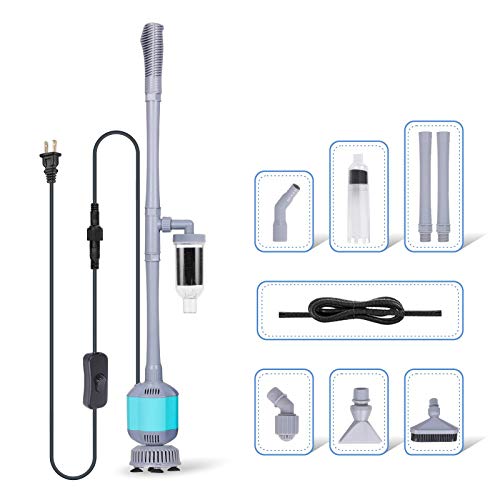
hygger Electric Aquarium Gravel Vacuum Cleaner
A mains pump handles water changing, gravel washing, sand cleaning and circulation through swappable nozzles. Flow far outpaces a hand siphon, which shortens the job on a big tank. Owners report a minimum water depth is needed before the pump will prime.
Pros
- Fast flow saves time on big tanks
- Nozzles cover gravel, sand and circulation
- No manual priming step
Cons
- Requires a minimum water depth to prime
- Mains cable near water needs care

Marina Easy Clean Aquarium Gravel Cleaner
A narrow gravel tube and a self starting priming action pair with a short bucket length hose. The reduced bore lifts debris without dragging fine gravel out of a small tank. Ten and twenty gallon setups are exactly its territory.
Pros
- Narrow bore protects fine substrate
- Primes without mouth suction
- Coils into a cupboard easily
Cons
- Bucket work is unavoidable
- Slow on anything past 30 gallons

Fluval Gravel Vac Multi-Substrate Cleaner
Designed around varied substrates, this lifts waste from between plant roots and fine sand without hoovering the aquascape. A squeeze bulb primes quickly and flow stays deliberately gentle. Keepers with carpeting plants report far less disruption during maintenance.
Pros
- Gentle flow protects carpeting plants
- Handles sand as readily as gravel
- Light enough to steer one handed
Cons
- Low flow lengthens each session
- Not practical on very large tanks
Side by side
| # | Model | Standard hose length | Best for | Score | Price |
|---|---|---|---|---|---|
| 1 | Python No Spill Clean and Fill Aquarium Maintenance System | 25 feet, extendable | Best overall | 9.4 | Check price |
| 2 | Aqueon Aquarium Water Changer | 25 or 50 feet options | Best for long hose runs | 9.2 | Check price |
| 3 | Laifoo 25ft Aquarium Siphon Water Changer | 25 feet | Best budget | 9.0 | Check price |
| 4 | Eheim Quick Vac Pro Automatic Gravel Cleaner | Battery operated | Best for spot cleaning | 8.8 | Check price |
| 5 | hygger Electric Aquarium Gravel Vacuum Cleaner | Mains electric pump | Best for large tanks | 8.6 | Check price |
| 6 | Marina Easy Clean Aquarium Gravel Cleaner | Short, bucket length | Best for small tanks | 8.3 | Check price |
| 7 | Fluval Gravel Vac Multi-Substrate Cleaner | Squeeze bulb | Best for planted tanks | 8.0 | Check price |
Questions worth asking
How often should I change aquarium water?
Most freshwater keepers change twenty to thirty percent weekly. Heavily stocked tanks need more and lightly stocked planted tanks less. Rising nitrate is the clearest sign changes are overdue.
Do tap connected water changers waste water?
They use mains water to create suction while draining, so more goes down the drain than comes out of the tank. Running the tap at a moderate rate rather than fully open reduces that.
Can I use a water changer on a saltwater tank?
Use the draining and vacuuming side freely, but never refill a marine tank from the tap. Saltwater must be mixed to the correct salinity and temperature in a separate container first.
Will a water changer harm my fish?
Healthy adult fish move away from the intake. Fry, shrimp and snails can be drawn up the tube, so cover the mouth with mesh in a shrimp tank and check the bucket before emptying it.
Do I need to remove fish during a water change?
No, and catching them causes far more stress than the change does. Leave fish in place, change no more than about half the volume at once, and match the incoming temperature.
How do I stop a siphon losing suction?
Keep the gravel tube below the water line, avoid sharp kinks, and make sure the drain end stays lower than the tank throughout. Air drawn in at the top is the usual culprit.
Can I vacuum the whole gravel bed at once?
Better not to. Nitrifying bacteria colonise the substrate, so most keepers clean a third to a half each session and rotate sections. That keeps the biological filter stable.
What size tank justifies an electric water changer?
Past roughly 50 gallons, bucket work becomes genuinely tedious and a tap or pump driven system pays back in time. Below 20 gallons, a simple siphon and a bucket is quicker to set up.
Which water changer suits a nano tank?
A narrow bore siphon such as the Marina Easy Clean, or a battery unit that leaves water in the tank. Tap driven systems pull far too hard at that scale.
The verdict
Python No Spill Clean and Fill remains the water changer to beat, turning bucket carrying into a single hose routine. Owners with large tanks far from a tap should choose the Aqueon Water Changer and its fifty foot hose. Nano and planted keepers get better results from the gentler Marina Easy Clean or Fluval Gravel Vac.
Olivia Hartley
Olivia spent several years working at an animal shelter and a pet-supply retailer before joining the editorial team. She researches pet gear with an emphasis on safety, comfort and the fine print that owners often miss.

