Why Does a Front Clip Harness Reduce Pulling Better Than a Back Clip?
A front clip harness redirects a dog’s forward pulling momentum sideways instead of letting it channel straight into the leash and the handler’s arm. When a dog lunges forward and the leash attaches at the chest, the tension turns the dog slightly toward the handler rather than letting it dig in and pull straight ahead, which makes sustained pulling physically harder to do effectively, not just less comfortable.
The basic mechanics of a pulling dog
A dog that leans its weight into a harness and pulls forward is using its chest and shoulder muscles against a fixed resistance point. When that resistance point is on the back, between the shoulder blades, the leash tension lines up with the direction the dog is already pulling, which does little to interrupt the behavior and can even make it feel like it is working against the dog’s full forward strength.
Why moving the clip to the chest changes the physics
With the leash attached at the center of the chest, any forward pulling force creates a slight rotational effect rather than a straight-line one. As the dog pulls, the harness tugs the dog’s shoulders sideways toward the handler instead of simply resisting the pull head-on, which breaks the dog’s balance and straight-ahead momentum in a way a back clip does not.
Why this does not rely on pain or discomfort to work
Unlike a prong or choke style tool, a front clip harness does not depend on discomfort increasing with harder pulling to discourage the behavior. It works through leverage and balance disruption, which is why it is commonly recommended for dogs where a trainer wants to reduce pulling without introducing a correction-based tool.
The trade-off most owners do not expect
Front clip harnesses are generally not recommended for structured off-leash training, sports, or long-distance activities like sledding or heavy hiking, since the sideways pull can affect a dog’s natural gait over extended use and does not offer the same full freedom of shoulder movement a well-fitted back clip harness does.
Why fit matters more with a front clip design than a back clip
A front clip harness that sits too low can ride up into the armpit area during use, and one that is too loose lets the chest strap shift out of the ideal centered position needed for the sideways redirect to work consistently. A back clip harness is more forgiving of a slightly imperfect fit since it is not relying on the exact geometry of the pull to function. Checking the fit again after the first few walks matters too, since webbing can stretch slightly and a strap that measured correctly in the store can loosen just enough to drift out of position once the dog has worn it a handful of times.
Does it work for every dog that pulls
It helps most dogs that pull from excitement or habit, but it is not a fix for a dog that is lunging aggressively at another dog or person, since that behavior is driven by something other than simple loose-leash walking habits and usually needs separate behavioral work alongside any equipment change.

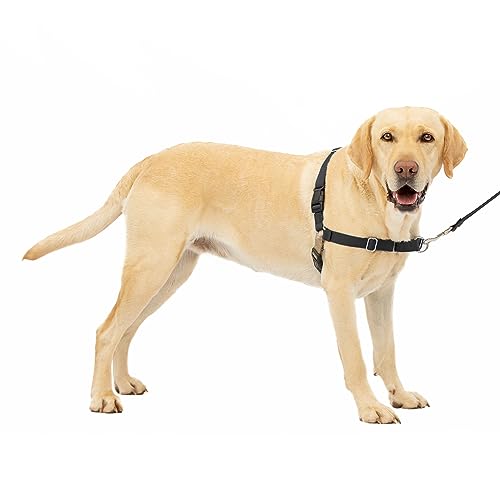
PetSafe 3in1 Easy Walk Harness
One of the most widely used front-clip harnesses, with a chest strap designed to tighten slightly and redirect a pulling dog’s shoulders without using a choke mechanism.
Good to know
Does a front clip harness stop pulling completely on its own?
Rarely on its own. It makes pulling physically less effective and often reduces it noticeably, but lasting change usually needs some loose-leash training paired with the equipment.
Can a front clip harness be used for a puppy still learning leash manners?
Yes, many trainers recommend it specifically during the leash-training phase, since it helps a puppy learn without needing a correction-based tool while its walking habits are still forming.
Is a front clip harness safe for small dogs?
Yes when sized correctly, though small dogs generally pull with less force to begin with, so the benefit over a back clip is sometimes less dramatic than it is for a strong, large breed.
Does a front clip harness restrict a dog’s shoulder movement?
To some degree during sustained use, which is why it is generally recommended for everyday walks rather than for structured running, hiking long distances, or sports where full shoulder extension matters.
Can a front clip harness cause a dog to trip or get tangled?
It can increase the chance of the leash crossing in front of the dog’s legs compared to a back clip, so some supervision and leash handling awareness helps, especially early on.
Why does my dog still pull hard even in a front clip harness?
Strong, highly motivated dogs can still pull meaningfully even with the redirect effect, since the harness changes the mechanics of pulling but does not remove the dog’s underlying drive or excitement.
Is a head halter more effective than a front clip harness?
A head halter generally gives even more directional control since it turns the head rather than the chest, but many owners find a front clip harness easier for a dog to tolerate and adjust to.
Can a front clip harness be combined with a back clip for extra control?
Yes, some double-ended leashes attach to both points at once, giving a trainer more control during transitional training, though this is more of a specialized technique than typical daily walking setup.
Do front clip harnesses work for dogs that lunge at other dogs?
Not reliably for reactive lunging specifically, since that behavior is driven by arousal or fear rather than simple pulling habit, and usually needs separate behavioral training alongside any harness change.
How tight should a front clip harness fit across the chest?
Snug enough that two fingers fit comfortably under the strap but it cannot slip over the dog’s head or shoulders, since a loose fit lets the chest strap drift out of the ideal centered pulling position.
Can a front clip harness be used for a dog with a sensitive trachea?
Yes, this is actually one of its advantages over a collar, since the chest and shoulder area is less prone to the type of pressure that can affect a dog’s trachea compared to a neck-based attachment.
Do front clip harnesses wear out faster than back clip designs?
Not inherently, though the chest strap on a front clip harness experiences more direct pulling force and friction over time, so checking stitching and buckle wear periodically is a reasonable habit.
Is it normal for a dog to walk slightly sideways when first using a front clip harness?
Yes, a brief adjustment period where a dog walks a little crooked or hesitant is common as it adapts to the new leverage point, and this usually settles within a few walks.
Can a front clip harness help with leash reactivity during training sessions?
It can make redirecting a dog’s attention physically easier during a reactive moment since the sideways leverage helps turn the dog’s body, but it works best as one tool within a broader reactivity training plan, not a standalone fix. A qualified trainer can also help time that redirect correctly, since turning a reactive dog’s body too late in the reaction tends to be far less effective than catching it early.
Should a front clip harness be removed once a dog stops pulling regularly?
Many owners transition back to a standard back clip harness once loose-leash walking becomes consistent, treating the front clip as a training-phase tool rather than a lifelong necessity, though continuing to use it causes no harm either.
Final word
The front clip harness earns its reputation through simple leverage, not gimmicks, redirecting a dog’s own forward force rather than fighting it head-on. It is a genuinely useful training-phase tool for most pulling dogs, just not a permanent substitute for teaching loose-leash walking in the first place.
Olivia Hartley
Olivia spent several years working at an animal shelter and a pet-supply retailer before joining the editorial team. She researches pet gear with an emphasis on safety, comfort and the fine print that owners often miss.