How Does a No Pull Dog Harness Actually Redirect Pulling Force?
A no-pull harness works through mechanics rather than correction, by moving the leash attachment point from the back to the front of the chest. When a dog pulls forward with its full body weight, a front-clip leash catches that momentum and turns it sideways, physically rotating the dog back toward the handler instead of letting the chest drive straight ahead, which makes pulling an ineffective strategy rather than an uncomfortable one.
Why back-clip attachment points do not discourage pulling
A leash clipped at the shoulders or back sits roughly in line with the direction a dog naturally pulls, which means the dog’s full forward momentum goes directly into the leash with no redirection at all. This is the same mechanical setup used in sled-dog harnesses, which are specifically designed to let a dog pull as hard and efficiently as possible, essentially the opposite of what a no-pull design is trying to achieve.
How the front-clip mechanism actually changes the physics
With the leash attached at the chest, forward pulling force gets converted into a sideways rotational force the moment the leash goes taut, since the dog’s body wants to continue forward while the leash anchor point pulls sideways toward the handler. That rotation interrupts the dog’s forward momentum and turns the body partway around, which is far less efficient for pulling than driving straight ahead.
Why some no-pull designs also tighten slightly under pull
Certain no-pull harnesses use a martingale-style loop around the chest or front legs that snugs slightly when the dog pulls, adding a small amount of additional resistance on top of the redirection effect. This needs a correct, snug-but-not-tight fit to work as intended, since a loose harness lets the tightening loop shift into a position where it could restrict a front leg’s natural motion.
Why fit matters as much as the design itself
A harness that is too loose lets the body shift inside it when the dog pulls, which reduces how effectively the front clip can redirect force and also increases the risk of a dog backing out of it entirely. A properly snug fit, checked by making sure a couple of fingers can still slide comfortably under the straps, is necessary for the mechanical redirection to actually work as designed.
How this differs from a head halter’s redirection
A head halter like a Halti or Gentle Leader redirects at the head rather than the chest, working on the principle that where the head points, the body generally follows, which produces a stronger and more immediate turning effect than a chest-based harness but requires more careful introduction since many dogs initially resist anything around the muzzle.
What a no-pull harness does not solve by itself
The redirection mechanism reduces the physical effectiveness of pulling, but it does not address the underlying motivation behind leash reactivity, excitement, or a dog that has never been taught any alternative to pulling, which is why most trainers recommend pairing a no-pull harness with actual loose-leash training rather than relying on the equipment alone.
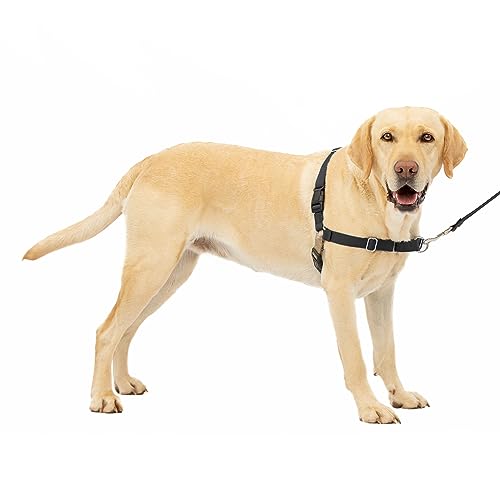
PetSafe Easy Walk Harness
A widely used front-clip no-pull harness that redirects forward pulling force sideways through a chest-mounted leash attachment point.
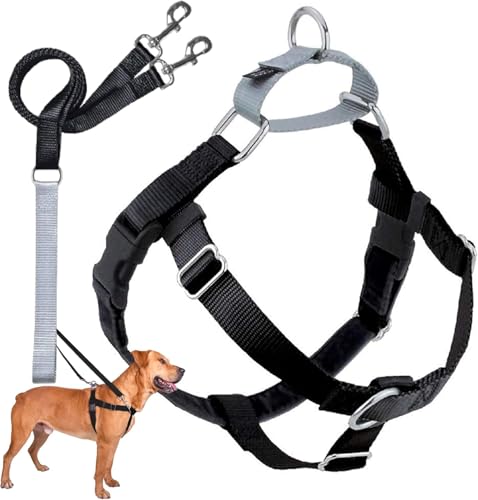
2 Hounds Design Freedom No-Pull Harness
A two-point harness offering both a front chest clip and a back clip, allowing a double-ended leash setup that combines redirection with additional control.
Common questions
Does a no-pull harness hurt the dog when it pulls?
No, a properly fitted front-clip harness works through mechanical redirection rather than pain or pressure on sensitive areas, which is a key difference from aversive training tools.
Can a no-pull harness be used on puppies?
Many front-clip harnesses are sized appropriately for puppies, though a correct, adjustable fit matters even more for a growing puppy since sizing needs will change as the puppy develops.
Why does my dog still pull somewhat even with a no-pull harness on?
The harness reduces pulling efficiency but does not eliminate the underlying motivation to pull, so some reduced pulling is common until it is combined with consistent loose-leash training.
Is a front-clip harness safe for dogs with breathing issues?
A well-fitted chest harness that does not restrict the throat is generally considered safer than a neck collar for brachycephalic or breathing-sensitive breeds, since it avoids direct pressure on the trachea.
Can a no-pull harness cause shoulder or gait problems over time?
Poorly fitted harnesses, particularly ones that cross tightly over the front of the shoulder joint, have been raised as a concern for restricting natural shoulder movement, which is why proper fit and design matter for long-term use.
Does the material of the harness affect how well it redirects force?
Material mainly affects durability and comfort rather than the core redirection mechanism, which depends primarily on where the leash attachment point sits relative to the dog’s center of pulling force.
Is it normal for a dog to resist wearing a harness at first?
Yes, many dogs need a short adjustment period when first wearing any new harness, and gradually introducing it with positive association before expecting calm walks is a common recommended approach.
Can a no-pull harness be combined with a regular collar?
Yes, many owners keep a regular collar on for ID tags while using the harness specifically for leash attachment and walking control, since the two serve different purposes.
Do dual-clip harnesses work better than single front-clip designs?
A dual-clip design offers more flexibility, including the option to use a double-ended leash connecting both points for extra control, though a single front-clip harness is often sufficient for moderate pulling.
How tight should a no-pull harness actually be?
Snug enough that it cannot slip over the head or shoulders when the dog pulls, but loose enough to fit a couple of fingers comfortably under the straps without digging into the skin.
Can a harness replace the need for any leash training at all?
No, the harness changes the physics of pulling but does not teach a dog an alternative behavior, so pairing it with basic loose-leash training produces better long-term results than the harness alone.
Do working or service dogs use the same no-pull harness designs?
Working dog harnesses are generally built differently, prioritizing stability and load distribution for tasks rather than discouraging pulling, since many working roles actually require controlled pulling.
Is it safe to leave a no-pull harness on a dog all day?
Front-clip harnesses are generally designed for walks rather than all-day wear, and leaving one on for extended periods can cause chafing or restrict normal movement if not removed during rest.
Can small dog breeds use the same no-pull harness mechanism as large breeds?
Yes, the same front-clip redirection principle applies regardless of size, though harnesses are typically sized specifically for smaller frames to keep the fit snug rather than using a scaled-down large-breed design.
Does a no-pull harness need a different leash than a standard collar walk?
A standard six-foot leash works fine with most front-clip harnesses, though some owners prefer a slightly shorter leash with a front-clip setup since it gives a bit more immediate feedback when redirecting a pulling dog.
Can a harness lose its redirection effect as a dog grows or gains weight?
Yes, a harness that fit snugly before can become too loose or too tight as a dog’s body changes, which reduces how effectively the front clip can redirect force, making periodic fit checks worth doing over time.
Is it common for trainers to recommend a specific brand of no-pull harness?
Trainers generally focus more on the front-clip design principle and correct fit than on a specific brand, since multiple reputable brands apply the same core mechanical redirection concept with only minor design differences.
Where this leaves you
The appeal of a front-clip harness is that it does not rely on a dog understanding anything, it simply makes pulling physically less rewarding the moment the leash goes taut. That makes it a genuinely useful tool, but it works best as a bridge toward real loose-leash habits, not as a permanent substitute for them.
Olivia Hartley
Olivia spent several years working at an animal shelter and a pet-supply retailer before joining the editorial team. She researches pet gear with an emphasis on safety, comfort and the fine print that owners often miss.


