Is an FM Transmitter Actually a Good Option for Older Cars Without Bluetooth?
An FM transmitter is a legitimate workaround for a car with no aux input or Bluetooth, letting a phone’s audio play through the factory radio with no wiring changes. It is not a sound quality upgrade though, since legal power limits on these devices cap how strong the signal can be, so static, range, and competing local stations are permanent limitations rather than something a better unit fully solves.
What an FM transmitter actually does
It takes audio from your phone, usually over Bluetooth or a cable, and rebroadcasts it on a chosen low-power FM frequency, which your car’s existing radio then tunes into like any other station. In effect, your phone becomes a tiny, short-range unlicensed radio transmitter for the length of the drive.
Why sound quality is inherently limited
The audio has to be compressed into a broadcast FM signal and then decoded again by your car’s standard FM receiver, which adds a layer of hiss and background noise that a direct aux cable or true Bluetooth audio connection does not have. Regulations such as FCC Part 15 in the United States also cap transmission power, so the signal degrades quickly with distance from the antenna.
The real-world obstacle is finding a clear frequency
In cities with many active radio stations, an open, unused frequency can be hard to find, and even a technically open one can get partially overridden by a strong nearby station as you drive, causing intermittent static or bleed-through audio.
Why it still beats the realistic alternatives for most older cars
Compared to burning CDs, carrying a cassette aux adapter, or swapping the entire head unit, an FM transmitter plugs into the 12-volt socket with no wiring changes and lets you use normal phone audio. For a car that is otherwise perfectly reliable, that convenience is usually worth the sound quality tradeoff.
When the car’s own electronics make things worse
Some older vehicles with noisier electrical systems or less shielded alternators introduce an audible whine or extra static through an FM transmitter that a newer, better-shielded car would not show nearly as much.
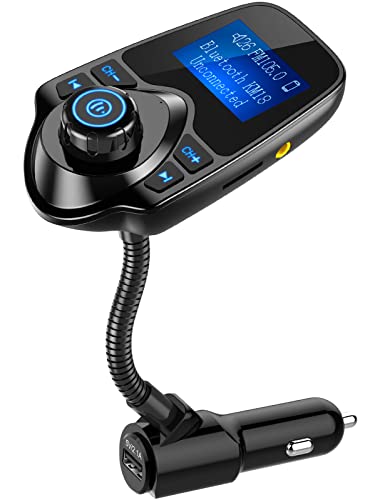
Nulaxy KM18 Bluetooth FM Transmitter
A widely used 12-volt plug-in transmitter with Bluetooth audio and hands-free calling, representative of the basic category this answer describes.

VicTsing Bluetooth FM Transmitter
A similar plug-in transmitter with a dedicated display for frequency selection, useful for quickly finding and locking a clearer channel.
Questions worth asking
Why does my FM transmitter work fine until I drive into certain areas?
You have likely driven within range of a licensed station broadcasting on the same or an adjacent frequency, which overpowers the much weaker transmitter signal from your device.
Can I use the same FM transmitter in any country?
Not reliably. Legal power limits and the frequency bands considered acceptable for in-car use vary by country, so a transmitter designed for one region may underperform or not comply with regulations in another.
Does a more expensive FM transmitter actually sound noticeably better?
Somewhat. Pricier units tend to hold a stable frequency lock better and may offer multiple presets, but all of them operate within the same low-power legal limits, so the ceiling on sound quality is similar across brands.
Will leaving it plugged in drain my car battery?
Only if your 12-volt socket stays powered when the ignition is off and you leave the transmitter connected, since most sockets cut power automatically with the car off.
Should I use an FM transmitter if my old car already has basic Bluetooth?
No, if your car can already pair directly, use that instead, since it skips the extra conversion step and avoids the static issues that come with rebroadcasting over FM.
Why is there a slight delay between the audio and what I expect?
Bluetooth buffering combined with the transmitter’s own short processing time can introduce a small delay, usually unnoticeable for music but occasionally noticeable when watching video with sound.
Do these transmitters support hands-free phone calls too?
Most Bluetooth FM transmitters do, routing call audio through the same FM link so you can talk through your car speakers without touching the phone.
Is a wired aux-to-FM transmitter better than a Bluetooth one?
Often slightly, since a wired connection skips the Bluetooth compression step entirely, leaving one less point where audio quality can degrade before it reaches the FM broadcast stage.
Can my phone case or mount interfere with the signal?
Rarely. The bigger interference sources are nearby radio towers and other electronics inside the vehicle, not phone accessories.
Why does static get worse on long highway drives?
It is less about speed and more about leaving the local coverage pocket of whichever frequency you picked, as you pass through areas served by different local stations.
Do all FM transmitters let me charge my phone while using them?
Most do, since they are built to sit in a powered 12-volt socket and include a USB pass-through port for charging alongside streaming audio.
Is it worth replacing the whole car stereo instead of using a transmitter?
For a car that is otherwise reliable, usually not. A full head unit swap costs considerably more than solving the single missing feature with a small plug-in transmitter.
Can two nearby cars with FM transmitters interfere with each other?
Technically yes if both land on the same frequency at close range, though this is uncommon in normal driving since the signal range is so short.
Does weather affect FM transmitter reception?
Not meaningfully, since this is a very short-range in-cabin signal rather than long-distance broadcast reception, which is where weather conditions matter more.
Can an FM transmitter work in a rental car without any setup hassle?
Yes, since it needs no wiring at all, just plugging into the 12-volt socket and pairing over Bluetooth, which makes it a popular choice for rental or borrowed cars.
Does the transmitter’s antenna length affect signal quality?
Most plug-in units have their antenna built into the device body itself, so there is little to adjust, though keeping it unobstructed within the cabin helps maintain a steadier signal.
Is it legal to use an FM transmitter in a car in the United States?
Yes, as long as the device complies with FCC Part 15 low-power limits, which nearly all consumer units sold in the US are designed to meet.
Can an FM transmitter’s output level be adjusted separately from the car’s own volume?
Yes, most transmitters include their own output level setting in addition to the car stereo’s volume control, and finding a reasonable balance between the two often reduces static compared to maxing out just one.
Does an FM transmitter work the same in an electric car as in a gas car?
Mechanically yes, since it is simply broadcasting to the car’s existing FM receiver, though the quieter cabin of many electric vehicles can make any background static more noticeable than it would be over a louder gas engine.
Can an FM transmitter interfere with my car’s factory safety or navigation systems?
No, these transmitters broadcast only on the FM radio band and have no access to or effect on separate vehicle systems like navigation or safety electronics.
Is there a real difference between a transmitter with a screen and one without?
A screen mainly helps with quickly finding and confirming a clear frequency, but it does not change the underlying audio quality or broadcast range compared to a simpler button-only model.
Our take
An FM transmitter is an honest stopgap, not a hidden sound upgrade. It works best when you find a reliably dead frequency on your regular routes, and anyone chasing real fidelity over convenience should look at a proper aux retrofit or head unit replacement instead.
Marcus Chen
Marcus covered consumer electronics for enthusiast tech publications for six years before joining ChoiceCrest. He specializes in translating manufacturer spec sheets into plain-language buying advice, with a focus on audio, computing accessories and smart-home gear.