Is a Battle Rope Workout Actually a Full Body Exercise or Mostly Arms?
A battle rope workout is genuinely a full body exercise, not just an arm workout, because generating the wave motion requires bracing through the core, hips, and legs while the arms and shoulders do the visible work of whipping the rope. The arms and shoulders fatigue fastest and most visibly, which is why it gets mistaken for an arm only exercise, but the stabilizing muscles through the trunk and lower body are working the entire time to keep the body anchored against the rope’s resistance.
What’s actually happening in the arms and shoulders
The visible part of a battle rope workout is the rapid alternating or simultaneous wave motion created by the shoulders, forearms, and grip, and this is genuinely demanding work, particularly for shoulder stabilizer muscles that aren’t heavily used in many other common exercises. This is also usually the first area to fatigue, which is why people watching a battle rope station tend to assume it’s primarily an arm exercise.
Why the core is working just as hard
Every wave generated at the rope’s anchor point sends a reactive force back through the body, and the core’s job is to resist that force so the hips and spine stay stable instead of twisting or collapsing with each wave. A battle rope session with poor core engagement tends to show up as excessive torso rotation or lower back strain rather than a clean, controlled wave pattern.
The role of the legs and hips during a set
Most battle rope drills are performed from an athletic stance with bent knees and a slight squat position held for the duration of the set, which means the quads, glutes, and hip stabilizers are under sustained isometric load the entire time, separate from whatever the arms are doing. Some variations deliberately add squats, lunges, or lateral steps into the wave pattern specifically to increase lower body involvement.
How battle ropes compare to pure arm exercises
A genuine arm isolation exercise like a bicep curl keeps the rest of the body still and targets one muscle group directly, while a battle rope session has no still point; the whole body is bracing, stabilizing, and generating force simultaneously. That’s the core distinction that makes it a full body conditioning tool rather than an arm accessory movement.
Why battle ropes are often used for conditioning, not just strength
Because the exercise combines sustained full body muscular engagement with a high heart rate response, battle ropes are commonly programmed as a cardio strength hybrid in circuit and interval training rather than as a dedicated strength building tool for any single muscle group. That combination is part of why short battle rope intervals, often 20 to 30 seconds, feel disproportionately exhausting compared to their duration.
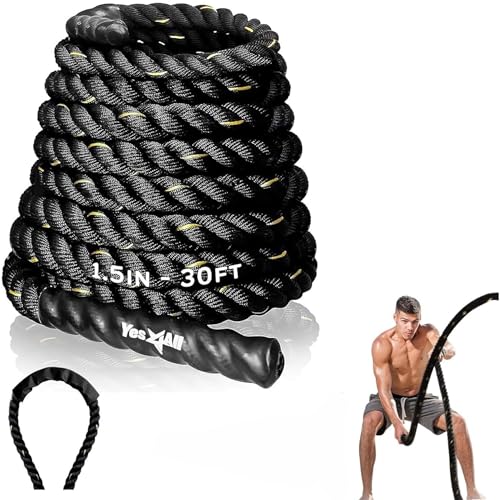
Yes4All Battle Rope
A commonly used poly dacron battle rope available in multiple lengths and thicknesses, suited to both home and commercial training setups.

Titan Fitness Battle Rope
A heavier gauge battle rope option often chosen for more advanced conditioning work where a thicker rope increases the resistance of each wave.
Common questions
Do battle ropes build muscle or just burn calories?
Both to some degree; the sustained tension builds some muscular endurance in the shoulders, grip, and core, while the overall intensity also drives a significant calorie burn through elevated heart rate.
Why do my legs feel sore after a battle rope workout?
Most battle rope drills are performed from a held athletic squat stance, so the quads and glutes are under constant isometric load throughout each set, which explains soreness even though the arms are doing the visible motion.
Can battle ropes replace cardio machines like a treadmill?
They can serve as a substitute for interval style cardio in short bursts, but they’re less practical for sustained steady state cardio over long durations compared to a treadmill or bike.
Is battle rope training good for beginners?
Yes, with shorter work intervals and lighter rope thickness, though beginners should expect the shoulders and grip to fatigue quickly at first until conditioning builds.
How long should a battle rope be for home use?
Most home setups use a 30 to 40 foot rope anchored at the midpoint, giving two 15 to 20 foot working ends, though shorter ropes around 20 feet total work in more confined spaces.
Does rope thickness change the difficulty of the workout?
Yes, a thicker rope is heavier and harder to whip into a clean wave, increasing the resistance and muscular demand compared to a thinner rope at the same wave speed.
Can battle ropes cause lower back pain?
They can if the core isn’t engaged properly, since the reactive force from each wave needs to be absorbed by a braced trunk; poor form shifts that load onto the lower back instead.
What muscles do battle ropes target the most?
Shoulders, forearms, and grip see the most direct work, while the core and lower body are engaged throughout for stabilization, making it a genuinely full body movement rather than an isolated one.
How do you anchor a battle rope at home?
Most home users loop the midpoint around a secured pole, heavy furniture leg, or a dedicated anchor point bolted to a wall or floor, since the anchor needs to hold against significant repeated force.
Are battle ropes effective for weight loss?
They can contribute to weight loss as part of an overall calorie deficit routine, since the high intensity drives a meaningful calorie burn, though no single exercise causes fat loss on its own without a broader diet and activity approach.
How often can you train with battle ropes each week?
Two to four sessions per week is common for most people, with rest days between to let the shoulders and grip recover from the repetitive strain.
Do battle ropes help with grip strength?
Yes, sustained gripping under tension is a direct byproduct of most battle rope drills, making it a reasonable secondary tool for building grip endurance.
What’s the difference between alternating waves and double waves on a battle rope?
Alternating waves move one arm at a time in a continuous rhythm, while double waves move both arms together, which tends to demand more core and shoulder power per rep but at a slower pace.
Can battle rope training be modified for shoulder injuries?
It can be modified with lighter rope, shorter intervals, and smaller wave amplitude, but anyone with an active shoulder injury should get clearance from a physical therapist or doctor before resuming, since the shoulder joint is under repeated load throughout the exercise.
Do battle ropes require a lot of space to use safely?
A clear area roughly the length of the rope’s working ends plus some swing room on each side is recommended, since the rope moves unpredictably at speed and can strike nearby objects or people.
Can battle rope training be combined with other exercises in one circuit?
Yes, it’s commonly paired with bodyweight moves like squats, burpees, or kettlebell swings in interval circuits specifically because it adds a full body conditioning element without needing a transition to different equipment.
Is it normal to feel out of breath quickly during a battle rope set?
Yes, the combination of continuous upper body movement and sustained lower body bracing raises heart rate quickly, which is why even experienced athletes often find short battle rope intervals more taxing than expected.
The bottom line
The arm burn from a battle rope session is real, but it’s not the whole story. The core and legs are doing continuous stabilizing work the entire time, which is exactly what makes it a legitimate full body conditioning tool rather than a glorified arm workout with extra noise.
Derek Holt
Derek has a background coaching recreational and amateur athletes and has worked the sales floor at specialty fitness retailers. He focuses on equipment durability, ergonomics and realistic use cases rather than marketing claims.