How to Pick a Battle Rope That Fits Your Space
POWER GUIDANCE Battle Rope wins on braid density, holding a round profile through months of slams. Yes4All Battle Exercise Training Rope matches its 30, 40 and 50 foot sizing with wider stock availability. Amazon Basics Battle Exercise Training Rope suits anyone still deciding whether rope training sticks.
POWER GUIDANCE Battle Rope is the pick for a garage gym with room to fold a 40 foot rope. Tightly braided poly dacron keeps its round shape instead of flattening at the anchor loop, and heat shrink grips stay sealed where tape peels. No sleeve ships in the box, so concrete sessions will chew the midpoint.
Length dictates floor space and diameter dictates who can hold on, which is why two ropes with identical listings suit very different buyers. We compared stated diameters, available lengths, braid density, handle finish and whether an anchor or sleeve arrives in the box, alongside owner feedback on fraying. Ropes bundling a wall anchor ranked higher, since most home garages offer nothing fixed to wrap around.
Our top picks
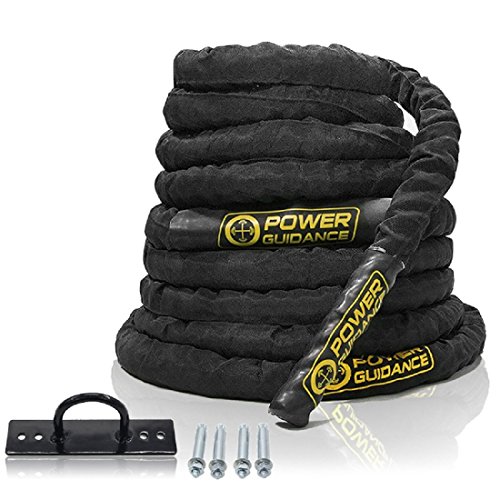
POWER GUIDANCE Battle Rope
Triple strand poly dacron is braided tightly enough to keep a round cross section through heavy slams. Heat shrink handles replace the tape that peels off cheaper ropes within weeks. Sizing spans 30, 40 and 50 feet in both 1.5 and 2 inch diameters, which covers beginners and grip specialists from one listing.
Pros
- Tight braid resists flattening at the anchor loop
- Heat shrink grips stay sealed under repeated slams
- Six size combinations across two diameters
Cons
- Ships without a protective sleeve for concrete
- Two inch version is awkward to reposition alone
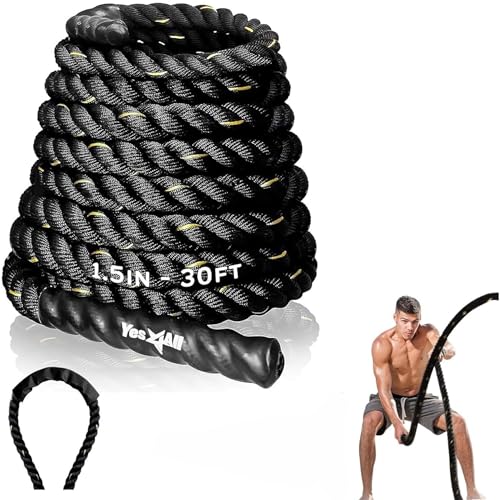
Yes4All Battle Exercise Training Rope
Same three lengths and two diameters as the boutique ropes, from a brand that moves far higher volume. Poly dacron fibre sheds water, so a damp garage or shed will not rot it. Owners report the wrapped grip ends working loose earlier than heat shrink handles do.
Pros
- Full 30 to 50 foot range in both diameters
- Water shedding fibre survives damp storage
- Stock stays available when other sizes sell out
Cons
- Wrapped grip ends loosen with heavy use
- Braid sits looser than the premium ropes
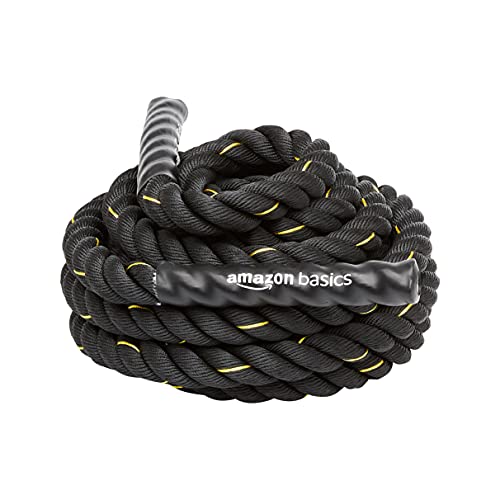
Amazon Basics Battle Exercise Training Rope
Plain poly dacron with taped ends and nothing else in the box. Waves, slams and alternating circles all work, which covers the first few months of any rope programme. Anyone training outdoors should add a sleeve separately, because abrasion starts at the anchored midpoint.
Pros
- Simplest way to find out if rope training suits you
- Standard sizing matches published interval programmes
- No hardware or coating that can fail
Cons
- Taped ends fray earlier than heat shrink handles
- Neither anchor nor sleeve is supplied

Garage Fit Battle Rope with Anchor Kit
An anchor strap in the box solves the common garage problem of having no post, rack or beam to loop around. Nylon sleeve shields the midpoint, exactly where concrete edges begin sanding the braid. Rope underneath is standard poly dacron in the usual diameters and lengths.
Pros
- Wall or floor anchor removes the need for a fixed post
- Sleeve protects the wear point from day one
- One purchase covers rope, anchor and sleeve
Cons
- Mounting needs a stud or solid masonry wall
- Requires a drill and setup time before the first session

Onnit Battle Ropes
Built for commercial floors where dozens of members share one rope each week. Thicker braid and reinforced ends absorb repeated slamming onto rubber matting. Weight is real, especially at 2 inch, so grip endurance runs out early for newcomers.
Pros
- Holds up under shared gym floor use
- Reinforced ends resist fraying behind the handles
- Heavier feel suits advanced conditioning intervals
Cons
- Too heavy to be encouraging as a first rope
- No 30 ft option for small rooms

Rep Fitness Battle Rope
Extra slack in the longer runs raises the work per wave, which suits timed conditioning intervals. Diameter stays consistent end to end, so a wave carries all the way to the anchor instead of dying halfway. Folded in half, a 50 foot rope still claims around 25 feet of clear floor.
Pros
- Longer runs add workload without adding diameter
- Even diameter carries the wave to the anchor
- Sealed ends hold the braid together
Cons
- Wants roughly 25 ft of clear floor at 50 ft
- Awkward to carry outdoors and back each session

Profect Sports Pro Battle Rope
A nylon sleeve ships alongside the rope, which decides whether asphalt sessions cost you one season or several. Poly dacron dries after rain without holding water weight. Grip thickness suits an average hand span, so larger hands may prefer the 2 inch option.
Pros
- Sleeve included for grass, gravel and asphalt
- Dries fast and will not rot outdoors
- Comfortable diameter for average hand size
Cons
- Sleeve adds drag where the rope turns at the anchor
- Handle finish is plainer than heat shrink grips
How to pick the right one
What to look for in a battle rope Three specs decide this purchase: material, diameter and length. Poly dacron is the default because it resists water, sheds grit and does not leave fibres in your palms the way manila does. Diameter sets grip demand, with 1.5 inch working for most adults and 2 inch reserved for dedicated grip work. Length drives both workload and floor space, since a rope anchors at its midpoint and doubles back toward you.
How much floor space a 30, 40 or 50 foot rope needs Halve the stated length to get your working distance. Roughly 15 feet of clear floor suits a 30 foot rope, 20 feet suits a 40, and 25 feet suits a 50. Headroom only matters for overhead slams, where arms extend fully above the head. Most two car garages settle at 30 or 40 feet once shelving and a parked car eat into the run.
Anchoring a rope in a garage, gym or park Squat rack uprights, fixed posts and mounted wall anchors all work, provided the loop cannot ride upward under load. Wrap the midpoint instead of knotting it, because a knot concentrates wear into one spot and shortens the rope. Sliding a nylon sleeve over that midpoint stops concrete edges from sanding the braid. Outdoors, run a strap around the trunk and clip the rope to that, since bark strips an outer braid within weeks.
Best battle rope for beginners, conditioning and grip training Beginners last longer on a 1.5 inch rope at 30 or 40 feet, because grip fatigue otherwise ends the set before the lungs do. Conditioning athletes gain from 50 feet, where added slack forces more work into every wave. Grip specialists step up to 2 inch and accept shorter working sets in exchange. Older trainees and anyone returning from injury should stay at 1.5 inch, favouring alternating waves over double arm slams.
Compared at a glance
| # | Model | Material | Best for | Score | Price |
|---|---|---|---|---|---|
| 1 | POWER GUIDANCE Battle Rope | Triple strand poly dacron | Best overall | 9.4 | Check price |
| 2 | Yes4All Battle Exercise Training Rope | Poly dacron | Best value | 9.2 | Check price |
| 3 | Amazon Basics Battle Exercise Training Rope | Poly dacron | Best budget | 9.0 | Check price |
| 4 | Garage Fit Battle Rope with Anchor Kit | Poly dacron | Best for home gyms | 8.8 | Check price |
| 5 | Onnit Battle Ropes | Poly dacron | Best for heavy training use | 8.5 | Check price |
| 6 | Rep Fitness Battle Rope | Poly dacron | Best for long distance waves | 8.3 | Check price |
| 7 | Profect Sports Pro Battle Rope | Poly dacron | Best for outdoor sessions | 8.0 | Check price |
Frequently asked questions
What length battle rope should you buy?
Choose 30 feet for a tight garage and 40 feet as the general purpose size. Go to 50 feet only with about 25 feet of clear floor and a conditioning goal.
Is a 1.5 inch or 2 inch battle rope better?
A 1.5 inch rope suits most adults and allows longer sets before the hands give out. Pick 2 inch when grip strength itself is the training target.
How much floor space do battle ropes need?
About half the stated length, because the rope anchors at its midpoint. That puts a 40 foot rope at roughly 20 feet of clear run.
Can you use a battle rope without an anchor?
Yes. Loop the midpoint around a squat rack upright, a fixed post or a pair of heavy kettlebells. A dedicated strap is safer, since it stops the loop riding upward.
Can battle ropes be used outdoors?
Poly dacron handles rain and dries without rotting, so outdoor use is fine. Fit a nylon sleeve first, because asphalt and concrete abrade the midpoint fast.
Do battle ropes help with fat loss?
They raise heart rate quickly with low joint impact, which makes them useful for short interval work. Diet still drives the result more than any single exercise.
How do you stop a battle rope from fraying?
Fit a sleeve at the anchor point and train on rubber matting or grass instead of bare concrete. Never knot the midpoint, since knots concentrate wear.
Poly dacron vs manila battle rope, which lasts longer?
Poly dacron lasts longer. It resists water, sheds no fibres into your hands, and survives outdoor use, while manila absorbs moisture and eventually rots.
Which battle rope is best for beginners?
A 1.5 inch rope at 30 or 40 feet, such as the Yes4All or Amazon Basics option. Both keep grip demand manageable while endurance builds.
The bottom line
POWER GUIDANCE Battle Rope earns the recommendation for a home garage, since its dense braid and heat shrink handles outlast the taped ends that fail first on budget ropes. Buyers facing bare walls with no rack to wrap should take the Garage Fit kit instead, which arrives with the anchor and sleeve sorted. For a rope shared across a gym floor every week, Onnit keeps its shape longest.
Derek Holt
Derek has a background coaching recreational and amateur athletes and has worked the sales floor at specialty fitness retailers. He focuses on equipment durability, ergonomics and realistic use cases rather than marketing claims.