How Often Should You Replace Sandpaper Grit?
Sandpaper does not wear out on a schedule measured in days or number of passes. It wears out when the abrasive particles dull or clog, which you can tell by touch, by how much pressure you suddenly need, and by what the dust looks like. Coarser grits used on soft wood or paint tend to load up and die fastest, while fine grits on hard material last the longest before glazing over.
What a worn-out sheet actually feels like
A fresh sheet of sandpaper has a rough, almost sharp texture you can feel by dragging a fingernail across it. Once the abrasive particles have sheared off or rounded over, the same sheet feels noticeably smoother and starts to slide across the surface instead of biting into it. That slide, not a set number of strokes, is the real signal a sheet is done.
Why the grit number changes how fast wear happens
Lower grit numbers like 60 or 80 use larger, more aggressive abrasive particles that remove material fast but also fracture and dull faster under pressure. Higher grit numbers like 220 or 320 use smaller particles that resist dulling longer, but they clog with fine dust and resin far more easily than they wear down mechanically, so a clogged fine sheet can look used up long before the abrasive itself is actually spent.
Material being sanded matters more than the grit itself
Sanding resinous softwood like pine or sanding through old paint gums the sheet up with sticky residue almost immediately, sometimes within a minute of contact. Sanding bare hardwood or metal wears the abrasive down through friction instead, which is a slower process but eventually flattens the particles the same way. The failure mode is different even when the grit number is identical.
The practical signs it is time to swap sheets
Watch for four things: the surface starts to shine instead of looking dull and cut, you find yourself pressing harder to get the same result, the workpiece starts to heat up or show light burn marks, and the dust coming off changes from a fine even powder to clumpy or discolored debris. Any one of those is a clearer signal than counting strokes.
You can extend a sheet’s useful life
Clogged grit, especially on orbital sander discs, can often be revived by rubbing a crepe rubber cleaning stick or even a dry piece of scrap wood across the clogged areas to knock debris out of the particles. Sanding with a dust collection attachment or vacuum sander also keeps resin and fine dust from re-depositing on the sheet mid-job, which noticeably extends how long one disc lasts.
Buying and storing sandpaper efficiently
Multi-grit variety packs are usually cheaper per sheet than buying single grits individually, and keeping a small stock of the grits you reach for most, typically 120 and 220 for general woodworking, prevents a mid-project scramble. Stored sandpaper can also degrade over years from humidity softening the backing or the adhesive bonding the grit, so very old stock is worth test-sanding a scrap piece before trusting it on a real project.
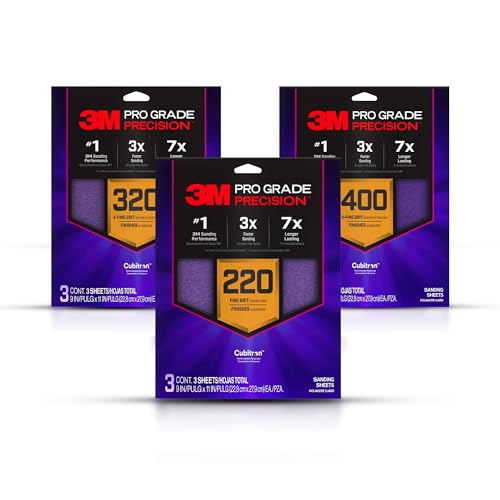
3M Pro Grade Precision Sanding Sheets, Assorted Grit
A widely available multi-grit sandpaper pack covering coarse through fine grits for general woodworking and finishing work.

Gator Finishing Sandpaper Multi-Pack
A budget-friendly assorted sandpaper pack commonly used for hand sanding and small DIY touch-up jobs.
Good to know
How do you know sandpaper is too worn to keep using?
The clearest sign is that it starts sliding smoothly across the surface instead of biting into it, usually paired with a shinier look on the material being sanded and noticeably less dust coming off per pass.
Why does sandpaper on paint wear out faster than on bare wood?
Paint and old finish soften slightly under friction heat and gum up the spaces between abrasive particles, which clogs the sheet mechanically long before the particles themselves have actually dulled.
Can you clean and reuse clogged sandpaper?
Yes in many cases. Rubbing a crepe rubber cleaning stick or a dry scrap of wood across a clogged area knocks loose debris out from between the particles and can restore a surprising amount of cutting ability.
Does higher grit sandpaper last longer than lower grit?
It depends on the failure mode. Fine grit resists mechanical dulling longer but clogs with dust faster, while coarse grit dulls mechanically sooner but clogs less, so neither is universally longer lasting.
Is it normal for sandpaper to shed grit particles while sanding?
A small amount of shedding is normal, especially on cheaper paper backing, but heavy shedding that leaves visible grit debris on the workpiece usually means the adhesive bonding the particles is failing.
Why does sandpaper heat up and smell while sanding?
Friction between a dulling or clogged sheet and the material generates more heat than a sharp sheet does, and on wood that heat can scorch resin or sap, which produces a faint burning smell.
Should you use a brand new sheet for every project?
Not necessarily. A sheet with moderate wear is often fine for rough shaping or earlier sanding passes, and it makes sense to save genuinely fresh sheets for the final fine-grit pass where cut quality matters most.
Does wet sanding make sandpaper last longer?
Wet sanding with water as a lubricant on wet-dry paper reduces heat buildup and helps flush away debris, which does extend usable life for fine-finish work on things like automotive clear coat or metal.
Why do orbital sander discs wear out at the edges first?
The outer edge of a round disc travels a longer path per rotation than the center, so it contacts more material per second and tends to dull or clog before the middle of the disc does.
Can old stored sandpaper go bad even if it was never used?
Yes. Humidity can soften the paper backing or weaken the adhesive holding the grit in place over years of storage, so very old unused sheets sometimes shed grit or tear before they even get a chance to dull.
Does sanding metal dull sandpaper faster than sanding wood?
Generally yes, because metal is harder and generates more friction heat per pass, which wears down abrasive particles faster than the softer resistance wood typically offers.
Is it worth buying a dedicated sandpaper cleaning stick?
For anyone doing regular sanding with an orbital or random orbit sander, yes, since it is inexpensive and can meaningfully extend the life of discs that would otherwise get tossed after clogging.
How many passes can one sheet of sandpaper realistically handle?
There is no fixed number since it depends entirely on grit, material, and pressure, which is exactly why checking the sheet’s feel and the dust it produces is a more reliable gauge than counting strokes.
Does the brand of sandpaper affect how long a sheet lasts?
Yes, within reason. Higher-quality backing and better adhesive bonding of the abrasive particles generally means a sheet holds its cutting ability longer before particles shed or dull compared to very cheap generic sheets.
Why does fresh sandpaper feel more aggressive than a used sheet?
New abrasive particles have sharp, uneroded edges that bite into material efficiently, while use rounds those edges off over time, which is exactly the mechanical process that eventually makes a sheet feel smooth instead of grabby.
Can you tell sandpaper is worn out just by the sound it makes?
Many experienced woodworkers can, since a sharp sheet tends to produce a slightly coarser scratching sound while a worn or clogged sheet sounds smoother and quieter against the same material.
Is it better to switch grits often or sand longer with one grit?
Following the proper grit progression, skipping no more than one step at a time, generally produces a better finish than over-relying on a single grit, and it also reduces how long any one sheet has to work before being retired.
Does humidity in a workshop affect how fast sandpaper wears?
High humidity can soften paper backing over time and cause fine dust to clump rather than clear away from the sheet, which effectively speeds up how fast a sheet clogs during use.
Final word
There is no clock running on a sheet of sandpaper, only a feel and a look that change as the abrasive wears down or clogs. Learning to read the surface and the dust instead of counting strokes will get more honest life out of every sheet, and it is a cheaper habit than replacing paper on a fixed schedule that has nothing to do with how it is actually being used.
Jake Monroe
Jake worked as a residential contractor for over a decade before shifting to full-time writing. He evaluates power tools, hand tools and workshop gear through the lens of someone who has actually used them on job sites, not just read the box.


