How to Choose a Quilting Ruler for Accurate Rotary Cuts
The Omnigrid 6 x 24 Inch Ruler handles strip cutting and squaring with double-line markings visible on dark fabric. The Olfa Frosted Advantage Ruler matches that accuracy at a lower cost. Quilters on a budget can rely on the Dritz Quilting 3-in-1 Ruler for basic squaring and hemming.
Quilters cutting long strips and bias binding get the most from the Omnigrid 6 x 24 Inch Ruler, thanks to double-line markings readable on dark fabric. Its 24-inch length, though, feels awkward for trimming small blocks.
Markings, acrylic thickness, and grip vary more between ruler brands than most buyers expect, and a ruler that slips mid-cut can ruin a seam allowance. We compared listed dimensions and material thickness, then checked owner feedback on accuracy and non-slip performance across seven current Amazon listings.
The top picks, ranked

Omnigrid 6 x 24 Inch Ruler (R6X24)
Full fabric-width strips and long bias-binding cuts finish in a single pass on this ruler. Double-line markings in black and yellow stay readable on both light and dark fabric. At 3mm thick, the acrylic resists blade nicks better than thinner rulers.
Pros
- Double-line markings read clearly on dark fabric
- 3mm acrylic holds up to daily rotary cuts
- 45 and 60 degree lines cover common bias angles
Cons
- 24-inch length feels awkward for trimming small blocks
- No built-in grip strip, so it can shift on slick fabric

Olfa Frosted Advantage Ruler 6 x 24 Inch (RA-624)
A frosted acrylic surface cuts glare under bright sewing-room lighting, keeping lines easier to track. Markings run in a single black grid rather than double lines, which keeps the price below premium long rulers. At 2.5mm, it runs slightly thinner than the Omnigrid but still holds a straight edge for rotary cuts.
Pros
- Frosted finish cuts glare under overhead lighting
- Costs less than double-line rulers of the same size
- Etched numbers resist rubbing off with handling
Cons
- Single-line markings are harder to read against black fabric
- No non-slip coating on the back

Creative Grids 6.5 x 12.5 Inch Non-Slip Ruler (CGR6122)
Embedded silicone-like dots on the underside grip fabric during rotary cuts, cutting down on mid-line slipping. At 6.5 by 12.5 inches, it suits trimming fat quarters and squaring individual blocks rather than full-width strips. Orange and black double-vision markings show up against most quilting cottons.
Pros
- Non-slip dots hold position without a mat clip
- Double-vision markings work on light and dark fabric
- Compact size stores flat in a drawer
Cons
- Too short for full fabric-width strip cuts
- Non-slip dots can pick up lint over time

Quilters Select Non-Slip Ruler 6.5 x 24 Inch
An extra half-inch of width over a standard 6-inch ruler covers wider borders and sashing without repositioning mid-cut. A printed Positioning Guide grid helps align the ruler with seam lines on pieced blocks. A non-slip strip along one edge keeps it from creeping during long squaring cuts.
Pros
- 6.5-inch width squares wide borders in fewer passes
- Positioning guide helps align seams on pieced tops
- Non-slip edge strip resists creeping
Cons
- Larger size needs a full-length cutting mat
- Costs more than a standard 6 x 24 inch ruler

June Tailor Shape Cut Plus Ruler System
A sliding stop attachment locks in a chosen strip width, so repeat cuts land at the same measurement each time. Rubber grip strips along the base cut down on slipping for quilters still building rotary-cutting confidence. Removing the stop turns it into a standard 6 x 24 inch ruler.
Pros
- Adjustable stop prevents repeat measuring errors
- Rubber grips reduce slipping for new rotary cutters
- Works as a plain ruler once the stop is detached
Cons
- Stop hardware adds bulk compared to a flat ruler
- 1/4-inch markings are less precise than 1/8-inch grids

Dritz Quilting 3-in-1 Multi-Purpose Ruler
A straightedge, hem gauge, and right-angle square combine in one 6 x 12 inch tool. Small projects like table runners or doll quilts suit it better than bed-size work. Center-finding lines help square up blocks without a separate tool.
Pros
- Combines three tools in one low-cost ruler
- Compact size stores easily in a sewing kit
- Center-finding lines simplify squaring small blocks
Cons
- Too small for cutting long strips or borders
- No non-slip backing
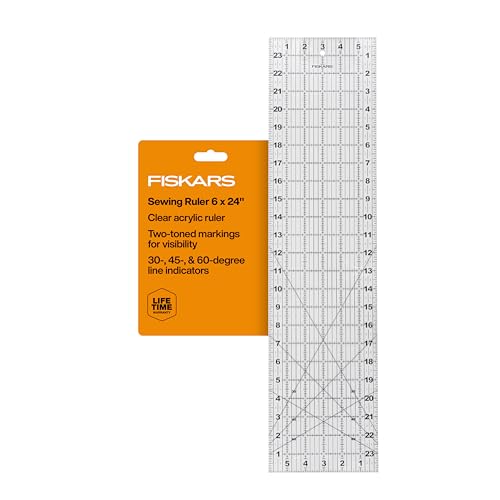
Fiskars Non-Slip Ruler 6 x 6 Inch
Half-square triangles and small blocks trim cleanly on this 6 x 6 inch square, no full-size cutting mat required. Non-slip backing keeps it steady on smaller work surfaces. Diagonal lines built into the grid handle bias trimming on pieced squares.
Pros
- Compact enough for travel sewing kits
- Non-slip backing holds steady on small mats
- Diagonal lines speed up bias trimming
Cons
- Too small for strip cutting or squaring large quilts
- Limited to one fixed size for all cuts
How to choose
What to look for in a quilting ruler Acrylic thickness determines how well a ruler holds up to daily rotary cuts. Most quality rulers run 2.5mm to 3mm thick, resisting nicks from the blade. Markings matter just as much as material, since double-line grids in contrasting colors stay visible on light and dark fabric. Single-color print can disappear against black or navy backing. Grip coatings or embedded dots keep a ruler from sliding mid-cut, protecting the seam allowance underneath.
Matching ruler size to the cut you’re making Long 6 x 24 inch rulers handle full-width strips and bias binding in one pass. Shorter rulers around 6.5 x 12.5 inches suit trimming fat quarters and squaring individual blocks. Small 6 x 6 inch squares work best for half-square triangles and travel kits, since they fit inside a project bag. Quilters piecing bed-size quilts often keep two sizes on hand instead of forcing one ruler to do every job.
Best for beginners vs experienced quilters New quilters benefit from a built-in stop or grip strip, since these lock strip width and cut down on measuring mistakes. The June Tailor Shape Cut Plus system adds that guide directly onto a 6 x 24 inch ruler. Experienced quilters often prefer a plain frosted ruler without extra hardware, since it lies flatter against fabric. Non-slip dot patterns, like those on Creative Grids rulers, suit both skill levels because they stop movement without changing how the ruler reads.
Caring for acrylic rulers and rotary blades Acrylic scratches when stored loose in a drawer alongside scissors or pins. Flat storage in a case or hanging rack keeps edges true for accurate cuts. Heat warps acrylic, so a ruler left in a hot car can bow slightly and throw off measurements. Pair any ruler with a sharp rotary blade, since a dull blade drags against the edge and chips the plastic over repeated use.
The lineup, side by side
| # | Model | Size | Best for | Score | Price |
|---|---|---|---|---|---|
| 1 | Omnigrid 6 x 24 Inch Ruler (R6X24) | 6 x 24 inches | Best overall | 9.4 | Check price |
| 2 | Olfa Frosted Advantage Ruler 6 x 24 Inch (RA-624) | 6 x 24 inches | Best value | 9.1 | Check price |
| 3 | Creative Grids 6.5 x 12.5 Inch Non-Slip Ruler (CGR6122) | 6.5 x 12.5 inches | Best for precision cuts | 8.9 | Check price |
| 4 | Quilters Select Non-Slip Ruler 6.5 x 24 Inch | 6.5 x 24 inches | Best for squaring large quilts | 8.6 | Check price |
| 5 | June Tailor Shape Cut Plus Ruler System | 6 x 24 inches with adjustable stop | Best for beginners | 8.3 | Check price |
| 6 | Dritz Quilting 3-in-1 Multi-Purpose Ruler | 6 x 12 inches | Best budget | 8.1 | Check price |
| 7 | Fiskars Non-Slip Ruler 6 x 6 Inch | 6 x 6 inches | Best for small blocks and travel | 8.0 | Check price |
Common questions
What size quilting ruler should I buy first?
A 6 x 24 inch ruler covers the widest range of tasks, from strip cutting to squaring blocks. Add a smaller 6.5 x 12.5 inch or 6 x 6 inch ruler later for trimming individual blocks.
How do quilting rulers differ from regular rulers?
Quilting rulers use thick acrylic that resists rotary blade nicks and include seam-allowance markings, angle lines, and grid patterns that a standard ruler lacks.
Are non-slip quilting rulers worth it?
Owners report fewer shifted cuts with non-slip dots or coatings, especially on slippery fabrics like batiks or silks. Standard rulers cost less but need more careful hand pressure.
Can I use a quilting ruler with any rotary cutter?
Yes, acrylic rulers work with standard 45mm and 60mm rotary cutters. A dull blade drags against ruler edges and can chip the acrylic over time.
What is the best quilting ruler for beginners?
Rulers with a sliding stop or grip strip, such as the June Tailor Shape Cut Plus system, reduce measuring errors while new quilters learn to read grid lines.
6 x 24 vs 6.5 x 24 ruler, which is better?
The extra half inch on a 6.5 x 24 inch ruler covers wider borders and sashing in fewer passes, useful for bed-size quilts rather than small blocks.
Is a frosted or clear acrylic ruler better for cutting?
Frosted acrylic reduces glare under bright sewing-room lighting, which helps some quilters track lines. Clear acrylic shows the fabric pattern underneath more directly.
How do you clean and store acrylic quilting rulers?
Wipe rulers with a damp cloth and mild soap, then dry flat. Store them flat or hanging rather than stacked loosely with pins or scissors that can scratch the surface.
Which quilting ruler works best for cutting bias binding?
The Omnigrid 6 x 24 Inch Ruler includes printed 45 and 60 degree diagonal lines, which line up bias strips without extra measuring.
Final word
The Omnigrid 6 x 24 Inch Ruler takes the top spot for its balance of size, double-line visibility, and long-strip accuracy that fits most quilting workflows. Quilters on a tighter budget should pick the Dritz Quilting 3-in-1 Ruler instead, since it covers basic squaring and hemming at a lower cost. Anyone squaring queen or king-size quilt tops will get steadier results from the wider Quilters Select 6.5 x 24 Inch Ruler, and beginners still building confidence should start with the guided June Tailor Shape Cut Plus system.
Jake Monroe
Jake worked as a residential contractor for over a decade before shifting to full-time writing. He evaluates power tools, hand tools and workshop gear through the lens of someone who has actually used them on job sites, not just read the box.