How Does a Moisture Meter Actually Detect Water Inside Walls?
Most handheld moisture meters used on walls work one of two ways. Pin-type meters push two small metal probes into the surface and measure electrical resistance between them, since wetter material conducts electricity better, so resistance drops as moisture rises. Pinless meters instead use electromagnetic sensing to read moisture content a short distance beneath the surface without puncturing it. Neither type actually senses liquid water directly, both infer moisture content from how it changes the material’s electrical properties.
Pin-type meters and electrical resistance
Two small probes are pressed or lightly driven into the drywall or wood surface, and the meter runs a small current between them while measuring resistance. Wetter material shows lower resistance because water conducts electricity far better than dry wood or gypsum.
Pinless meters and electromagnetic sensing
Instead of probes, these meters generate a low-frequency electromagnetic field a short distance into the wall and measure how that field is disturbed by moisture content, allowing a non-invasive scan across a surface with no holes left behind.
Why depth and material calibration both matter
Pinless meters typically only read accurately to a limited depth, often under an inch, so moisture sitting deeper inside a wall cavity can go undetected, and most meters offer separate calibration scales for wood versus drywall or concrete since each material’s baseline electrical behavior differs.
Why a reading is relative, not an exact percentage of water
Meters display a moisture value calibrated against standard reference material densities, so an unusual wall material, like certain insulation-backed panels or treated lumber, can throw off the accuracy of a reading calibrated for ordinary drywall or framing lumber.
Why professionals often use both types together
A pinless scan quickly surveys a large wall area to find suspicious zones, then a pin meter confirms and quantifies moisture at that specific spot, sometimes probing slightly deeper to judge whether moisture is only at the surface or has soaked further into the material.
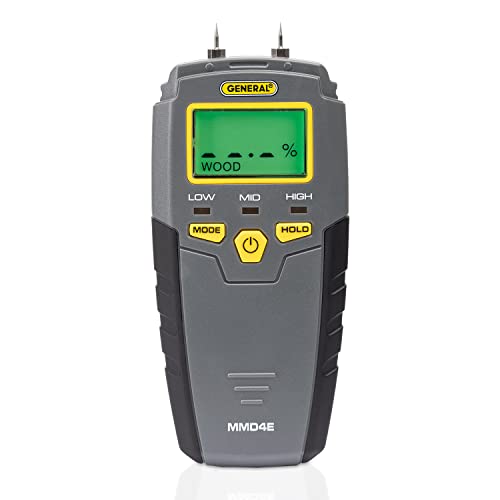
General Tools MMD4E Digital Moisture Meter
A common pin-type moisture meter used on both wood and building materials, illustrating the resistance-based method described above.

Klein Tools ET140 Pinless Moisture Meter
A pinless meter that scans walls non-invasively using electromagnetic sensing, often used for a quick first survey before any probing.
Questions worth asking
Can a moisture meter detect water behind drywall before it reaches the surface?
A pinless meter can often pick up elevated moisture a short distance behind the surface before it becomes visible, which is exactly why they are useful for early leak detection.
Does a pin-type moisture meter leave permanent holes in the wall?
Yes, technically, though the pin holes are tiny, generally no more noticeable than a small nail hole, and easy to patch.
Why do moisture meters give different readings on wood versus drywall at the same actual moisture level?
Each material has a different baseline electrical resistance and dielectric behavior, so meters use separate calibration scales to translate the raw reading into an accurate moisture percentage for that specific material.
Can a moisture meter read through tile or paint?
Pinless meters can often sense reasonably well through a painted surface, but through tile, thick coatings, or metal-backed surfaces, accuracy drops significantly since the electromagnetic field cannot read through those as reliably.
Is a higher moisture reading always a sign of an active leak?
Not necessarily. It indicates elevated moisture content at that moment, which could be an active leak, residual moisture from a recent repair, high ambient humidity, or condensation, so a reading is a starting point for further investigation rather than a standalone diagnosis.
Do moisture meters work on concrete walls the same way as drywall?
Most quality meters include a concrete-specific scale, since concrete’s normal moisture range and electrical behavior differ substantially from wood or gypsum.
Why does the reading change if I move the meter just an inch to the side?
Moisture in walls is rarely perfectly even, so small localized variations in material density, embedded objects like nails, or uneven moisture spread can shift readings slightly even over a short distance.
Can a cheap moisture meter be as accurate as a professional-grade one?
Budget meters can give a reasonably reliable relative reading of wetter versus drier, but professional meters tend to offer better calibration accuracy, multiple material scales, and more consistent sensing depth.
Does temperature affect moisture meter readings?
Yes, extreme temperatures can slightly affect a material’s electrical properties and the meter’s own circuitry, which is why many professional units include temperature compensation.
Can a pin-type meter tell how deep inside the wall the moisture actually is?
To a degree. Longer insulated pins used on some professional models allow probing at a specific depth, but a basic short-pin consumer meter mainly reads moisture right at the surface layer it penetrates.
Can a moisture meter give a false low reading even with a real leak present?
Yes, if moisture has not yet spread to where the meter is probing, or it is trapped behind a non-conductive barrier like certain vapor-retardant coatings, a nearby leak can go undetected until it spreads further.
Do metal studs or nails behind the wall interfere with pinless readings?
Yes, metal objects behind the wall can distort the electromagnetic field a pinless meter relies on, sometimes producing a falsely high or erratic reading near those spots.
How often does a moisture meter need to be recalibrated?
Most consumer meters do not need routine recalibration, but professional units are periodically checked against a known reference block, especially when accuracy matters for insurance or remediation documentation.
Can a moisture meter be used on exterior walls the same way as interior ones?
Yes, though exterior siding materials sometimes need their own calibration setting, since materials like stucco or fiber cement behave differently electrically than interior drywall.
Does the meter’s battery level affect reading accuracy?
A weak battery can occasionally cause erratic or unreliable readings on some models, so checking the battery level is a reasonable first step whenever a reading seems inconsistent.
Is there a meaningful difference between professional and consumer moisture meters in daily use?
Professional meters generally offer more consistent calibration and additional material scales, which matters most for documentation-grade inspections rather than a quick homeowner check.
Can a moisture meter help trace a leak back to its actual source?
Not directly, a meter identifies where moisture currently is, but tracing it back to its source still requires inspecting plumbing, roofing, or window flashing in the area the meter flags.
Does a moisture meter work the same on insulation as it does on drywall?
Not reliably, many insulation materials have inconsistent density and composition that make standard moisture meter calibration far less accurate than on more uniform materials like drywall or framing lumber.
Is a reading of zero proof that a wall is completely dry?
Not entirely, a very low reading strongly suggests dryness at the spot tested, but it does not rule out isolated moisture elsewhere on the same wall that the meter was not pointed at.
Does a moisture meter benefit from a reference reading taken from a known-dry area first?
Many professionals take one for comparison, since a reading is often more meaningful when compared against a known-dry baseline on the same material rather than judged in isolation.
The bottom line
A moisture meter is reading electrical behavior and inferring water content from it, not sensing liquid directly, which is why understanding its limits matters as much as the number on the display. A pinless scan to find the suspicious area followed by a pin reading to confirm it remains the most reliable approach for anyone actually tracking down a leak.
Jake Monroe
Jake worked as a residential contractor for over a decade before shifting to full-time writing. He evaluates power tools, hand tools and workshop gear through the lens of someone who has actually used them on job sites, not just read the box.