How Does a Dish Drying Rack’s Material Affect How Fast Dishes Dry?
Material changes drying speed mainly by how much it holds onto water itself and how well it lets water run off the dishes rather than pool against them. Open stainless steel wire racks drain fastest because water beads up and rolls away instead of clinging to a flat surface. Solid plastic racks and bamboo or wood racks tend to hold a thin film of moisture in grooves, joints, or grain, which slows both the rack’s own drying and, indirectly, the dishes resting on it. The tray or drainboard underneath usually matters as much as the rack material itself.
Why stainless steel wire racks dry dishes fastest
Bare stainless steel has a low tendency to hold water on its surface, so droplets bead up and roll toward the drainboard instead of spreading into a film. The open wire design also means almost every surface of a plate or bowl has airflow reaching it from multiple sides, not just the top. That combination of fast runoff and open air circulation is the main reason stainless racks consistently outperform solid designs in everyday use.
Why solid plastic racks sometimes leave dishes damp
Plastic tines and trays often have narrow grooves or seams where surface tension holds a thin bead of water in place rather than letting it run off. Those same grooves, plus the suction cup feet many plastic racks use, are common spots for mildew to develop if the rack is not wiped down regularly. The plastic itself does not absorb water, but its shape frequently traps it longer than an open wire design would.
What changes with bamboo or wood racks
Wood and bamboo have some natural absorbency, so they pull a little surface moisture off dishes on contact, which can make dishes feel drier to the touch sooner. The tradeoff is that the rack itself stays damp longer afterward, and if it is not allowed to fully air dry between uses, that trapped moisture in the grain can lead to warping, cracking, or dark staining over time. Occasional oiling helps slow that breakdown but does not eliminate it.
The drainboard and tray design matters as much as the material
A sloped tray that funnels water to a single spout clears standing water away from the rack base quickly, while a flat tray lets water pool and re-wet the bottoms of dishes sitting near it. This is often the bigger factor in total dry time, since two racks made of the same material can perform very differently depending on whether their tray actually channels water away or just collects it.
Why vinyl-coated steel racks behave differently than bare stainless
Coated wire racks protect glassware from scratching and resist the surface rust that occasionally shows up on bare steel welds, but the coating itself can hold a very thin film of water in its texture a little longer than bare metal would. In practice the difference is small, and the scratch and rust protection is usually worth the slightly slower dry time for households with a lot of glassware.
Why humidity in the kitchen can erase material differences entirely
In a humid kitchen, the surrounding air is already close to saturated, so no rack material can pull much additional moisture away from dishes no matter how well it is designed. Material differences show up most clearly in drier conditions or well-ventilated kitchens, which is why the same rack can seem to perform inconsistently between seasons or rooms.
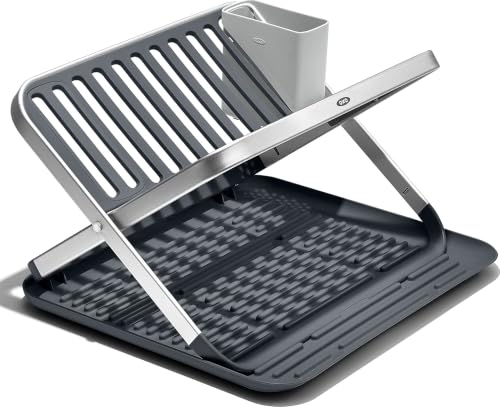
OXO Good Grips Twin Dish Rack
A steel and plastic hybrid rack with a sloped drainboard and separate utensil holder, built for sink-side counters with limited space.

simplehuman Steel Frame Dish Rack
A fully stainless steel wire rack with an attached drainboard that channels water to a spout rather than letting it pool on the counter.
Questions worth asking
Does a stainless steel rack ever rust from being wet all the time?
Fully stainless models resist rust well, but cheaper racks that are only a thin stainless coating over another metal can show rust at welds or cut edges over time, especially if they’re never fully dried.
Is a bamboo dish rack sanitary enough for daily use?
It can be, but it needs regular oiling and full air drying between uses, since the wood grain can hold enough trapped moisture to support mold growth in households with limited counter airflow.
Can a good drainboard design make up for a slower-drying material?
Yes, largely. A tray with a clear slope and a defined spout clears standing water fast enough that it often matters more than whether the rack itself is plastic, bamboo, or steel.
Why do dishes still feel damp an hour after washing no matter what rack I use?
That’s usually ambient kitchen humidity, mineral residue from hard water, or the rack sitting somewhere with poor airflow, like tucked against a wall, rather than a flaw in the rack material.
Do flexible silicone dish racks dry dishes as well as rigid wire ones?
They drain water fine, but their flatter shape gives less airflow underneath dishes compared to a raised, open wire design, so dry time tends to run a bit longer.
Does rinse aid in a dishwasher actually change how fast dishes air-dry afterward?
Yes, rinse aid reduces water’s surface tension so it sheets off glass and dishware instead of forming droplets, which noticeably speeds up air drying on any rack material.
Is a two-tier rack slower to dry than a single-tier one?
Often slightly, since water dripping from the upper tier can land on dishes in the lower tier and keep them wetter longer than if they were drying on their own.
Why does my utensil holder have holes in the bottom?
Those holes let water drain straight out the bottom instead of pooling around utensil handles, which would otherwise keep the lower ends of forks and spoons wet much longer.
Does pushing a rack flush against a wall slow down drying?
It can, since the airflow on the wall-facing side of the dishes gets restricted, trapping moist air right where it’s hardest for it to escape.
How often should a dish rack itself be cleaned?
A quick wipe weekly and an occasional vinegar soak for mineral buildup keeps grooves and feet clear, since leftover grime and limescale are what actually slow drainage over time, not the base material.
Do collapsible or foldable racks dry as well as fixed ones?
Generally yes once fully unfolded and locked flat, though hinge joints can trap a little water and are worth wiping separately.
Why does hard water leave a white film on a dish rack faster than soft water?
Minerals left behind as hard water evaporates settle into grooves and crevices, and that residue builds up over time regardless of whether the rack is plastic or metal.
Is there one dish rack material that resists both rust and mildew long term?
Fully stainless steel, not a painted or lightly coated version, holds up best against rust, and its open wire shape resists the mildew buildup that solid plastic grooves are more prone to.
Does rack color or finish affect drying speed?
No, color and finish have no meaningful effect on drying speed; what matters is the surface material’s water retention and how open or solid the design is.
Does the number of dishes on a rack at once affect how fast they dry?
Yes, overcrowding a rack blocks airflow between dishes and can leave items in the middle of a packed load noticeably wetter than ones on the outer edges.
Is it better to stand plates upright rather than lay them flat on a rack?
Yes, standing plates on their edge lets water run straight down and off instead of pooling in a shallow flat-lying dish, which speeds drying regardless of rack material.
Our take
Rack material matters less than most people assume once the drainboard design is factored in. Open stainless wire wins on raw drying speed in most kitchens, but a well-sloped tray on a plastic or bamboo rack can close most of that gap, while a flat tray on any material will leave dishes sitting in standing water regardless of what the rack itself is made from.
Dana Whitfield
Dana spent eight years buying and merchandising for a regional kitchenware retailer before moving into editorial work. She has handled thousands of SKUs across cookware, small appliances and kitchen organization, and focuses on the practical differences that matter once a product is actually in daily use.