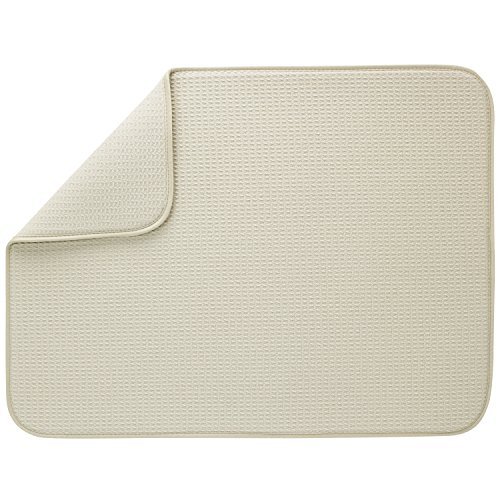
Which Dish Rack Actually Resists Rust Long Term?
OXO’s Good Grips Stainless Steel Dish Rack ranks first for full stainless construction that will not chip and rust the way coated wire does. Simplehuman’s Steel Frame Dish Rack fits households washing in batches. Better Houseware’s Roll-Up Dish Drying Rack folds flat for kitchens with no spare counter space.
OXO’s Good Grips Stainless Steel Dish Rack suits anyone tired of replacing a rusted rack every couple of years, since full stainless construction leaves no coating to chip. Its swiveling spout channels runoff into the sink, though the fixed frame will not collapse for storage. Larger households that wash in batches get more from simplehuman’s Steel Frame Dish Rack, and tight kitchens do better with the Better Houseware Roll-Up mat that stores flat in a drawer.
Rust rarely starts on a flat surface. It starts where a coating chips at a weld or a bent wire, letting water reach the bare metal underneath. Material and drainage design decide how long a rack survives, not how polished it looks in a listing photo. We compared stated materials, drainage paths and footprint, then weighed owner reports of rust, tipping, and how each rack handled heavy pots or long knives.
The top picks, ranked
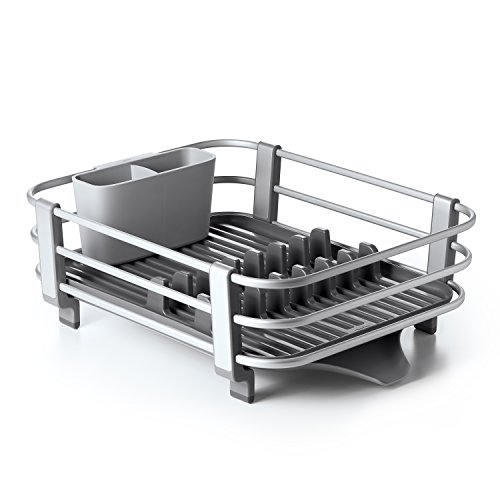
OXO Good Grips Stainless Steel Dish Rack
Full stainless steel replaces the coated wire found on cheaper racks, removing the weld points where rust typically starts. A corner spout swivels to aim runoff directly into the sink rather than pooling on the counter. Plate slots hold dishes upright while a separate flatware caddy keeps utensils sorted during drying.
Pros
- Solid stainless build eliminates chip-prone coating
- Corner spout drains water into the sink automatically
- Flatware caddy separates utensils from plates
Cons
- Costs more than coated wire alternatives
- Fixed frame does not fold down for storage

simplehuman Steel Frame Dish Rack
A wider frame and taller plate slots handle a full batch wash better than compact racks sized for a few items. Rubber-lined slots cushion glassware against the bare steel underneath. A detachable cutlery cup lifts out for separate soaking, and a built-in spout swivels toward the sink.
Pros
- Wider frame suits batch dishwashing after big meals
- Rubber-lined slots protect glassware from scratches
- Cutlery cup detaches for a separate soak
Cons
- Larger footprint eats more counter space
- Heavier than lightweight wire racks to reposition

KitchenAid Full Size Dish Rack
This full-size footprint fits a standard load of plates, bowls and glasses without dangerous stacking. Coated steel wire keeps the price below solid stainless, though the coating can chip at bend points after years of daily loading. An angled base funnels water toward a front drainage channel.
Pros
- Full-size capacity covers a standard daily dish load
- Coated wire costs less than solid stainless
- Angled base channels water toward the front
Cons
- Coating can chip at bends after years of use
- Chipped spots eventually invite rust

Umbra UDry Dish Drying Rack
Two tiers stack a drying mat beneath a smaller upper rack, fitting more into a narrow counter run than single-level designs. Silicone-coated steel resists both rust and countertop scratching. Smaller households get more use from it than large families washing bigger loads at once.
Pros
- Two-tier stacking maximizes a narrow counter run
- Silicone coating resists rust and scratching
- Built-in mat catches drips without a separate towel
Cons
- Smaller capacity than full-size racks
- Mat needs regular wiping to prevent mildew
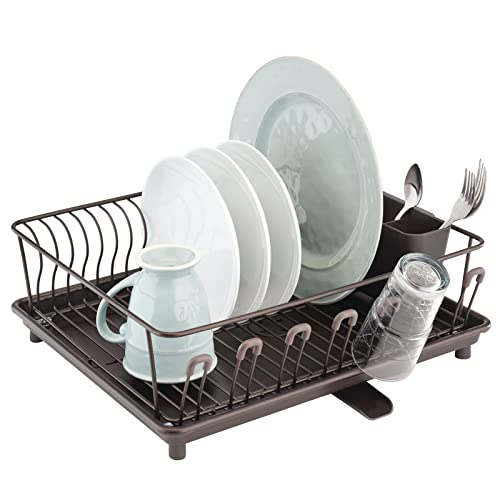
mDesign Large Kitchen Countertop Dish Drying Rack
A large wire frame covers a full dish load at a lower price than steel or stainless alternatives. Coating resists rust early on, though it runs thinner than premium racks and shows wear sooner under daily use. A separate cutlery cup and cup holders round out a basic layout.
Pros
- Lower price than steel or stainless racks
- Cutlery cup and cup holders included at no extra cost
- Large frame handles a full dish load
Cons
- Thinner coating wears faster than premium racks
- Rust risk rises once the coating chips

Polder Advantage Dish Rack
An extending drain tray slides out over the sink edge, moving water off the counter more effectively than a fixed base. Rustproof plated steel holds up under regular water exposure. The tray telescopes to fit different sink and counter widths, useful in kitchens with a nonstandard layout.
Pros
- Extending tray directs water off the counter
- Telescoping width fits nonstandard sink layouts
- Rustproof plating resists corrosion over time
Cons
- Extending mechanism adds a moving part to maintain
- Holds fewer plates than full-size racks

Better Houseware Roll-Up Dish Drying Rack
This silicone-coated wire mat rolls up completely for drawer storage, freeing the counter entirely when not in use. It works over a sink or across a counter with a towel beneath it, unlike rigid racks that need a fixed spot. Capacity depends on available counter or sink space, since there is no built-in basin.
Pros
- Rolls up flat for compact drawer storage
- Silicone coating resists rust and scratching
- Works over a sink or flat on a counter
Cons
- No built-in basin, so it needs a towel or sink beneath
- Less structured than rigid racks for tall items
How they compare
| # | Model | Material | Best for | Score | Price |
|---|---|---|---|---|---|
| 1 | OXO Good Grips Stainless Steel Dish Rack | Stainless steel | Best overall | 9.3 | Check price |
| 2 | simplehuman Steel Frame Dish Rack | Steel with rubber-lined slots | Best for large loads | 9.1 | Check price |
| 3 | KitchenAid Full Size Dish Rack | Coated steel wire | Best for everyday capacity | 8.9 | Check price |
| 4 | Umbra UDry Dish Drying Rack | Silicone-coated steel | Best compact footprint | 8.7 | Check price |
| 5 | mDesign Large Kitchen Countertop Dish Drying Rack | Coated steel wire | Best budget | 8.5 | Check price |
| 6 | Polder Advantage Dish Rack | Rustproof plated steel | Best drainage design | 8.2 | Check price |
| 7 | Better Houseware Roll-Up Dish Drying Rack | Silicone-coated stainless steel wire | Best for small kitchens | 8.0 | Check price |
Before you buy
What decides how long a dish rack lasts Rust rarely appears on a flat surface. It starts where a coating chips at a weld or bend, letting water reach bare metal underneath. Fully stainless racks skip this failure mode since there is no coating to chip in the first place. Coated wire costs less upfront but needs gentler handling to delay the same outcome.
Matching capacity to household size A household that washes throughout the day needs less capacity than one that batch-washes after big meals. Wider frames and taller plate slots suit batch washing. Compact two-tier or roll-up designs fit smaller households or kitchens with limited counter space better.
Drainage design and protecting your counter A directional spout or an extending tray moves water into the sink instead of letting it pool on the counter. Standing water damages laminate and wood surfaces over time, and it can seep into cabinets below. Flat, sloped-base racks work fine over a towel but need careful positioning to avoid runoff.
Storage for kitchens with no spare counter space Roll-up silicone mats collapse into a drawer entirely, useful where counter space is needed for food prep between meals. Rigid two-tier racks trade that flexibility for sturdier daily drying capacity. Choose based on whether the counter needs to double as workspace or stays dedicated to drying.
Good to know
What is the best material for a dish rack that will not rust?
Fully stainless steel resists rust best over years of use, since there is no coating to chip and expose the metal underneath. Coated wire racks cost less but eventually fail at the weld points.
How do you get mold off a dish rack?
Soak it in warm water with vinegar or a mild bleach solution, then scrub crevices with an old toothbrush. Dry the rack fully before the next use to slow mold from returning.
Is a roll-up dish rack good for a small kitchen?
Yes. It collapses flat for drawer storage and frees the counter completely when dishes are not drying, which suits kitchens with little permanent counter room.
Can dish racks go in the dishwasher?
Many stainless and coated wire racks are dishwasher safe, but check the product’s care label first. Some coatings and silicone parts do not tolerate a full heat cycle well.
What is the difference between coated wire and stainless steel dish racks?
Coated wire applies a plastic or rubber layer over steel, which lowers cost but can chip and rust over time. Stainless steel costs more upfront but resists rust indefinitely without any coating to fail.
How much counter space does a full-size dish rack need?
Full-size racks typically need close to two feet of counter length once drainage room is included. Compact two-tier or roll-up designs fit into a much smaller area.
Do dish racks need a mat underneath them?
Racks without a built-in basin or directional drain benefit from a towel or mat underneath to catch drips. Racks with a swiveling spout or extending tray send water into the sink instead.
How often should a dish rack be replaced?
Coated wire racks often need replacing every one to three years once rust or coating damage shows up. Solid stainless steel racks last considerably longer with routine cleaning and drying.
Dish rack vs drying mat, which dries dishes faster?
A rack holds plates upright so air moves around both sides, which dries dishes faster than a flat mat that traps moisture underneath. Mats work better for oddly shaped items that will not stand upright in a rack.
Final word
OXO’s Good Grips Stainless Steel Dish Rack is the strongest all-around pick, since full stainless construction avoids the rust that eventually undermines coated wire. Households washing in large batches should size up to simplehuman’s Steel Frame Rack instead, where the extra capacity and rubber-lined slots handle bigger loads. Anyone without dedicated counter space should skip rigid racks and choose the Better Houseware Roll-Up mat, which stores flat in a drawer between uses.
Dana Whitfield
Dana spent eight years buying and merchandising for a regional kitchenware retailer before moving into editorial work. She has handled thousands of SKUs across cookware, small appliances and kitchen organization, and focuses on the practical differences that matter once a product is actually in daily use.