Do Fuel Additives Actually Clean an Engine or Just Marketing?
It genuinely depends on which additive and what it’s targeting. Polyetheramine, or PEA, based fuel injector and intake valve cleaners have real independent testing behind them showing measurable deposit reduction, while many bargain bottles with weak concentrations add little beyond what the detergent already required in all gasoline sold in the US is doing. The honest answer is that some additives work close to as advertised, and plenty of others are overselling a modest chemical cleaning effect.
Your gas already contains some detergent, by law
All gasoline sold in the United States must meet a minimum detergent additive requirement under EPA regulation, which means a normal fill-up is already providing some baseline deposit control before any aftermarket bottle gets added. For an additive to actually matter, it needs to meaningfully exceed that baseline level, not just duplicate what’s already in the tank.
PEA chemistry is the most proven, other formulas vary widely
Polyetheramine, commonly shortened to PEA, is the most extensively studied and most effective deposit-control chemistry at removing intake valve and fuel injector deposits in independent testing, and it’s specifically the chemistry behind the TOP TIER gasoline standard that several major gas brands voluntarily exceed. Additives built around simpler solvent-based formulas generally show far less measurable cleaning effect in comparison.
What even a good additive can’t fix
A fuel additive cleans chemical deposits, it doesn’t repair a worn fuel injector, fix a failing fuel pump, or restore compression lost to actual mechanical wear inside the engine. Marketing language implying a bottle can make an engine run ‘like new’ is overselling what is, at best, a targeted deposit-cleaning product rather than a mechanical repair.
Dosing and frequency matter more than label marketing suggests
Using a concentrated dose at the label’s recommended interval, often once every several thousand miles, tends to do more measurable cleaning work than diluting a smaller amount into every single fill-up, despite some products marketing frequent light use as the ideal approach. A stronger, less frequent treatment generally gives the chemistry more concentrated contact time with deposits.
Direct injection engines have a real limitation additives can’t solve
Gasoline direct injection engines inject fuel straight into the cylinder rather than through the intake port, which means fuel additives running through the fuel system never actually wash over the intake valves the way they do in older port-injected engines. This makes GDI engines more prone to intake valve carbon buildup specifically, and fuel additives, however effective at cleaning injectors, simply can’t reach that particular deposit location.
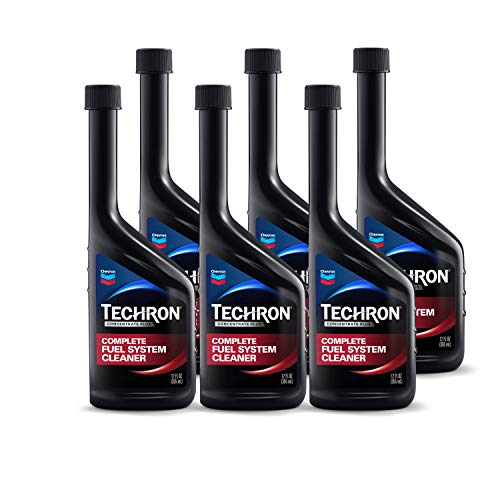
Chevron Techron Concentrate Plus Fuel System Cleaner
A PEA-based fuel system cleaner with independent testing supporting measurable deposit reduction in fuel injectors and intake systems.

Red Line SI-1 Complete Fuel System Cleaner
A concentrated fuel system cleaner commonly used as a periodic treatment rather than an every-fill-up additive, following the stronger-less-frequent dosing approach.
Common questions
How do I know if a fuel additive uses PEA chemistry?
Check the product label or safety data sheet for polyetheramine or PEA listed as an active ingredient, since manufacturers using this proven chemistry generally advertise it specifically rather than burying it in vague marketing language.
Can a fuel additive improve fuel economy noticeably?
A measurable improvement is possible if deposits were significantly restricting fuel flow or combustion efficiency beforehand, but for an engine with only mild deposit buildup, any fuel economy gain from a single treatment is usually modest at best.
Do I need a fuel additive if I only use TOP TIER gasoline?
Less urgently, since TOP TIER gasoline already includes a higher detergent additive concentration than the EPA minimum, though periodic additional treatment can still help in high-mileage engines or ones that have run on non-TOP TIER fuel for extended periods.
Can fuel additives damage an engine if used too often?
Using additives far beyond the label’s recommended frequency or concentration isn’t typically dangerous for the chemistry, but it also doesn’t add benefit and simply wastes money relative to the proper dosing schedule.
Will a fuel additive fix a rough idle or stalling issue?
Only if the rough idle is actually caused by deposit buildup on injectors or valves; if the real cause is a failing sensor, vacuum leak, or mechanical issue, an additive won’t resolve it since it only addresses chemical deposits, not mechanical faults.
Do diesel engines use the same type of fuel additives as gasoline engines?
No, diesel fuel systems use different additive chemistry targeted at diesel-specific issues like injector coking and cetane improvement, so gasoline-specific PEA additives aren’t formulated for or appropriate in diesel fuel.
Is it true that intake valve carbon buildup can’t be cleaned with any fuel additive on GDI engines?
That’s correct for additives run through the fuel system, since direct injection means fuel never contacts the intake valves; cleaning GDI intake valve deposits typically requires a separate walnut-blasting or intake cleaning service rather than any fuel additive.
How often should a fuel injector cleaner actually be used?
Most manufacturers recommend treatment every 3,000 to 5,000 miles for routine maintenance use, though some concentrated products are designed for a single stronger treatment less frequently, so following the specific product’s label is more reliable than a generic rule.
Can an old or high-mileage car benefit more from fuel additives than a newer one?
Often yes, since older engines have had more time to accumulate deposits, particularly if they’ve run on lower-quality fuel for extended periods, so a concentrated treatment can show a more noticeable effect on a higher-mileage engine than on a nearly new one.
Do fuel additives help with the check engine light coming on for misfire codes?
They can help if the misfire is deposit-related, such as a fouled injector affecting spray pattern, but a misfire caused by a worn spark plug, coil, or mechanical issue won’t be resolved by a fuel additive regardless of chemistry.
Is it worth paying more for a premium fuel additive brand?
The proven value comes from the actual chemistry, mainly PEA concentration and independent testing behind it, rather than the brand name itself, so comparing active ingredients across products is more useful than assuming a higher price always means better performance.
Can fuel additives clean carbon off spark plugs?
Not directly, since additives work through the fuel and injector system rather than contacting spark plugs, which sit in the combustion chamber; persistent spark plug fouling usually points to a separate issue like a rich fuel mixture or an oil leak rather than something a fuel additive addresses.
Do fuel additives expire or lose effectiveness in storage?
Most have a reasonably long shelf life when sealed and stored at moderate temperatures, but extreme heat or a long-opened bottle can degrade some of the active chemistry over time, so checking the manufacturer’s stated shelf life is worthwhile for older bottles.
Can using too much fuel additive at once cause any noticeable problems?
Significantly exceeding the recommended dose isn’t typically dangerous to the engine, but it doesn’t improve cleaning effectiveness proportionally either, and some users report a temporarily rougher idle immediately after an unusually large dose as looser deposits get cleared through the system.
Do fuel additives work the same in older carbureted engines as in modern fuel-injected ones?
The core deposit-cleaning chemistry works similarly, but carbureted engines have different fuel delivery pathways than injectors, so the specific deposits an additive targets, and how directly it reaches them, differ somewhat between the two fuel delivery systems.
Is there a way to verify a fuel additive actually worked without a lab test?
Not precisely, though some owners track subtle changes like smoother idle or slightly improved throttle response after a treatment, these observations are far less reliable than the independent lab testing that validates specific product chemistries like PEA.
Where this leaves you
The honest take is that fuel additives aren’t uniformly a scam or uniformly essential, the real answer depends entirely on the chemistry inside the bottle. A proven PEA-based cleaner used at the recommended dose genuinely removes measurable deposits, while a weak, diluted formula marketed for every fill-up is mostly riding on gasoline’s existing detergent requirement doing the actual work.
Tony Russo
Tony trained as an automotive technician and spent years in service and parts retail before moving into writing. He focuses on garage tools, car care products and accessories from a hands-on maintenance perspective.