Which Wheel Cleaner Actually Removes Baked-On Brake Dust?
Sonax Wheel Cleaner Full Effect dissolves bonded brake dust fastest, with a visible colour change to prove it. Adam’s Deep Wheel Cleaner is the safer pick for ceramic coated wheels. Meguiar’s Ultimate All Wheel Cleaner works best across a mixed set of finishes.
Sonax Wheel Cleaner Full Effect earns the spot in most garages, with Adam’s Deep Wheel Cleaner as the alternative for ceramic coated wheels and Meguiar’s Ultimate All Wheel Cleaner for a mixed set of finishes. Each clears bonded brake dust without heavy scrubbing.
Aggressive formulas that clear baked-on dust fastest can also etch a polished lip or dull an anodised finish if left too long. We compared published pH data, stated dwell times and iron dissolving action, then checked what owners report about long term effects on different wheel types.
What we recommend
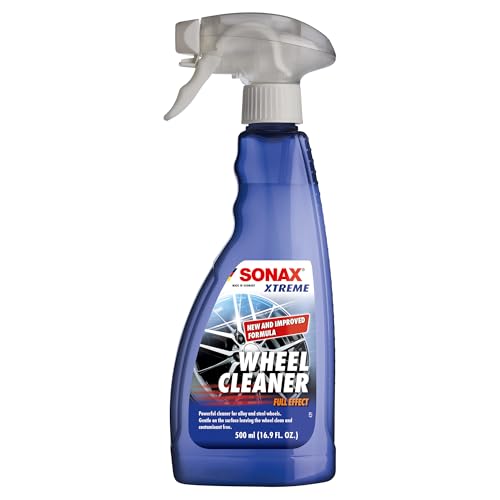
Sonax Wheel Cleaner Full Effect
This acid free gel turns deep purple as it reacts with embedded brake dust, so the cleaning action stays visible. It clears bonded contamination that ordinary soap leaves behind, without the risk acid based formulas carry. Owners report it clears neglected wheels in a single dwell where cheaper cleaners need two passes.
Pros
- Visible colour change shows where contamination sits
- Clears bonded dust with minimal agitation
- Acid free formula suits delicate finishes
Cons
- Strong sulphur smell during the reaction
- Uses a lot of product on large wheels

Adam’s Polishes Deep Wheel Cleaner
A pH neutral iron remover built for frequent use without degrading a ceramic coating or wax layer. Its thicker consistency clings to vertical wheel faces instead of running straight to the floor. Owners report it stays gentle enough for weekly washes while still lifting a week of commuting dust.
Pros
- Won’t strip wheel coatings or sealants
- Clings well to vertical wheel faces
- Safe for frequent maintenance washing
Cons
- Less bite on heavily neglected wheels
- Needs a second pass on baked on deposits

Chemical Guys Diablo Gel Wheel and Rim Cleaner
Formulated as an acid free gel safe across chrome, polished aluminium, anodised and painted wheels, this is the low risk pick when the finish is unknown. Its thick body holds it in place on the barrel, where most contamination collects. Owners report it works best as a maintenance step rather than a rescue product.
Pros
- Broadest finish compatibility of the group
- Gel stays put on barrels and spokes
- Mild enough for regular use
Cons
- Not strong enough for long neglected wheels
- Thick gel needs thorough rinsing

Meguiar’s Ultimate All Wheel Cleaner
Meguiar’s built this as a single product for every common wheel finish, useful when a household runs several cars with different wheels. A colour changing iron remover combines with enough cleaning power for road film. Owners report reliable results with very few complaints of finish damage.
Pros
- Genuinely safe across common wheel finishes
- Short dwell time suits sunny days
- Widely available in most sizes
Cons
- Middling strength on severe contamination
- Sprayer produces a wide, wasteful pattern

Griot’s Garage Heavy Duty Wheel Cleaner
This is the product for wheels that haven’t been properly cleaned in a year, strong enough to break down layered brake dust and road tar. It works more aggressively than the maintenance formulas above, so dwell time discipline matters. Owners recommend switching to something milder once wheels return to a clean baseline.
Pros
- Cuts through layered, neglected contamination
- Works fast, so wheels finish quickly
- Good value in the larger bottle size
Cons
- Too strong for routine weekly use
- Must not be allowed to dry on the wheel

P and S Brake Buster Wheel Cleaner
A non acid formula that dilutes for maintenance work and goes on neat for heavier jobs, stretching a single bottle a long way. It runs odourless compared with sulphur based iron removers, a real benefit in a closed garage. Owners treat it as the sensible choice for weekly wheel cleaning across several vehicles.
Pros
- Dilutable, so a bottle lasts a long time
- Far less smell than iron removing gels
- Trusted in professional detailing use
Cons
- No colour change to show where it is working
- Needs more agitation than gel formulas

Armor All Extreme Wheel and Tire Cleaner
This one handles both the wheel face and the tyre sidewall in a single pass, suited to a quick weekend clean rather than a full detail. It stays widely stocked and cheap enough to use generously on a very dirty car. Owners report it manages routine road grime but won’t touch heavily bonded brake dust.
Pros
- Cleans wheels and tyres in one step
- Cheapest way to keep on top of road film
- Easy to find almost anywhere
Cons
- Ineffective on bonded brake dust
- Short dwell window before it dries
Compared at a glance
| # | Model | Type | Best for | Score | Price |
|---|---|---|---|---|---|
| 1 | Sonax Wheel Cleaner Full Effect | Acid free iron dissolving gel | Best overall | 9.4 | Check price |
| 2 | Adam’s Polishes Deep Wheel Cleaner | pH neutral iron remover | Best for coated wheels | 9.1 | Check price |
| 3 | Chemical Guys Diablo Gel Wheel and Rim Cleaner | Acid free gel | Best for delicate finishes | 8.9 | Check price |
| 4 | Meguiar’s Ultimate All Wheel Cleaner | Acid free, all finish formula | Best for mixed wheel types | 8.7 | Check price |
| 5 | Griot’s Garage Heavy Duty Wheel Cleaner | Heavy duty alkaline cleaner | Best for neglected wheels | 8.5 | Check price |
| 6 | P and S Brake Buster Wheel Cleaner | Non acid, dilutable cleaner | Best for high volume use | 8.2 | Check price |
| 7 | Armor All Extreme Wheel and Tire Cleaner | Combined wheel and tyre cleaner | Best budget | 8.0 | Check price |
How to choose
Iron removers versus general cleaners Brake dust isn’t just dirt, it is hot metal particles that embed into the wheel finish and corrode there. A general purpose cleaner lifts loose grime but leaves those particles behind, which is why washed wheels can still look dull. Iron dissolving formulas such as Sonax Full Effect break down that bonded contamination chemically, and the purple colour change is the reaction becoming visible, not a marketing trick.
Knowing your wheel finish before you spray Painted and clear coated wheels, standard on most modern cars, tolerate almost anything acid free. Polished aluminium, anodised and chrome plated wheels are far more fragile, and an acidic cleaner can stain or etch them permanently within a single dwell. Use a pH neutral or acid free product like Chemical Guys Diablo Gel when the finish is unclear, and test a small inner section first.
Dwell time and why drying is the real danger Almost every case of wheel damage traces back to cleaner drying on the surface rather than the chemical itself. Work one wheel at a time, keep it out of direct sun, and rinse before the product starts to dry. Wetting the wheel first on a hot day slows evaporation and extends the safe working window.
Tools that make the chemical work less hard A soft wheel woolie for the barrel, a detailing brush for lug nut recesses and a dedicated wheel bucket do more for results than switching to a stronger chemical. The barrel hides the worst contamination and is where most people never reach. Keep wheel tools separate from paint wash media, since embedded brake dust particles scratch bodywork instantly.
Common questions
How often should wheels be cleaned?
Every wash if possible, and at minimum every couple of weeks. Brake dust corrodes into the finish over time, so frequent light cleaning with a pH neutral product like Adam’s Deep Wheel Cleaner beats an annual rescue job.
Is an acid based wheel cleaner worth using?
Rarely, for home use. Acids clear severe contamination quickly, but the margin for error is small and the damage is permanent. Acid free iron removers now get close to the same result with far less risk.
Why does wheel cleaner turn purple?
That’s iron dissolving chemistry reacting with embedded brake dust particles. The colour is the reaction itself, not a dye, so heavy purple bleeding signals significant bonded contamination. It rinses away completely with water.
Can these be used on ceramic coated wheels?
Use a pH neutral product. Adam’s Deep Wheel Cleaner is formulated specifically for coated wheels, and diluted P and S Brake Buster is another safe option. Strong alkaline rescue cleaners shorten a coating’s life.
Will wheel cleaner damage brake calipers or rotors?
Painted calipers generally handle acid free products fine, though repeated strong cleaning can dull the paint. Rotors show surface rust after any wash regardless, and it wears off within the first few stops.
What causes the smell from iron removers?
The sulphur odour comes from the active chemistry and is normal. It’s unpleasant in an enclosed garage, so work outdoors or with the door open, or reach for low odour P and S Brake Buster instead.
Do wheels need a separate tyre cleaner?
Tyres need an alkaline degreaser to remove old dressing and blooming, which most wheel cleaners aren’t built for. A combined product like Armor All Extreme handles light cases, but a dedicated tyre cleaner gives new dressing a better base.
Should wheels be sealed after cleaning?
It makes every future clean easier. A wheel sealant or ceramic spray stops brake dust bonding as tightly, so a rinse and mild cleaner often suffice. Apply it once wheels are fully decontaminated, not over existing bonded dust.
The bottom line
Sonax Wheel Cleaner Full Effect remains the most capable single bottle here, clearing bonded brake dust without the risks that come with acidic formulas. Use Adam’s Deep Wheel Cleaner for routine maintenance on coated wheels, and keep Griot’s Garage Heavy Duty Wheel Cleaner in reserve for the first deep clean on badly neglected sets.
Tony Russo
Tony trained as an automotive technician and spent years in service and parts retail before moving into writing. He focuses on garage tools, car care products and accessories from a hands-on maintenance perspective.


