Do Dog Booties Actually Stay On During Walks?
Whether booties stay on depends far more on fit and closure type than on brand reputation, since a boot that is even slightly too loose around the ankle will work itself off within the first few minutes of walking, especially on a dog unfamiliar with wearing them. Booties with a wide adjustable strap that sits above the dew claw, rather than just elastic around the ankle, tend to stay on significantly more reliably during real walks.
Why ankle fit matters more than the boot itself
A dog’s ankle, or more precisely the area just above the paw, narrows and widens slightly with each stride, and a boot that cannot flex and grip through that motion works loose step by step. This is true even of otherwise well-made boots if the size chosen is off even slightly.
Elastic-only closures versus strap closures
Simple pull-on boots with just an elastic opening are the most prone to sliding off, since elastic alone has no mechanism to stay anchored above the paw once a dog is actively moving, running, or walking through resistance like deep snow or mud. A separate adjustable strap that cinches above the elastic opening gives the boot something to grip against that elastic alone cannot provide.
Why new boots fail more often than broken-in ones
A dog unfamiliar with wearing anything on its feet often walks unnaturally at first, lifting paws higher or shaking them, which can work even a well-fitted boot loose during the first few outings. This settles down significantly once a dog gets used to the sensation, which is part of why a short indoor practice period before a real walk improves success rates.
Terrain and conditions change how much a boot gets tested
Dry, flat pavement puts far less stress on a boot’s fit than deep snow, mud, or uneven terrain that pulls and twists the boot with each step. A boot that stays on reliably during a short neighborhood walk may come loose much faster during a hike through snow or brush.
Sizing mistakes that cause boots to slip off
Measuring paw width while the dog is standing and bearing weight, not with the foot relaxed and lifted, gives a more accurate size, since paws spread slightly under weight and a boot sized for a relaxed paw often ends up too loose for a weight-bearing one.
What actually helps beyond the boot itself
Trimming excess paw fur that can bunch up inside a boot and create extra slack, and double-checking that dew claws are not caught awkwardly inside the boot opening, both reduce the chances of a boot working loose that has nothing to do with the boot’s design itself.
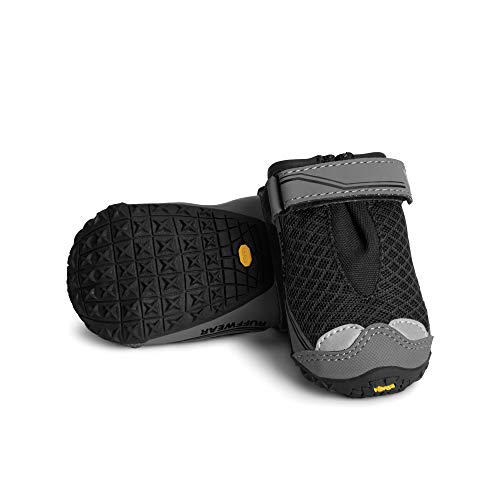
Ruffwear Grip Trex Dog Boots
A widely used outdoor dog boot with an adjustable strap closure above an elastic opening, designed to stay secured through active movement and varied terrain.

Muttluks Dog Boots
A fleece-lined boot with a hook-and-loop strap closure, commonly used for both everyday walks and cold-weather protection.
Frequently asked questions
What is the most common reason dog boots fall off during walks?
Incorrect sizing, usually boots fitted too loose around the ankle, is the most common cause, followed closely by relying on elastic-only closures that have nothing to anchor against once the dog is moving.
Do dogs need a practice period before boots stay on reliably?
Yes, most dogs walk unnaturally the first few times wearing boots, which can work even a correctly fitted boot loose, and a short indoor adjustment period before real walks improves how well boots stay on.
Are strap-closure boots always better than pull-on elastic boots?
For most active use, yes, a secondary strap gives the boot something to grip above the elastic opening, which noticeably improves retention compared to elastic alone, especially on rough terrain.
Can trimming paw fur help boots stay on better?
Yes, excess fur around the paw and ankle can bunch up inside a boot and create slack that makes it easier for the boot to slip off during movement.
Does the material of the walking surface affect how well boots stay on?
Yes, loose or deep surfaces like snow, mud or sand put far more twisting stress on a boot than flat, dry pavement, which is why a boot that stays on well on sidewalks may not do as well on a snowy trail.
How tight should a dog boot be without cutting off circulation?
A boot should be snug enough that you cannot easily slide a finger underneath the closure, but still loose enough to not visibly indent or pinch the skin, which usually falls somewhere in a narrow comfortable range.
Can a dog’s running gait make boots come off faster than walking?
Yes, the higher impact and faster stride of running puts more stress on a boot’s fit than walking does, so boots that work fine on a leisurely walk may still slip during a run.
Do all four boots need to be the same size on one dog?
Not always, some dogs have slightly different front and back paw sizes, so measuring each paw individually rather than assuming uniform sizing improves overall fit and retention.
Is it normal for a dog to try to shake off boots at first?
Yes, this is a common initial reaction to the unfamiliar sensation, and it usually decreases with repeated short exposures rather than indicating the boots do not fit.
Can boots stay on better with a specific lacing or wrapping technique?
Some boots include additional wrap-around straps specifically because a single closure point is more prone to slipping than a boot secured at two points along the ankle.
Does dew claw placement affect how well a boot fits and stays on?
Yes, a dew claw caught awkwardly inside or against the boot opening can create pressure points that encourage a dog to shake the boot off, so checking claw position during fitting matters.
Can worn-out elastic in an older boot cause it to fall off more easily?
Yes, elastic loses its grip over repeated stretching and washing cycles, so a boot that fit well when new may need replacing once the elastic no longer snaps back snugly.
Is it harder to keep boots on small dogs than large dogs?
Many owners find smaller breeds’ paws and ankles proportionally more difficult to fit precisely, since small sizing differences have a bigger relative impact on a smaller paw.
Do booties stay on better when a dog is distracted during the walk?
Often yes, a dog focused on sniffing, walking or playing tends to pay less attention to the boots than one standing still fixating on the unfamiliar sensation, which can reduce shaking and pawing.
Can wet boots slip off more easily than dry ones?
Yes, water can reduce the grip of certain closure materials and also make paws slightly slicker inside the boot, both of which can contribute to a boot working loose faster in wet conditions.
Is it worth sizing up if a dog’s paw measurement falls between two sizes?
Generally no, sizing down with a slightly more secure fit tends to stay on better than sizing up and accepting extra room that a boot can shift around in.
Can regular use break in a boot to fit more securely over time?
Some boot materials do soften and mold slightly to a dog’s foot shape with repeated wear, though this has limits and does not fix a boot that was meaningfully too large from the start.
Do veterinary recommended boots for injury recovery use different retention methods than everyday walking boots?
Some recovery-focused boots use more rigid or wrap-style closures specifically for added security and stability, which can differ from the lighter closures found on boots meant mainly for casual daily walks.
Our take
A boot staying on is mostly a fit and closure problem, not a brand quality problem, which is why the same model that works great on one dog slides off another. Measuring paws under weight, choosing a strap closure over elastic alone, and giving a dog a short adjustment period before a real walk solves most of what people blame on the boots themselves.
Olivia Hartley
Olivia spent several years working at an animal shelter and a pet-supply retailer before joining the editorial team. She researches pet gear with an emphasis on safety, comfort and the fine print that owners often miss.