Wire Ferrule Crimpers That Leave A Clean, Secure Crimp
The Knipex Self-Adjusting Crimping Pliers lead this group, automatically setting crimp force to match ferrule size without a manual die swap. The Weidmuller PZ 6 Roto suits precision panel work, and the Preciva tool covers occasional use at the lowest cost here.
The Knipex Self-Adjusting Crimping Pliers are the strongest pick for anyone crimping a mix of ferrule sizes in one session, since the jaw automatically adjusts force to match the ferrule diameter without stopping to swap a die. That consistency matters because an under-crimped ferrule can pull loose and an over-crimped one can crack the insulation. The convenience comes at a higher price than basic fixed-die crimpers.
A ferrule crimper only does its job if the crimp holds the wire firmly without crushing it flat, across whatever range of ferrule sizes a project actually uses. We compared crimp consistency, die mechanism, and how each tool handled a range of ferrule sizes without needing a different tool per size.
How to pick the right one
What a ferrule crimper needs to get right A proper ferrule crimp compresses the metal sleeve evenly around the wire strands without crushing them flat or leaving the crimp loose enough to pull free. The die shape, square or hexagonal, and the mechanism’s consistency both affect how reliably that happens across repeated crimps. A ratcheting mechanism, found on most tools here, prevents releasing the handle before the crimp fully completes.
Self-adjusting versus fixed-die crimpers A self-adjusting crimper, like the Knipex model, senses ferrule size and sets force automatically, which speeds up jobs with mixed wire gauges. A fixed-die or interchangeable-die crimper, such as the WAGO or IWISS tool, needs a correctly matched die for each size but often costs less. Panel builders working mostly within one or two ferrule sizes rarely need the self-adjusting convenience.
Square versus hexagonal crimp profiles A square crimp, common on tools like the Phoenix Contact CRIMPFOX, applies pressure from two directions and suits most general wiring tasks. A hexagonal crimp, like Weidmuller’s PZ 6 Roto, applies pressure from six points around the ferrule, giving a more even compression that some industrial specifications require. Check equipment or code requirements before assuming either profile is universally accepted.
Matching a crimper to how often you use it High-volume panel shops benefit from an ergonomic, fatigue-reducing design like Ferrules Direct’s tool, since hand strain adds up across hundreds of daily crimps. Occasional DIY or small-shop use rarely justifies that investment, making a multi-die tool like Preciva’s or IWISS’s a more practical choice. Brand-matched tools, like WAGO’s, make sense only when standardized on that same ferrule brand.
What we recommend

Knipex Self-Adjusting Crimping Pliers
Knipex builds the jaw on this crimper to sense ferrule diameter and adjust clamping force automatically, so the same tool crimps a 0.5 and a 2.5 square millimeter ferrule correctly without a die change. That self-adjustment removes a common source of inconsistent crimps across a mixed batch of wire sizes. Electricians doing panel work across varied wire gauges get reliable results without stopping to swap parts.
Pros
- Automatically adjusts force across ferrule sizes
- No die swapping needed between wire gauges
- Consistent crimp quality reduces pulled-loose wires
Cons
- Higher price than basic fixed-die crimpers
- Limited to the ferrule range this specific jaw covers

Weidmuller PZ 6 Roto Crimping Tool
Weidmuller fits this tool with a rotating hexagonal die that applies even pressure around the full circumference of the ferrule, rather than crimping from just two sides. That six-point crimp distributes force more evenly, which matters for maintaining conductivity in vibration-prone panel installations. Industrial control panel builders favor this hexagonal crimp over a simple two-sided squeeze.
Pros
- Hexagonal crimp distributes force evenly around the ferrule
- Wide ferrule range covers most panel wiring needs
- Ratchet mechanism ensures full crimp completion
Cons
- Premium pricing compared to basic crimpers
- Heavier tool than compact handheld options

Phoenix Contact CRIMPFOX Crimping Tool
Phoenix Contact matches this crimper’s die markings to the same color-coding system used on its ferrule packaging, making it fast to confirm the right die setting at a glance. The ratcheting mechanism prevents releasing the crimp until it reaches full compression. Panel builders already using Phoenix Contact ferrules get a tool that matches their existing color system directly.
Pros
- Color-coded die matches common ferrule packaging
- Ratchet prevents incomplete crimps
- Wide size range covers most control panel wiring
Cons
- Color system only helps if ferrules use matching codes
- Costs more than generic multi-die crimpers

IWISS Ferrule Crimping Tool
IWISS includes a set of interchangeable dies with this crimper, covering a broader range of ferrule sizes than a single fixed-die tool at a lower overall cost. Swapping dies takes a bit longer than a self-adjusting jaw, but the price difference makes up for the extra step for many buyers. DIYers and small shops working across varied projects get solid flexibility here.
Pros
- Interchangeable dies cover a wide ferrule range
- Lower cost than premium self-adjusting crimpers
- Ratchet ensures a complete crimp before release
Cons
- Die swapping takes longer than automatic adjustment
- Build quality trails premium German brands

Ferrules Direct FDT Crimping Tool
Ferrules Direct builds this tool specifically for high-repetition panel work, with a ratchet mechanism designed to reduce hand fatigue across hundreds of crimps in a shift. The ergonomic handle shape spreads grip pressure more evenly than a basic plier handle. Panel shops running production-level wiring jobs benefit most from the fatigue-reducing design.
Pros
- Ergonomic handle reduces fatigue over long shifts
- Ratchet ensures consistent crimp depth every time
- Built specifically for repetitive production use
Cons
- Narrower ferrule range than premium multi-size tools
- Less flexible for occasional varied-size work
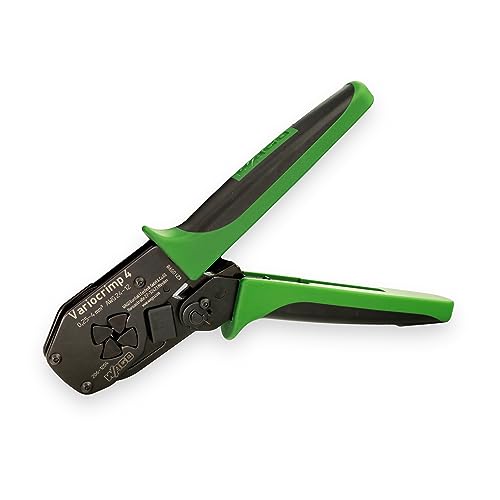
WAGO Crimping Tool
WAGO shapes this crimper’s die specifically to match its own ferrule line’s dimensions, giving the most consistent fit when used exclusively with WAGO ferrules. The profile is less universal than a generic square or hexagonal die, so mixing brands can produce less reliable results. Electricians standardized on WAGO terminal blocks and ferrules get the closest brand-matched tool available.
Pros
- Die profile matches WAGO ferrule dimensions closely
- Ratchet mechanism ensures complete crimps
- Reliable results when paired with WAGO components
Cons
- Less consistent results with non-WAGO ferrule brands
- Narrower size range than general-purpose crimpers

Preciva Ferrule Crimping Tool
Preciva fits six crimp profiles onto a rotating die wheel, letting you select a size without swapping separate die pieces, at the lowest price in this comparison. Build quality trails premium brands, with slightly more effort needed to achieve a fully even crimp. DIYers and hobbyists doing occasional ferrule work get functional results without a large investment.
Pros
- Lowest price point among crimpers compared here
- Rotating wheel avoids losing separate die pieces
- Covers a reasonably wide ferrule range
Cons
- Less consistent crimp quality than premium brands
- Handle feels less durable under frequent daily use
The lineup, side by side
| # | Model | Crimp profile | Best for | Score | Price |
|---|---|---|---|---|---|
| 1 | Knipex Self-Adjusting Crimping Pliers | Square, self-adjusting | Best overall ferrule crimper | 9.3 | Check price |
| 2 | Weidmuller PZ 6 Roto Crimping Tool | Hexagonal, six-point | Best for rotating die precision | 8.9 | Check price |
| 3 | Phoenix Contact CRIMPFOX Crimping Tool | Square | Best for color-coded ferrule sizing | 8.8 | Check price |
| 4 | IWISS Ferrule Crimping Tool | Square and hexagonal dies included | Best value multi-die pick | 8.7 | Check price |
| 5 | Ferrules Direct FDT Crimping Tool | Square | Best for high-volume panel building | 8.6 | Check price |
| 6 | WAGO Crimping Tool | WAGO-specific profile | Best for WAGO ferrule compatibility | 8.5 | Check price |
| 7 | Preciva Ferrule Crimping Tool | 6-position rotating wheel | Best budget pick | 8.1 | Check price |
Frequently asked questions
What is a wire ferrule used for?
A ferrule is a metal sleeve crimped onto the end of stranded wire, preventing the strands from fraying or loosening when inserted into a terminal block or connector.
Can one crimper handle multiple ferrule sizes?
Self-adjusting tools like the Knipex model handle a range automatically. Fixed-die tools need a matching die or die wheel position for each size.
What is the difference between square and hexagonal crimps?
A square crimp compresses from two sides, while a hexagonal crimp compresses from six points around the ferrule for more even pressure distribution.
Is a ratcheting crimper necessary for ferrules?
A ratchet mechanism helps ensure the crimp reaches full compression before the handle releases, reducing the chance of an incomplete, loose crimp.
Do ferrule crimpers work on standard wire without a ferrule?
No, they are shaped specifically to compress a ferrule’s metal sleeve and are not designed for crimping bare wire or other connector types.
Can mixing ferrule brands with a brand-specific crimper cause problems?
Yes, a tool like WAGO’s crimper is matched closely to its own ferrule dimensions, so other brands may not achieve as consistent a crimp.
How do I know if a crimp is too loose or too tight?
A properly crimped ferrule resists a firm tug on the wire without the sleeve deforming excessively or cracking the wire’s insulation.
Are interchangeable die crimpers harder to use than fixed ones?
They require selecting and inserting the correct die before crimping, adding a step that fixed or self-adjusting tools skip.
The verdict
The Knipex Self-Adjusting Crimping Pliers are the best overall choice for most electricians and panel builders, since automatic force adjustment removes the guesswork across mixed ferrule sizes. Shops standardized on WAGO terminal blocks should pick the WAGO Crimping Tool instead, since its matched die profile gives the most reliable results with that specific ferrule brand. Buyers doing occasional DIY ferrule work get the best value from the Preciva 6-in-1 crimping tool.
Jake Monroe
Jake worked as a residential contractor for over a decade before shifting to full-time writing. He evaluates power tools, hand tools and workshop gear through the lens of someone who has actually used them on job sites, not just read the box.


