Which Wood Jointer Actually Leaves a Square Edge?
JET JJ-6CSDX leads for shops jointing several times a week, thanks to quick-set knives and a 56-inch table. Cutech 40160H-CT pairs a spiral cutterhead with benchtop pricing. WEN JT6561 offers a cast iron table and two-blade cutterhead for lighter, budget-conscious use.
JET JJ-6CSDX suits shops jointing several times a week and wanting the closest thing to a professional machine. Cutech 40160H-CT works when a spiral cutterhead matters more than a full stationary footprint. WEN JT6561 fits shops running one project a month on a fixed budget.
Two jointers sharing identical table lengths can still leave opposite finishes on the same board, since cutterhead type changes how grain tears. We compared motor power, knife or insert systems, fence travel and table length across seven models, then checked owner reports for recurring complaints like snipe, table sag or slow knife changes.
What matters most
What to look for in a wood jointer Table length decides how well long boards stay supported through a pass. Short infeed or outfeed sections let a board rock, leaving a bowed edge. Grain tear-out depends heavily on cutterhead type, while cutting depth depends on motor power. Bevels and rabbets need fence travel beyond a basic 45-degree stop. Under the cutterhead guard, packed chips signal weak dust collection. Compare these factors before brand names enter the decision.
Benchtop vs stationary jointers Benchtop models like the WEN JT6561 and Shop Fox W1829 bolt to a workbench and store on a shelf. Weight stays under 60 pounds, which keeps them portable but lets a hard cut push the fence out of alignment. JET JJ-6CSDX represents the stationary category, sitting on a fixed base with a longer bed that spreads the same cut across more table surface. That extra length cuts down on snipe past four feet. Weekly jointing tips the choice toward a stationary machine.
Straight knife vs helical vs spiral cutterheads Straight knife cutterheads, found on the WEN JT6561 and Shop Fox W1829, cut a board’s full width in one pass and stay simple to sharpen or replace. A nicked knife shows up as a ridge across every subsequent pass until swapped. Helical and spiral designs, used on the Rikon 20-600H, Cutech 40160H-CT and Grizzly G0814X, break that same cut into a dozen or more angled inserts. Each insert handles only a narrow slice of the board, so one nick affects a fraction of the width. Insert cutterheads also run quieter and leave less tear-out on curly grain.
Which jointer suits your shop size and lumber type A once-a-month hobbyist rarely needs more than a 6-inch benchtop jointer with a straight knife cutterhead. Furniture makers working curly or figured hardwoods benefit from an insert-style head that resists tear-out on reversing grain. Shops facing boards wider than 6 inches need the extra capacity of an 8-inch machine like the Powermatic PJ-882HH. Production runs favor a stationary frame over a benchtop one, since rigidity holds up under constant use. Apartment or garage shops short on floor space still cover most furniture parts with a compact 6-inch benchtop model.
Our top picks

JET JJ-6CSDX 6-Inch Jointer
Three HSS knives snap into a quick-set carrier, cutting blade-change time to minutes. A 56-inch combined table steadies four-foot boards without extra support underneath. Rabbets up to a half inch deep add a second function most benchtop jointers skip.
Pros
- Quick-set knives cut blade-change time
- 56-inch table supports longer boards than benchtop rivals
- Built-in rabbeting ledge doubles as a second tool
Cons
- Requires floor space no benchtop model needs
- Straight knives nick on embedded grit

Cutech 40160H-CT 6-Inch Spiral Cutterhead Jointer
Twelve two-sided carbide inserts replace typical straight knives, cutting tear-out on reversing grain. Bevels come without repositioning stock, since the fence swings 90 to 135 degrees. Table length reaches 30 inches, enough for face frames and drawer parts.
Pros
- Spiral cutterhead pricing matches straight-knife benchtops
- Inserts rotate instead of requiring full replacement
- Fence tilts well beyond a basic 45-degree stop
Cons
- Table falls short of stationary machine lengths
- Dust port needs a shop vac to stay clear
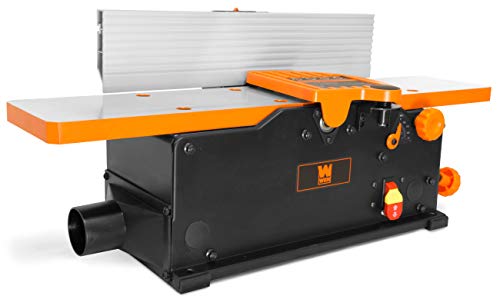
WEN JT6561 10-Amp 6-Inch Benchtop Jointer
A 10-Amp motor drives a two-blade, 6-1/8 inch cutterhead through 20,000 cuts per minute. Cast iron construction on table and fence resists flex common in stamped-steel benchtops. Fence bevels 45 degrees in either direction for angled trim and picture-frame edges.
Pros
- Cast iron table outperforms stamped steel at this price
- Straight blades keep replacement parts inexpensive
- Compact footprint suits a shared workbench
Cons
- Two-blade head needs more frequent changes
- No helical cutterhead option in this line
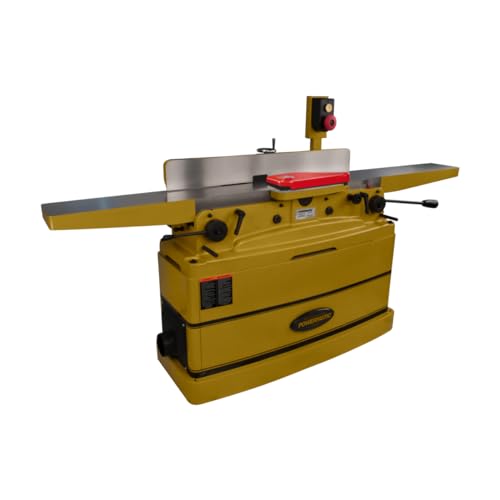
Powermatic PJ-882HH 8-Inch Parallelogram Jointer
Fifty-four four-sided carbide inserts wrap a helical cutterhead rated for daily production use. An 82-inch bed carries full-length boards through a face-jointing pass unassisted. One handwheel sets the fence to 45 degrees either direction or a square 90.
Pros
- 8-inch capacity handles wider rough lumber
- Helical inserts run quieter through long production runs
- Five-year warranty backs the cast iron castings
Cons
- Footprint demands a dedicated shop bay
- 230V circuit required to run the motor

Rikon 20-600H 6-Inch Helical Benchtop Jointer
A six-row helical cutterhead holds 12 HSS inserts set at a shearing angle, lowering noise and tear-out. Machined aluminum tables trim overall weight for benchtop mounting. Fence tilts from 90 to 45 degrees, and two push blocks ship in the box for narrow-stock safety.
Pros
- Helical head runs noticeably quieter than straight knives
- Insert cutters rotate rather than needing full swaps
- Push blocks included for narrow board safety
Cons
- Aluminum tables dent more easily than cast iron
- HSS inserts dull faster than carbide

Grizzly G0814X 6-Inch Jointer with V-Helical Cutterhead
Twenty-four indexable carbide inserts in a V-helical pattern shear through curly grain that tears under straight knives. Each insert rotates up to three times before replacement, stretching service intervals. A cabinet stand with a foot-pedal mobile base lets the machine roll into place and lock down.
Pros
- V-helical pattern handles reversing grain cleanly
- Carbide inserts last through repeated rotations
- Mobile base repositions the machine without a dolly
Cons
- Footprint runs heavier than any benchtop model here
- Cabinet stand adds to the overall cost
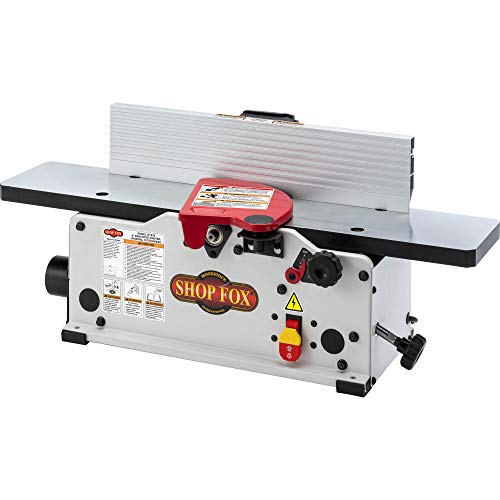
Shop Fox W1829 6-Inch Benchtop Jointer
A 1-1/2 HP motor spins a two-knife cutterhead at 10,000 RPM for 20,000 cuts per minute. Table length stops at 28-1/2 inches, short enough to store on a shelf. Cast iron fence holds tilt stops at 45 and 90 degrees for repeatable bevels.
Pros
- Compact table stores easily between projects
- Motor output exceeds most occasional-use needs
- Cast iron fence holds bevel angles reliably
Cons
- Shorter table struggles with boards over three feet
- Two-knife head lacks a helical upgrade option
How they compare
| # | Model | Motor | Best for | Score | Price |
|---|---|---|---|---|---|
| 1 | JET JJ-6CSDX 6-Inch Jointer | 1 HP, 115/230V | Best overall | 9.4 | Check price |
| 2 | Cutech 40160H-CT 6-Inch Spiral Cutterhead Jointer | Spiral type, 12 two-sided inserts | Best value | 9.2 | Check price |
| 3 | WEN JT6561 10-Amp 6-Inch Benchtop Jointer | 10 Amp | Best budget | 9.0 | Check price |
| 4 | Powermatic PJ-882HH 8-Inch Parallelogram Jointer | 2 HP, 230V | Best for wide stock and production shops | 8.8 | Check price |
| 5 | Rikon 20-600H 6-Inch Helical Benchtop Jointer | 6-row helical, 12 HSS inserts | Best for a quiet, tear-out-resistant finish | 8.5 | Check price |
| 6 | Grizzly G0814X 6-Inch Jointer with V-Helical Cutterhead | V-helical, 24 carbide inserts | Best for figured and reversing-grain wood | 8.3 | Check price |
| 7 | Shop Fox W1829 6-Inch Benchtop Jointer | 1-1/2 HP, 110V, 12 Amp | Best for a small shop or compact space | 8.0 | Check price |
Good to know
What size wood jointer do I need?
Six-inch jointers cover most furniture and cabinet parts, since face frames, drawer parts and typical retail lumber fall under that width. Eight-inch machines like the Powermatic PJ-882HH matter once rough lumber wider than 6 inches enters the shop. Match capacity to boards faced regularly, not to a board bought once in a while.
Is a 6-inch jointer big enough for a home shop?
Yes, for most furniture, boxes and cabinet components built from standard lumber widths. Wider panels can still be edge-jointed on a 6-inch machine even when the full face stays unflattened. Only shops routinely working slabs or wide glue-ups outgrow that 6-inch capacity.
What is the difference between a jointer and a planer?
A jointer flattens one face and squares one edge against that face, creating a flat reference surface. Afterward, a planer makes the opposite side parallel to the freshly flattened face. Skipping the jointer step leaves a planer copying existing warp instead of removing it.
Can a jointer fix a warped or bowed board?
Warp comes out as a jointer cuts down the high spots until the face sits flat against the table. Cupped or twisted stock needs several light passes rather than one deep cut. Severe warp can consume the whole board thickness before it flattens, so check stock before buying.
Are helical cutterhead jointers worth it over straight knives?
Owners report quieter running and less tear-out on figured or reversing grain with helical and spiral heads, based on listing details and reviews. Individual inserts also cost less to replace than a full set of straight knives after a nick. Clear pine or poplar users may not notice enough difference to justify the switch.
How wide of a board can a benchtop jointer face-joint?
Benchtop jointers such as the WEN JT6561, Cutech 40160H-CT and Shop Fox W1829 top out at 6 inches of width. Anything wider can only be edge-jointed, using the fence and one narrow face. Ripping a wide board into two narrower pieces before facing works as a common workaround.
Do jointer knives need sharpening or replacing?
Straight knives on machines like the WEN JT6561 typically get replaced rather than resharpened once dull. Insert-style cutterheads, as used on the Rikon 20-600H, let each carbide tip rotate to a fresh edge before replacement. Resinous or gritty reclaimed wood dulls either system sooner.
Stationary vs benchtop jointer: which is better for a home shop?
Stationary jointers like the JET JJ-6CSDX offer a longer bed and heavier castings, steadying long boards better. Benchtop models save floor space and cost less, suiting occasional projects. Weekly use tips the balance toward a stationary machine, since rigidity holds tolerances longer.
What is the best jointer for a small shop?
Shop Fox W1829 and WEN JT6561 both store on a shelf between projects, with tables under 30 inches. Their compact footprints suit garages and shared workbenches better than an 82-inch stationary bed. Either model still covers face frames, drawer parts and most cabinet-grade stock.
The bottom line
JET JJ-6CSDX takes the top spot for shops jointing often, pairing a long bed with quick-set knives. Cutech 40160H-CT brings spiral-cutterhead results to a benchtop budget, while WEN JT6561 covers occasional projects without straining a budget. Match cutterhead type and table length to how often boards actually need facing before choosing a size.
Jake Monroe
Jake worked as a residential contractor for over a decade before shifting to full-time writing. He evaluates power tools, hand tools and workshop gear through the lens of someone who has actually used them on job sites, not just read the box.


