Wine Decanter Shapes and How They Affect Aeration Speed
Riedel’s Vinum Extreme Decanter leads this comparison, built around a wide aeration base and 50.7 oz capacity. Bormioli Rocco’s Bach Decanter delivers strong value with dishwasher-safe glass. Le Chateau’s hand-blown crystal suits budget-conscious buyers wanting a traditional shape. Capacity, base design and cleaning method separated these seven models.
Riedel’s Vinum Extreme Decanter leads this roundup, pairing a 50.7 oz lead-free crystal body with a low, wide base built for fast aeration. Wine enthusiasts who open full-bodied reds regularly get the most from its wide swirling room. Hand washing is required, though, since the low profile skips most dishwasher racks.
Shape, capacity and glass quality vary enough between brands that judging one from photos alone falls short. We compared published capacity and material specs, owner feedback on chipping and cleaning difficulty, and how each design fits specific uses like gifting, young red wines and everyday storage.
What matters most
What to check before buying a wine decanter Capacity determines how much wine fits with room to swirl, ranging from 32 oz to over 50 oz across current models. Material affects both look and cost, since lead-free crystal gives thin, hand-blown walls while pressed glass costs less and often survives the dishwasher. Aeration speed follows shape, with wide, flat bases exposing more wine surface to air than narrow, tall silhouettes. Cleaning method matters just as much as capacity, since narrow necks trap sediment and need beads or a flexible brush.
Aeration decanters vs display decanters Wine spreads across a broad surface in wide-base decanters like the Riedel Vinum Extreme and Vintorio, speeding up the reactions that soften tannins in young reds. Table presence outranks aeration speed in swan-neck and cut-crystal designs, such as the Cuisivin Swan or Godinger Dublin. Drinking a bottle within the hour favors a wide base, while displaying a decanter between uses favors a decorative silhouette.
Which decanter fits young red wine, older wine or white wine Young, tannic reds like Cabernet Sauvignon or Syrah get the most benefit from wide-base decanters that maximize air contact within minutes. Older reds carrying delicate sediment need a gentler pour into a taller vessel, avoiding splashes that stir sediment back into the glass. White wine and rose rarely need decanting for aeration, though a decanter still works as a chilled serving vessel at the table. Full 750 ml bottles fit comfortably in anything rated 32 oz or larger, with extra headroom useful for swirling.
Cleaning, storage and gifting considerations Daily maintenance drops with dishwasher-safe models like the Bormioli Rocco Bach or Final Touch wide mouth decanter, compared with hand-wash-only crystal. Narrow-necked decanters need reusable cleaning beads or a bent bottle brush to reach the base without scratching glass. Gift buyers should look for a model shipping in its own box, such as the Godinger Dublin, since loose decanters risk chipping in transit. Storing a decanter upside down on a drying stand, included with the Vintorio set, helps prevent water spots inside.
The top picks, ranked

Riedel Vinum Extreme Decanter
A wide, flat base spreads wine across more surface area during aeration in this 50.7 oz lead-free crystal decanter. Hand-blown construction leaves the glass with thin walls that some owners compare to fine stemware. Standard dishwasher racks will not fit the low profile, so cleaning calls for hand washing with a bottle brush or decanting beads.
Pros
- Wide base speeds aeration for young, tannic reds
- Thin hand-blown walls concentrate aromas at the rim
- Sturdy footprint resists tipping on narrow counters
Cons
- Hand washing only adds maintenance time
- Wide shape takes up more shelf width than upright designs

Bormioli Rocco Bach Decanter
Machine-pressed lead-free glass keeps this 33.75 oz decanter’s cost below hand-blown crystal options, and Bormioli Rocco makes it in Italy. A bulb-shaped bottom paired with a narrow neck gives it a classic carafe silhouette. Top-rack dishwasher safety cuts cleaning time compared with hand-wash-only decanters.
Pros
- Dishwasher-safe glass saves cleaning time
- Machine-made construction lowers cost versus crystal
- Classic bulb shape fits standard cabinet shelves
Cons
- Narrower base aerates wine more slowly than wide designs
- 1 liter capacity leaves little room for swirling a full bottle

Le Chateau Wine Decanter
64 oz of capacity in this hand-blown decanter covers a full 750 ml bottle with extra room for swirling. Lead-free crystal and a ship’s-style silhouette give it a traditional look at a lower cost than branded crystal houses. A glass stopper ships included, though the narrow neck limits hand access during washing.
Pros
- 64 oz capacity leaves ample swirling room
- Included stopper preserves wine between servings
- Lower cost than premium crystal brands
Cons
- Narrow neck requires cleaning beads or a long brush
- Larger size needs more vertical cabinet clearance

Vintorio Wine Decanter
A wide base exposes young red wines to more air during pouring in this 34 oz Vintorio decanter. Included accessories cover a cork stopper, a wooden drying stand, reusable cleaning beads and a foil-cutter funnel. Hand-blown lead-free crystal keeps the glass thin, though capacity sits close to one bottle with limited extra swirling space.
Pros
- Included drying stand and cleaning beads simplify upkeep
- Wide base accelerates aeration for young, tannic reds
- Funnel with built-in foil cutter speeds up pouring
Cons
- 34 oz capacity leaves little room beyond one bottle
- Wide base takes up more counter footprint than tall designs

Godinger Dublin Wine Decanter
32 oz fits inside this cut-crystal design styled after traditional ship’s decanters, matching stopper included. Wedding and housewarming gift lists commonly include it, since it ships in its own gift box. Visual weight comes from the cut crystal pattern, which also adds more surface area to hand dry after washing.
Pros
- Gift box packaging suits wedding and housewarming presents
- Cut crystal pattern adds decorative detail to a bar cart
- Included stopper matches the cut glass design
Cons
- 32 oz capacity suits half bottles better than full 750 ml pours
- Cut pattern shows water spots if air dried instead of towel dried

Final Touch Wide Mouth Wine Decanter
A wide mouth opening on this 48 oz decanter fits a hand and sponge directly inside for washing. Wine splits into multiple streams through a built-in aerating insert positioned in the neck. Lead-free glass construction stays dishwasher safe, cutting maintenance compared with narrow-necked crystal decanters.
Pros
- Wide mouth allows hand washing without cleaning beads
- Dishwasher-safe glass reduces upkeep time
- Built-in aerator splits pour streams without a separate funnel
Cons
- Wide mouth shape looks less formal than classic crystal decanters
- Built-in aerator insert is not removable for deep cleaning
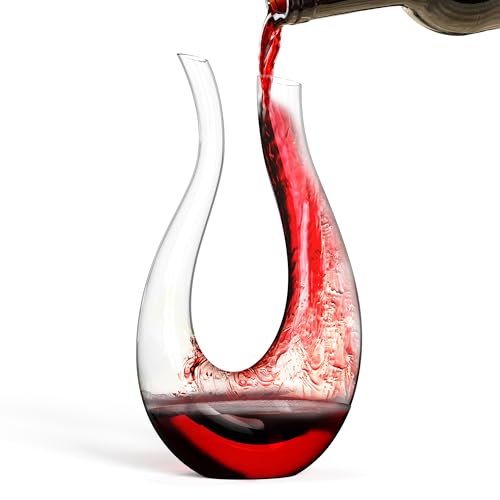
Cuisivin Swan Wine Decanter
A swan-neck silhouette shapes this 34 oz Cuisivin decanter, aimed at display and gifting rather than daily aeration. Hand-blown lead-free crystal forms the curved neck, which needs cleaning beads or a flexible brush to reach. Owners note it works better as a table centerpiece for entertaining than as an everyday decanting tool.
Pros
- Swan-neck silhouette stands out as a table centerpiece
- Hand-blown crystal gives each piece slight shape variation
- 34 oz capacity suits single-bottle service for small gatherings
Cons
- Curved neck is difficult to clean without specialty brushes
- Decorative shape offers less aeration surface than wide-base designs
How they stack up
| # | Model | Capacity | Best for | Score | Price |
|---|---|---|---|---|---|
| 1 | Riedel Vinum Extreme Decanter | 50.7 oz (1500 ml) | Best overall | 9.4 | Check price |
| 2 | Bormioli Rocco Bach Decanter | 33.75 oz (1 liter) | Best value | 9.1 | Check price |
| 3 | Le Chateau Wine Decanter | 64 oz (1.89 liters) | Best budget | 8.8 | Check price |
| 4 | Vintorio Wine Decanter | 34 oz (1000 ml) | Best for aerating young red wine | 8.6 | Check price |
| 5 | Godinger Dublin Wine Decanter | 32 oz (946 ml) | Best for gifting | 8.3 | Check price |
| 6 | Final Touch Wide Mouth Wine Decanter | 48 oz (1.4 liters) | Best for easy cleaning | 8.1 | Check price |
| 7 | Cuisivin Swan Wine Decanter | 34 oz (1000 ml) | Best for display and collectors | 8.0 | Check price |
Questions worth asking
How long should you decant red wine before serving?
Young, tannic reds often open up within 30 to 60 minutes in a wide-base decanter. Older reds carrying sediment need only 15 to 20 minutes, since separating sediment matters more than aerating the wine.
What is the difference between a wine decanter and a wine aerator?
A standalone vessel holding an entire bottle while wine sits for aeration and sediment separation describes a decanter. An aerator is typically a smaller pour-through device, or a built-in decanter feature like the Final Touch insert, mixing air into wine within seconds.
Do you need to decant white wine?
White wine rarely needs aeration, since most whites lack the tannins that soften with air exposure. A decanter still works as a chilled serving carafe for a full bottle at the table.
What is the best wine decanter for beginners?
Dishwasher-safe glass and 33.75 oz capacity make the Bormioli Rocco Bach Decanter a solid beginner choice, skipping the hand-washing routine crystal models require. Cost stays lower than hand-blown options too, lowering the risk of a costly mistake while learning to decant.
How do you clean a wine decanter with a narrow neck?
Reusable stainless steel or glass cleaning beads, swirled with water and a drop of dish soap, reach the base without a brush. A bent bottle brush works as an alternative for decanters like the Le Chateau or Cuisivin Swan with curved necks.
Is lead-free crystal safe for serving wine?
Other minerals, often zinc or titanium oxide, give lead-free crystal its clarity and weight instead of lead oxide. Daily wine service stays safe, and none of the precautions older leaded crystal decanters needed apply here.
Wine decanter vs carafe, what is the difference?
A simpler serving vessel without a design focus on aeration usually describes a carafe, while a decanter’s base shape is built to expose wine to air. Many product listings use the terms interchangeably, so checking base width and capacity matters more than the name.
What size wine decanter fits a standard 750 ml bottle?
Any decanter rated 32 oz or larger holds a standard 750 ml bottle, which equals about 25.4 oz. Sizes closer to 50 oz, like the Riedel Vinum Extreme, leave more headroom for swirling without spilling.
What is the best wine decanter for gifting?
Godinger’s Dublin Decanter suits gifting best, since its cut crystal design ships in its own gift box for wedding and housewarming presents. A matching stopper rounds out the presentation without needing separate packaging.
Our take
Riedel’s Vinum Extreme Decanter remains the strongest all-around pick, since its wide base speeds aeration and its 50.7 oz capacity handles a full bottle with swirling room. Buyers wanting dishwasher-safe cleanup over hand washing should pick the Bormioli Rocco Bach Decanter instead, trading some aeration speed for lower daily maintenance. Wedding or housewarming gifts are better served by the Godinger Dublin, since its cut crystal design and included gift box suit presentation over everyday use.
Dana Whitfield
Dana spent eight years buying and merchandising for a regional kitchenware retailer before moving into editorial work. She has handled thousands of SKUs across cookware, small appliances and kitchen organization, and focuses on the practical differences that matter once a product is actually in daily use.


