How to Restore a Dull Blade With the Right Sharpener
Work Sharp’s Precision Adjust Elite gives the best edge for the effort with precise angle control and swappable abrasives. Chef’sChoice Trizor XV EdgeSelect sharpens fastest electrically, and the Spyderco Tri-Angle Sharpmaker excels at quick maintenance between full sharpenings.
Work Sharp’s Precision Adjust Elite is the sharpener worth buying for a household that cares about edges, with the Chef’sChoice Trizor XV EdgeSelect as the fast electric alternative and the Spyderco Tri-Angle Sharpmaker for quick upkeep. All three hold a consistent angle, the entire game in sharpening.
Inconsistency ruins more edges than bluntness ever does, and a hand held pull through removes plenty of steel while leaving a rough edge that dulls again fast. We compared angle control, included grit ranges, how much metal each tool removes and what owners report on both European and Japanese knives.
Before you buy
Why does angle consistency matter more than abrasive quality? A sharp edge is simply two flat bevels meeting cleanly. Angle wandering by a few degrees between strokes rounds the apex instead of forming it, and that ruins most home sharpening attempts. Guided systems such as the Work Sharp Precision Adjust Elite and the Spyderco Sharpmaker outperform freehand work for exactly this reason.
What sharpening angle suits your knife? European knives from makers like Wusthof and Zwilling traditionally use around twenty degrees per side. Japanese knives grind much thinner, commonly fifteen degrees or less. Sharpening a thin Japanese blade on a fixed twenty degree pull through grinds away the fine edge geometry that makes the knife good, so check what you own first.
How much steel does each sharpening method remove? Every sharpening removes metal, and the differences between tools are large. Carbide pull throughs and electric sharpeners cut fast and take the most. Ceramic rods and fine stones take very little, so a sensible routine hones often with something gentle and saves aggressive tools for genuinely damaged knives.
What do honing and stropping actually do? A thin burr of folded steel forms along the edge as you sharpen, and feeling for it tells you when one side is done. Light alternating strokes or a strop remove that burr and turn a rough sharp edge into a smooth one. A honing steel does not sharpen at all; it realigns the edge between sharpenings, which is why a dull feeling knife often recovers after a few passes.
What we recommend

Work Sharp Precision Adjust Elite
Clamping the blade and running abrasives along a guided arm keeps the angle identical from heel to tip on every pass. The Elite version widens the angle range and adds diamond plates plus a strop. Owners report genuinely sharp, repeatable edges after one or two learning sessions, on kitchen and pocket knives alike.
Pros
- Repeatable angle from heel to tip on every pass
- Abrasive range spans repair through to polishing
- Handles both Japanese and European bevel angles
Cons
- Slower process than an electric sharpener
- Clamp struggles to fit very wide chef knives
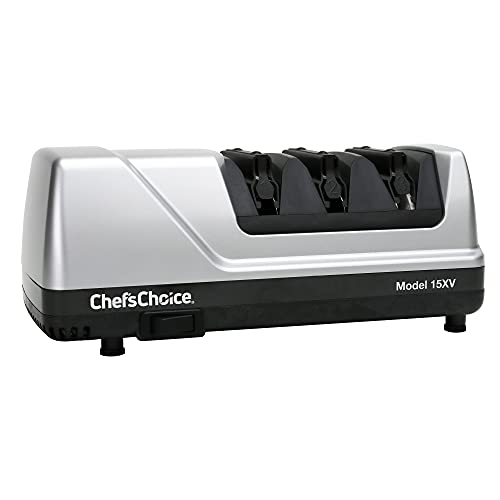
Chef’sChoice Trizor XV EdgeSelect 15
A standard twenty degree European edge converts to fifteen degrees across three stages here, using diamond abrasives and spring guides that hold the angle automatically. No technique separates dull from sharp, just three passes. Owners report excellent results on softer German steel, though it removes more metal than manual methods.
Pros
- Fastest route from dull to genuinely sharp
- Spring guides hold the angle with no technique needed
- Third stage strops for a refined finish
Cons
- Removes noticeably more steel than a stone would
- Bulky footprint for worktop storage
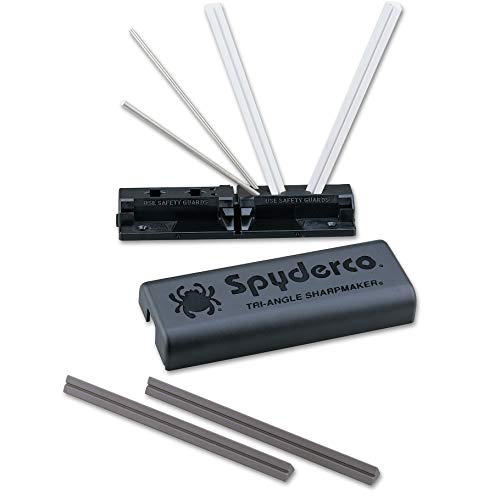
Spyderco Tri-Angle Sharpmaker
Ceramic rods sit at fixed forty and thirty degree included angles, so holding the knife vertically and drawing down is the entire technique. That vertical stroke stays consistent far more easily than a freehand angle ever does. Owners report it excels at keeping an already sharp knife sharp, and goes slowly on badly damaged blades.
Pros
- Vertical stroke stays consistent without practice
- Handles serrated and recurved edges well
- Compact design stores inside its own base
Cons
- Slow going when repairing a badly dulled blade
- Only two fixed angles are available

Sharp Pebble Premium Whetstone 1000 and 6000
Choosing exactly how much steel to remove is possible only with a water stone, which is why it remains standard for Japanese knives. A 1000 grit side reshapes a damaged edge, and a 6000 grit side polishes it keen. Owners report a real learning curve on holding the angle, followed by excellent results once technique settles.
Pros
- Finest achievable edge among the sharpeners here
- Removes only the steel you intend to remove
- Well suited to thin Japanese blade geometry
Cons
- Steepest learning curve in this comparison
- Requires soaking, flattening and clean up after use

Lansky Deluxe 5-Stone Sharpening System
Clamping the blade and guiding rods through preset angle holes delivers the same repeatability principle as pricier guided systems, at a lower outlay. Five hones span coarse repair through to fine polishing in one kit. Owners report excellent value for pocket and hunting knives, and some fiddliness repositioning long kitchen blades.
Pros
- Repeatable angles at a lower price than rivals
- Five grits cover repair through to polish
- Carry case keeps every piece together
Cons
- Long knives need repositioning partway through
- Clamp can mark a polished spine

Wusthof Two Stage Handheld Knife Sharpener
A coarse carbide stage and a fine ceramic stage restore a usable working edge in about a minute here. Busy kitchens benefit more than knife enthusiasts, since this maintains rather than properly sharpens a good knife. Owners report it as genuinely handy mid cooking, with the understood trade-off that carbide takes a bite out of the steel.
Pros
- Fastest touch up of any sharpener in this comparison
- Needs no skill or setup to use
- Compact enough for a kitchen drawer
Cons
- Carbide stage removes a significant amount of steel
- Resulting edge is functional rather than refined

KitchenIQ Edge Grip Two Stage Sharpener
Clipping over a worktop edge keeps both hands free and stable, safer and more consistent than a pull through held in mid air. A coarse carbide stage handles repair, and a ceramic stage finishes the edge. Owners report it as more than adequate for inexpensive kitchen knives and unsuitable for anything precious.
Pros
- Worktop grip makes each stroke more stable
- Lowest cost way to get a working edge here
- Takes almost no drawer space to store
Cons
- Aggressive removal rate on soft steel
- Fixed angle suits European knives only
The lineup, side by side
| # | Model | Type | Best for | Score | Price |
|---|---|---|---|---|---|
| 1 | Work Sharp Precision Adjust Elite | Guided rod sharpening system | Best overall | 9.4 | Check price |
| 2 | Chef’sChoice Trizor XV EdgeSelect 15 | Three stage electric sharpener | Best electric | 9.1 | Check price |
| 3 | Spyderco Tri-Angle Sharpmaker | Fixed angle ceramic rod system | Best for maintaining edges | 8.9 | Check price |
| 4 | Sharp Pebble Premium Whetstone 1000 and 6000 | Dual sided water stone | Best for control | 8.7 | Check price |
| 5 | Lansky Deluxe 5-Stone Sharpening System | Clamp and guide rod system | Best for consistent angles on a budget | 8.5 | Check price |
| 6 | Wusthof Two Stage Handheld Knife Sharpener | Handheld two stage pull through | Best for quick touch ups | 8.2 | Check price |
| 7 | KitchenIQ Edge Grip Two Stage Sharpener | Two stage pull through with counter grip | Best budget | 8.0 | Check price |
Frequently asked questions
How often should kitchen knives be sharpened?
A few times a year covers typical home use, with honing or touch ups far more frequent. A knife that slides off tomato skin or crushes herbs instead of cutting them needs attention. Frequent light maintenance beats occasional heavy grinding.
Are electric knife sharpeners bad for good knives?
Not ruinous, but they remove more steel than manual methods and impose their own edge angle. The Chef’sChoice Trizor XV works excellently on German steel. For expensive Japanese knives, a whetstone or guided system loses less material.
Can you sharpen serrated knives at home?
Yes, but not with a pull through built for straight edges. The Spyderco Sharpmaker handles serrations using its rod corners, and the Chef’sChoice Trizor XV has a dedicated stage for them. Each scallop needs individual attention, so it takes patience.
What grit whetstone should a beginner start with?
A 1000 grit side handles most sharpening jobs, and a 3000 to 6000 side refines the edge afterward. A combination stone like the Sharp Pebble 1000 and 6000 covers both. Reach for anything coarser only if the edge is chipped.
Do you need a honing steel in addition to a sharpener?
It helps considerably. A honing steel realigns a rolled edge in seconds and stretches the time between real sharpenings. Use it before or after cooking rather than trying to fix an already blunt knife.
How do you know when a knife is actually sharp?
It should slice a sheet of paper cleanly without tearing and glide into a tomato under its own weight. Feeling for a burr along the edge during sharpening signals when to switch sides. Skip testing it on a thumb.
Can these sharpeners handle single bevel Japanese knives?
A traditional single bevel knife such as a yanagiba needs a whetstone and specific technique, not a fixed angle device. Of the picks here, only the Sharp Pebble whetstone fits that job, and it still rewards learning the method properly.
Is a guided sharpening system worth it over a whetstone?
If sharpening happens occasionally and reliable results without practice matter most, yes. A guided system like the Work Sharp Precision Adjust Elite gets a good edge on the first attempt, while a whetstone rewards practice with better long-term control.
The verdict
Work Sharp’s Precision Adjust Elite gives the best edge for reasonable effort, and it handles kitchen and pocket knives equally well. Choose the Chef’sChoice Trizor XV EdgeSelect when speed and zero technique matter most, and add a Spyderco Tri-Angle Sharpmaker for quick maintenance between full sharpenings.
Dana Whitfield
Dana spent eight years buying and merchandising for a regional kitchenware retailer before moving into editorial work. She has handled thousands of SKUs across cookware, small appliances and kitchen organization, and focuses on the practical differences that matter once a product is actually in daily use.