Lifting Belts That Keep Your Spine Braced Under Load
The Rogue Ohio Lifting Belt leads this comparison as a single-prong leather belt built for heavy squats and deadlifts. Gymreapers Lever Belt suits lifters who want maximum tightness without punching new holes, while the Element 26 Nylon Belt fits anyone needing quick on-and-off adjustments between exercises.
The Rogue Ohio Lifting Belt stands out because its single-prong leather design matches federation standards for raw powerlifting meets. Its main limitation is adjustment speed, since a prong closure takes longer to fasten than a lever or velcro belt.
We compared published material, width, closure type and thickness across each listing based on manufacturer specifications and owner feedback on fit.
The shortlist, ranked

Rogue Ohio Lifting Belt
A 10 millimeter leather construction stays rigid enough to brace the core during max-effort squats and deadlifts. The single prong closure meets most powerlifting federation equipment rules, unlike lever or velcro designs. Suede backing reduces slipping against a lifting singlet or bare skin.
Pros
- Meets equipment rules for most raw powerlifting federations
- Rigid leather brace supports heavy squats and deadlifts
- Suede backing resists slipping during lifts
Cons
- Prong closure is slower to fasten than lever or velcro belts
- Break-in period needed before leather softens to the body

Gymreapers Lever Belt
A lever closure clamps down tighter than a prong can reach, which matters most on heavy single attempts. Suede lining grips the torso without digging in the way raw leather sometimes does. Lever position needs a wrench adjustment to resize, unlike adjustable hook designs.
Pros
- Lever closure reaches tighter than a prong belt
- Suede lining reduces skin irritation during long sessions
- Quick to snap shut once sized correctly
Cons
- Resizing the lever position requires a wrench and screws
- Not legal in federations that ban lever closures

Element 26 Nylon Weightlifting Belt
A continuous velcro closure lets lifters change tightness in seconds between warmup sets and max attempts. Nylon construction stays lighter and more flexible than leather, suiting Olympic lifts that need hip mobility. It lacks the rigid brace a thick leather belt provides on heavy grinds.
Pros
- Velcro closure adjusts tightness in seconds
- Lighter and more flexible than leather for Olympic lifts
- No break-in period required
Cons
- Less rigid support than thick leather on maximal lifts
- Velcro wears out faster than a prong or lever over years

Harbinger 4-Inch Padded Leather Lifting Belt
Foam padding along the inside reduces pressure points during high-rep accessory work, a detail competition belts skip. A contoured shape tapers at the front for comfort during situps and lighter movements. The tradeoff is less rigidity than a flat, uniform powerlifting belt.
Pros
- Foam padding improves comfort on high-rep training days
- Contoured shape allows more mobility than flat belts
- Suitable for general strength training beyond max lifts
Cons
- Less rigid brace than a flat, uniform powerlifting belt
- Tapered shape is not accepted in strict federation competition

Rip Toned Weight Lifting Belt
A nylon build with a double-prong buckle keeps the price down while still providing core support for general training. It ships lighter and more compact than leather alternatives, easing travel to different gyms. Long-term durability trails genuine leather under daily heavy use.
Pros
- Lower price point than leather lifting belts
- Compact and light enough to pack for travel
- Adjustable across a wide waist size range
Cons
- Less durable than leather under years of heavy daily use
- Buckle holes can stretch over with frequent heavy lifting

Schiek Model 2004 Nylon Lifting Belt
A contoured 6 inch back panel tapering to 2 inches at the hips allows deeper hip flexion during cleans and snatches. Nylon construction stays flexible through full range Olympic lifts that a rigid leather belt can restrict. It gives less maximal bracing than a flat powerlifting belt on single-rep squats.
Pros
- Contoured shape allows deep hip flexion for cleans and snatches
- Flexible nylon does not restrict Olympic lift ranges of motion
- Lighter than leather for dynamic, fast movements
Cons
- Provides less maximal bracing than a flat leather belt
- Not the first choice for max-effort powerlifting squats
Dark Iron Fitness Weightlifting Belt
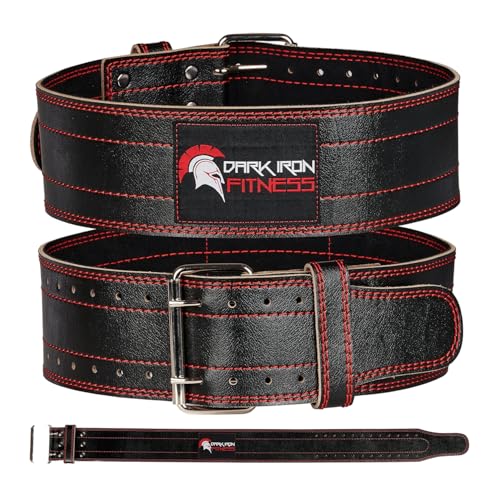
A hybrid leather and suede build gives first-time belt users a middle ground between rigid competition belts and soft nylon. The double prong closure is simple to learn before progressing to a lever system later. It runs slightly narrower support than a dedicated 10 millimeter competition belt.
Pros
- Simple double prong closure is easy for first-time users
- Hybrid leather softens faster than full competition leather
- Price sits below dedicated competition belts
Cons
- Thinner build offers less bracing than a 10mm competition belt
- Not intended for max-effort competition lifting
How they stack up
| # | Model | Material | Best for | Score | Price |
|---|---|---|---|---|---|
| 1 | Rogue Ohio Lifting Belt | 10mm leather | Best Overall for Powerlifting | 9.3 | Check price |
| 2 | Gymreapers Lever Belt | Leather, suede lined | Best for Maximum Tightness | 9.0 | Check price |
| 3 | Element 26 Nylon Weightlifting Belt | Nylon | Best for Quick Adjustments | 8.8 | Check price |
| 4 | Harbinger 4-Inch Padded Leather Lifting Belt | Leather with foam padding | Best Padded Comfort | 8.6 | Check price |
| 5 | Rip Toned Weight Lifting Belt | Nylon | Best Budget | 8.3 | Check price |
| 6 | Schiek Model 2004 Nylon Lifting Belt | Nylon | Best for Olympic Lifting Mobility | 8.2 | Check price |
| 7 | Dark Iron Fitness Weightlifting Belt | Hybrid leather and suede | Best for Beginners Transitioning from Machines | 8.0 | Check price |
What to look for
What to look for in a weightlifting belt Material decides how rigid the brace feels, with leather holding firmer than nylon under heavy load. Closure type, prong, lever or velcro, trades off speed of adjustment against maximum tightness. Width and thickness affect how much the belt limits torso movement during different lift types.
Powerlifting versus general strength training Federation competition favors a single-prong or lever leather belt like the Rogue Ohio or Gymreapers, since rules often ban velcro closures. General strength training tolerates more flexibility, where a nylon belt like the Element 26 or Rip Toned works fine. Olympic lifters need a contoured design like the Schiek 2004 that does not block hip flexion.
Matching closure speed to training style Lifters cycling through many exercises in one session benefit from velcro’s quick resizing, found on the Element 26. Max-effort single attempts favor a lever’s locked-in tightness, as on the Gymreapers belt. A standard prong buckle, used by Rogue and Dark Iron Fitness, sits in between on both speed and rigidity.
Comfort and break-in for daily use Full leather belts like the Rogue Ohio need a break-in period before they soften around the torso. Padded designs like the Harbinger skip that wait with foam cushioning from day one. Nylon belts need no break-in at all, which suits lifters who switch belts often or travel between gyms.
Good to know
How tight should a weightlifting belt fit?
A properly fit belt allows a deep breath against it before bracing; too loose provides no support and too tight restricts breathing during the lift.
Is a lever belt better than a prong belt?
A lever like the Gymreapers reaches tighter settings faster, but a prong belt like the Rogue Ohio adjusts more precisely across different training days.
Can beginners use a weightlifting belt?
Yes, though most coaches recommend learning to brace the core without a belt first, then adding one like the Dark Iron Fitness once lifts near bodyweight loads.
What width weightlifting belt is best?
A 4 inch belt, used by most listings here, suits most lifters; wider belts can dig into the ribs or hips depending on torso length.
Are nylon lifting belts as effective as leather?
For general training, nylon belts like the Element 26 provide adequate support; leather belts like the Rogue Ohio still edge out nylon for max-effort squats and deadlifts.
Is a velcro belt legal in powerlifting competition?
Most raw powerlifting federations require a single-prong or lever belt and disallow velcro closures, so check specific federation rules before competing.
Does a lifting belt prevent back injuries?
A belt increases intra-abdominal pressure to support the spine under load, but it does not replace proper lifting technique or adequate warmup.
What is the difference between a powerlifting belt and a bodybuilding belt?
Powerlifting belts stay a uniform width like the Rogue Ohio, while bodybuilding belts often taper at the front like the Harbinger for more hip mobility.
How long does a leather lifting belt last?
A quality leather belt like the Rogue Ohio or Gymreapers can last many years of regular training if stored flat and kept away from excess moisture.
The bottom line
The Rogue Ohio Lifting Belt is the strongest pick for lifters training toward competition-style squats and deadlifts. Anyone who wants faster, tighter adjustments between heavy sets should choose the Gymreapers Lever Belt instead. Olympic lifters needing hip mobility fit better with the contoured Schiek Model 2004.
Derek Holt
Derek has a background coaching recreational and amateur athletes and has worked the sales floor at specialty fitness retailers. He focuses on equipment durability, ergonomics and realistic use cases rather than marketing claims.