Aquarium Test Kits: Liquid Drops vs Strips vs Sensors
API’s Freshwater Master Test Kit leads for community freshwater tanks, while its Saltwater Master Test Kit suits reef and marine setups. Owners who want a one-minute weekly check instead of a multi-step liquid process should reach for Tetra’s EasyStrips 6-in-1 instead.
Community freshwater tanks call for API’s Freshwater Master Test Kit, which delivers accurate pH, ammonia, nitrite, and nitrate readings from roughly 800 tests per kit. Its glass-tube liquid process takes longer than dip strips and carries no saltwater calibration. Reef keepers need the marine version or a single-parameter reef test instead.
Freshwater and saltwater kits use different reagent calibrations, and strips trade some precision for speed, a tradeoff that confuses first-time buyers. We compared published parameter lists, test counts per kit, and owner feedback on reading ease against each tank type and testing habit. That match, not a single overall winner, decides which kit fits best.
The top picks, ranked

API Freshwater Master Test Kit
Glass test tubes hold liquid reagents here, covering pH, high-range pH, ammonia, nitrite, and nitrate in one kit. Roughly 800 tests ship across those five parameters, according to the listing. Owners report the color-match charts read more precisely than paper strips once the shake-and-time process becomes routine.
Pros
- Color chart booklet makes results easier to read
- Lower cost per test than most strip kits
- Standard freshwater kit trusted by long-time hobbyists
Cons
- Requires shaking bottles and timing color reactions
- Glass tubes are harder to read in dim light
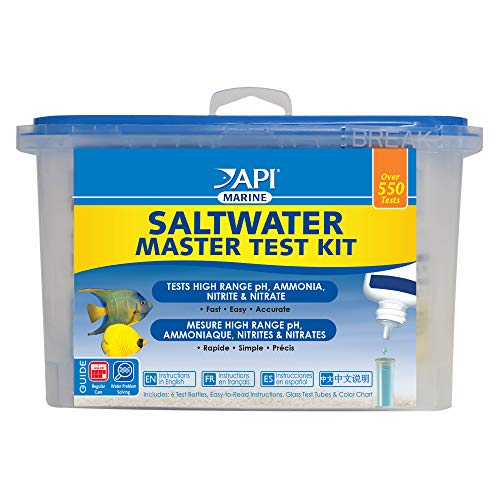
API Saltwater Master Test Kit
Marine-calibrated pH reagents replace the freshwater formula here, and the high-pH test drops out since reef water rarely needs it. Ammonia, nitrite, nitrate, and pH round out roughly 550 tests per box, per the manufacturer listing. Calcium, alkalinity, and magnesium sit outside its range, so reef keepers dosing corals still need supplemental kits.
Pros
- Marine-calibrated pH range matches reef tank chemistry
- Same glass-tube accuracy as the freshwater version
Cons
- Skips calcium, alkalinity, and magnesium entirely
- Reagent bottles need replacing about once a year

Tetra EasyStrips 6-in-1 Test Strips
One dip covers six parameters here, including carbonate and general hardness that API’s liquid kits skip entirely. Results appear in about a minute, versus the multi-step process liquid drops require, per the packaging instructions. Each canister holds just 25 strips, so cost per test runs higher than a liquid master kit.
Pros
- Fastest results of any kit in this lineup
- Tests hardness levels most liquid kits omit
Cons
- Strip color blocks are harder to distinguish than liquid vials
- Fewer tests per canister raises long-term cost

JNW Direct 16-in-1 Aquarium Test Strips
Sixteen parameters fit onto a single strip here, adding copper and free chlorine checks that most kits skip. A tub holds 100 strips, which lowers cost per test compared to smaller canisters. Owners report the wide color key needs good lighting to match accurately.
Pros
- Covers more parameters than any other kit here
- Large strip count keeps per-test cost low
Cons
- Sixteen color blocks per strip complicate quick reading
- Extra parameters like copper matter less for routine freshwater care

Seachem Ammonia Alert
A suction badge replaces one-time testing here, changing color continuously as free ammonia rises. Seachem rates each sensor for up to a year of monitoring, according to the product listing. Ammonia is the only parameter it reads, so it supplements rather than replaces a full liquid or strip kit.
Pros
- Constant monitoring catches ammonia spikes between manual tests
- No reagents or timing needed after installation
Cons
- Reads ammonia only, nothing else
- Subtle color shifts need consistent lighting to judge

Salifert Calcium Test Kit
Titration sets this kit apart, since reef keepers count reagent drops until a color shift instead of matching a chart. Calcium is the only parameter tested, with around 50 tests per box based on the manufacturer’s specs. Coral keepers dosing calcium reactors or additives rely on this precision to avoid overshooting target levels.
Pros
- Titration method gives finer readings than color charts
- Trusted brand among reef and coral keepers
Cons
- Tests only calcium, so alkalinity and magnesium need separate kits
- Drop-counting technique has a learning curve

Fluval 7-in-1 Test Strips
Core cycling parameters, ammonia, nitrite, and nitrate, sit alongside pH, hardness, and chlorine on this single strip. Fifty strips per bottle make it practical for the weekly checks a new tank needs during cycling. Results read in under a minute, though strip-based nitrite readings trend less precise than liquid drop tests.
Pros
- Covers all three cycling parameters plus hardness and chlorine
- Fast enough for frequent checks during a new tank cycle
Cons
- Strip nitrite and ammonia readings are less precise than liquid reagent tests
- Fifty-strip count runs out quickly with daily cycling checks
What to look for
What to look for in an aquarium water test kit Four parameters matter most for fish health, pH, ammonia, nitrite, and nitrate, and every kit here tests some combination of them. Freshwater and saltwater versions calibrate pH differently, so buying the wrong one skews readings. Tests per kit range widely, from fifty strips to roughly eight hundred liquid tests, which changes real cost per test over a year. Reading results by color chart takes practice too, whether comparing a strip or a filled test tube.
Are liquid test kits more accurate than strips Finer color gradients set liquid reagent kits like API’s master kits apart from strips, based on owner feedback across both product lines. Strips answer in under a minute, a pace that suits owners testing weekly for a quick snapshot. Nitrite and ammonia readings on strips cluster into broader color bands than liquid drops allow. Anyone chasing precise numbers during a tank cycle should lean toward liquid tests despite the extra steps.
Reef tanks need different parameters than freshwater tanks Calcium, alkalinity, and magnesium stability matter for saltwater and reef tanks in ways freshwater setups never need. Salifert’s calcium kit and similar single-parameter reef tests exist because master kits like API’s saltwater version stop at ammonia, nitrite, nitrate, and pH. Coral keepers dosing supplements typically stack a master kit with one or two of these single-parameter tests. Freshwater community tank owners rarely need calcium or alkalinity data unless they keep species that require harder water.
Is a continuous ammonia monitor worth adding Badge-style sensors like Seachem’s Ammonia Alert stay suctioned to the glass and shift color as ammonia rises, unlike a one-time drop or strip test. New tanks benefit most, since ammonia can spike between scheduled test days during cycling. Owners with red-green colorblindness sometimes struggle with chart-based color matching, and pairing a badge sensor with a digital pH meter avoids relying entirely on color perception. A badge alone still needs a full liquid or strip kit alongside it, since it tracks just one parameter.
How they compare
| # | Model | Test method | Best for | Score | Price |
|---|---|---|---|---|---|
| 1 | API Freshwater Master Test Kit | Liquid reagent drops | Best overall | 9.4 | Check price |
| 2 | API Saltwater Master Test Kit | Liquid reagent drops | Best for saltwater and reef tanks | 9.1 | Check price |
| 3 | Tetra EasyStrips 6-in-1 Test Strips | Dip strips | Best for quick weekly checks | 8.8 | Check price |
| 4 | JNW Direct 16-in-1 Aquarium Test Strips | Dip strips | Best budget value for high test count | 8.5 | Check price |
| 5 | Seachem Ammonia Alert | Sealed badge sensor | Best for continuous ammonia monitoring | 8.3 | Check price |
| 6 | Salifert Calcium Test Kit | Titration with liquid reagent | Best for reef calcium testing | 8.1 | Check price |
| 7 | Fluval 7-in-1 Test Strips | Dip strips | Best for new tank cycling | 8.0 | Check price |
Questions worth asking
How often should I test my aquarium water?
Established tanks generally need weekly testing for ammonia, nitrite, nitrate, and pH. New tanks going through the nitrogen cycle benefit from testing every one to two days until ammonia and nitrite both read zero.
Are liquid test kits more accurate than test strips?
Liquid reagent kits like the API master kits typically resolve finer color gradients than strips, based on owner feedback. Strips trade some precision for speed, delivering results in about a minute versus several minutes of shaking and timing for liquid drops.
What is the difference between a freshwater and saltwater test kit?
Freshwater kits calibrate pH reagents for lower, more acidic ranges, while saltwater kits like the API Saltwater Master Test Kit calibrate for the higher, more alkaline pH marine tanks maintain. Saltwater kits also drop the high-range pH test since reef water rarely needs it.
What do high ammonia and nitrite readings mean for my fish?
Any detectable ammonia or nitrite is toxic to fish and signals an uncycled or overstocked tank. Nitrate is less immediately dangerous but should stay low with regular water changes.
How long do water test kit reagents last before they expire?
Liquid reagent bottles typically stay accurate for about a year from manufacture, according to manufacturer guidance, though opened bottles can degrade faster if not stored properly. Test strips are more sensitive to humidity and should be kept sealed until use.
Can I use a freshwater test kit in a saltwater tank?
No. Freshwater and saltwater kits use different reagent calibrations, particularly for pH, so results from a freshwater kit will not read accurately in saltwater. Dedicated saltwater or reef kits exist specifically because marine chemistry differs enough to need separate reagents.
Is a separate calcium test kit necessary for reef tanks?
Reef tanks with corals benefit from a dedicated calcium test like Salifert’s, since master kits such as the API Saltwater Master Test Kit do not measure calcium, alkalinity, or magnesium. Fish-only saltwater tanks without corals can usually skip calcium testing.
How many tests do I get from a strip canister versus a liquid kit?
A liquid master kit like API’s freshwater version delivers roughly 800 tests across five parameters, while a strip canister like Tetra’s EasyStrips holds 25 strips covering six parameters per dip. Higher-count strip tubs, like JNW Direct’s 100-strip pack, close that cost-per-test gap somewhat.
Do I need a continuous ammonia monitor if I already test weekly?
A badge sensor like Seachem’s Ammonia Alert catches spikes between scheduled tests, something a once-a-week strip or liquid check can miss. New tanks mid-cycle benefit most, since ammonia can rise fast in just a day or two.
Our take
API’s Freshwater Master Test Kit remains the strongest pick for most freshwater tank owners, pairing proven color-match accuracy with a cost per test that beats every strip option here. Reef and saltwater keepers should start with the API Saltwater Master Test Kit and add a Salifert calcium test once corals settle in. Owners who just want a fast weekly snapshot without shaking reagent bottles are better served by Tetra’s EasyStrips or Fluval’s 7-in-1 strips instead.
Olivia Hartley
Olivia spent several years working at an animal shelter and a pet-supply retailer before joining the editorial team. She researches pet gear with an emphasis on safety, comfort and the fine print that owners often miss.
