Which Water Leak Sensor Actually Reaches Your Basement
YoLink’s Smart Water Leak Sensor wins for range, since its sub gigahertz radio reaches basements where WiFi drops out. Govee’s H5054 skips the hub entirely for the simplest setup. Ring’s Flood and Freeze Sensor fits best inside an existing Ring Alarm system, adding freeze detection alongside leak alerts.
YoLink’s sensor covers ground WiFi cannot, using a long range radio that checks in from basements and detached garages. Govee’s H5054 needs no hub, which keeps setup to a few minutes per unit. Ring owners get freeze detection and flood alerts through hardware already tied to their alarm app.
Leak sensors matter most in the spots WiFi struggles to reach, like basement corners and utility rooms behind concrete walls. A weak signal there means a missed alert exactly when it counts. We compared radio type, claimed range, local alarm volume, battery life and hub requirements, then weighed those specs against what owners report about false triggers and dropped connections.
The best picks, ranked

YoLink Smart Water Leak Sensor
YoLink skips WiFi for a sub gigahertz radio, so signal reaches a basement corner or a detached garage where WiFi would drop. A loud onboard siren fires locally the moment probes sense water. Paired with a YoLink valve controller, the sensor can shut off the water supply automatically instead of just sending a notification.
Pros
- Signal reaches basements and outbuildings WiFi cannot cover
- Can close a smart shutoff valve automatically
- Low power radio stretches battery life for years
Cons
- Needs the YoLink hub to send remote alerts
- Smaller ecosystem than Ring or SmartThings
Govee WiFi Water Sensor H5054
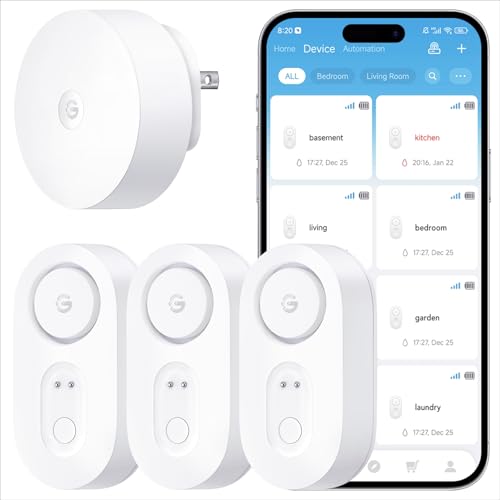
Connect the H5054 straight to home WiFi and skip buying a separate hub. Setup takes a couple of minutes per sensor, according to the listing. A high decibel siren fires locally, which matters when a phone sits in another room overnight.
Pros
- Skips the hub, connects directly to WiFi
- Loud local siren wakes someone nearby
- Multi pack listings make covering several rooms affordable
Cons
- Needs strong 2.4GHz signal exactly where it sits
- Remote alerts rely on the Govee cloud app

Ring Alarm Flood and Freeze Sensor
Already running Ring Alarm? This sensor joins the same app and base station without a second account. Beyond water contact, it flags freezing temperatures, useful in unheated crawl spaces where pipes burst before they leak. Monitoring subscribers can route alerts into Ring’s professional response chain.
Pros
- Joins an existing Ring system with no extra app
- Freeze detection warns before a pipe bursts
- Compatible with Ring professional monitoring plans
Cons
- Does nothing without a Ring Alarm base station
- Local alarm sits quieter than standalone leak sirens

Aqara Water Leak Sensor
Zigbee connects this compact sensor to Apple Home, Alexa and Google Home once bridged through an Aqara hub. A leak can then trigger a lamp, a speaker announcement or a valve in whatever platform already runs the house. Coin cell power keeps it running for years without attention, according to the listing.
Pros
- Small and cheap enough to place under every fixture
- Plugs into automations across major smart home platforms
- Coin cell battery lasts years between changes
Cons
- Carries no local siren on the sensor itself
- Depends on an Aqara or compatible Zigbee hub
SwitchBot Water Leak Detector
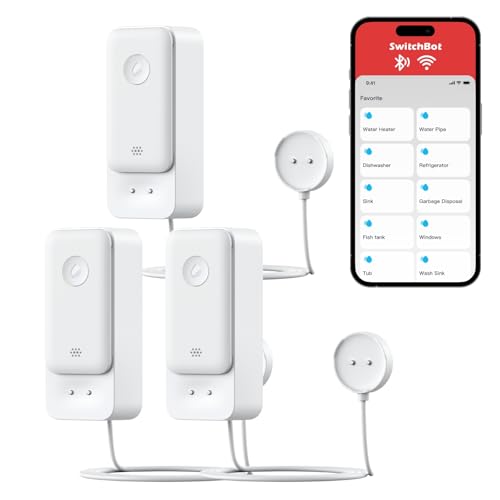
Bluetooth links this detector to other SwitchBot devices, so a leak can switch off a smart plug feeding a washing machine. IP67 rating lets it sit flush against a wet floor without damage. Remote alerts still need a SwitchBot hub, following the pattern of most devices in that lineup.
Pros
- Can cut power to an appliance the moment water is sensed
- Rugged IP67 body tolerates standing water
- Local siren still sounds even offline from the hub
Cons
- Remote phone alerts require a SwitchBot hub
- Automations stay limited to the SwitchBot ecosystem

Moen Flo Smart Water Detector
Pairing with the Flo smart shutoff valve turns this sensor into more than an alarm, closing the main water supply when it detects a puddle in the laundry room. Humidity and temperature readings flag slow problems before they turn into leaks. On its own it works as a capable WiFi sensor, but the Flo valve is where the system delivers its real value.
Pros
- Works with a whole home automatic shutoff valve
- Humidity and temperature data flags problems early
- Flo app presents alerts clearly, according to the listing
Cons
- Most benefit depends on adding the Flo valve
- Standalone use offers less than the full system

Zircon Leak Alert Water Detector
Water touches the probes and this detector screams, nothing more complicated than that. No app, no WiFi, no account to set up. A 9V battery keeps it running for years, making a handful of these under sinks a sensible low tech backup even inside a connected home.
Pros
- Nothing to configure and nothing to break
- Skips WiFi and any cloud subscription entirely
- Long battery life from a simple 9V cell
Cons
- Sends no alert when nobody is home to hear it
- Keeps no history and offers no automation
Side by side
| # | Model | Radio | Best for | Score | Price |
|---|---|---|---|---|---|
| 1 | YoLink Smart Water Leak Sensor | LoRa sub gigahertz, long range | Best overall | 9.4 | Check price |
| 2 | Govee WiFi Water Sensor H5054 | 2.4GHz WiFi, no hub | Best value | 9.2 | Check price |
| 3 | Ring Alarm Flood and Freeze Sensor | Ring Alarm base station | Best for Ring Alarm households | 9.0 | Check price |
| 4 | Aqara Water Leak Sensor | Zigbee, Aqara hub required | Best for smart home automation | 8.7 | Check price |
| 5 | SwitchBot Water Leak Detector | Bluetooth, hub needed for remote alerts | Best for cutting power automatically | 8.5 | Check price |
| 6 | Moen Flo Smart Water Detector | Water contact, humidity and temperature | Best paired with a whole home shutoff | 8.3 | Check price |
| 7 | Zircon Leak Alert Water Detector | Standalone audible alarm | Best budget | 8.0 | Check price |
Before you buy
How many leak sensors does a home actually need? Coverage matters more than any single sensor’s quality. One unit under the kitchen sink misses the washing machine, the water heater and the upstairs bathroom, where most costly leaks start. Multi packs make it affordable to place a sensor at every water heater, washing machine, dishwasher and basement floor drain.
Which wireless radio actually reaches every room? WiFi sensors are simplest to set up but need strong 2.4GHz signal exactly where coverage tends to fail. Zigbee and sub gigahertz radios need a hub yet push through walls and floors on less battery power. Choose a long range system like YoLink when a basement or detached garage has patchy WiFi.
Can a sensor stop a leak, not just report it? A notification sent while you’re at work does not turn off the water by itself. Pairing a sensor with an automatic shutoff valve, whether the Moen Flo system or a YoLink valve controller, converts an alert into actual prevention. Where a full valve is out of scope, a smart plug that cuts power to a washing machine solves one common failure cheaply.
How often should sensors and batteries be checked? Leak sensors sit untouched for years, which is exactly why they fail silently when needed most. Touch each sensor’s probes with a wet finger twice a year to confirm both the local siren and the phone alert still fire. Swap batteries on a calendar schedule instead of waiting for a low battery warning that might go unnoticed.
Good to know
Where should water leak sensors go in a house?
Start with the water heater, washing machine, dishwasher and under sink connections, then add sump pits and toilet bases. Place each sensor flat on the floor at the lowest point, not on a shelf above the appliance. Corners and shallow floor dips catch water first, according to owners who track where leaks actually pool.
Do water leak sensors need WiFi to work?
Not always. Govee’s H5054 connects straight to WiFi, YoLink and Aqara use their own radios through a hub, and the Zircon Leak Alert has no connectivity at all. Getting alerts while away from home requires some path to the internet, whether that’s WiFi at the sensor or a hub elsewhere in the house.
How long do leak sensor batteries last?
Zigbee and sub gigahertz sensors often run two years or more on their low power radios. WiFi sensors typically need fresh batteries every six to twelve months. Most models send a low battery alert, but a scheduled swap beats waiting for a warning that could be missed.
Can a leak sensor turn off the water automatically?
Only when paired with a motorized shutoff valve on the main supply, such as the Moen Flo valve or a YoLink valve controller. Without that pairing, the sensor can alert but cannot act. That combination is the only setup here that stops water flow while nobody is home.
Will a leak sensor catch a slow drip before it spreads?
Only if water actually reaches the probes, so placement matters more than sensitivity. A drip soaking into a cabinet base or running down a wall cavity may never reach floor level. Some sensors ship with a remote probe on a cable that tucks into a tight gap where water pools first.
Water leak sensor vs smart shutoff valve: which comes first?
A sensor alone can only alert, so buy sensors first to cover every risk point cheaply. Add a shutoff valve like the Moen Flo or YoLink controller once coverage is in place, since that’s what actually stops water flow. Budgets that stretch to both get detection and prevention together.
Are freeze sensors worth adding alongside leak detection?
In any home with pipes running through unheated space, yes. A freeze alert warns before a pipe bursts, which matters more than learning about the water afterward. The Ring Alarm Flood and Freeze Sensor and the Moen Flo detector both track temperature alongside water contact.
Do leak sensors give false alarms from mopping or condensation?
Genuine false alarms are rare since the trigger is simple contact between two probes. Mopping, condensation or a spilled drink can still set one off. Keeping sensors slightly away from areas that get splashed or mopped avoids most nuisance alerts.
How loud should a leak sensor’s alarm be?
Loud enough to wake someone through a closed door, which in practice means a siren rather than a soft beep. The person already at home is usually the fastest responder to a leak. Sensors without a local siren, like the Aqara, pair well with a smart speaker or hub that raises noise when triggered.
The bottom line
YoLink’s Smart Water Leak Sensor suits most homes best, since its long range radio reaches basements and garages where leaks start and it can close a valve instead of just sounding an alarm. Govee’s H5054 gets a house covered fastest without buying a hub. Ring households gain the most by adding the Flood and Freeze Sensor to hardware they already own.
Marcus Chen
Marcus covered consumer electronics for enthusiast tech publications for six years before joining ChoiceCrest. He specializes in translating manufacturer spec sheets into plain-language buying advice, with a focus on audio, computing accessories and smart-home gear.