HDMI Cables That Actually Support 8K and 4K120
The Belkin Ultra HD High Speed HDMI 2.1 Cable is the strongest all-around pick thanks to full HDMI 2.1 certification and 8K60 or 4K120 support. Console gamers get more gaming-specific features from the Zeskit Maya instead, while anyone running a cable through a wall or across a large room needs the Cable Matters Active Optical cable’s longer reach.
The Belkin Ultra HD High Speed HDMI 2.1 Cable stands out for carrying full independent HDMI 2.1 certification, backing its 48Gbps bandwidth and 8K60 or 4K120 support with verified testing rather than marketing claims alone. Its main limitation is a thicker jacket that is slightly less flexible than budget cables when routing behind a TV stand.
We compared published bandwidth, certification status and resolution support across each listing rather than running our own signal tests.
How to pick the right one
What HDMI cable specs actually matter Bandwidth, measured in Gbps, decides what resolution and refresh rate combination a cable can carry, with 48Gbps needed for 8K60 or 4K120 and 18Gbps sufficient for standard 4K60. Certification, whether HDMI 2.1 or the older Premium label used by the Monoprice cable, verifies that a cable actually delivers its advertised bandwidth. Gaming features like VRR and ALLM, found on the Zeskit Maya, only matter if the connected console or display also supports them.
Matching a cable to your TV, console or PC A 4K60 television paired with a standard streaming box rarely needs more than the Monoprice or Amazon Basics cable’s 18Gbps bandwidth. Current-generation gaming consoles running 4K at 120Hz benefit directly from the Zeskit Maya’s VRR and ALLM support. Buyers with an 8K display or a high-end gaming PC should prioritize the full 48Gbps bandwidth found on the Belkin, JSAUX and UGREEN cables.
Certified versus uncertified HDMI cables Certified cables, like the Belkin HDMI 2.1 model and the Monoprice Premium cable, undergo independent testing to confirm their bandwidth and feature claims. Uncertified cables, like the JSAUX and UGREEN options, often list the same specifications on paper but lack third-party verification. The practical difference matters most for buyers who have experienced signal dropouts or compatibility issues with uncertified cables in the past.
Cable length, durability and installation Standard copper HDMI cables, including most on this list, work reliably at shorter lengths but can degrade past a certain distance. The Cable Matters Active Optical cable solves this with a fiber core built for long in-wall or large-room runs where copper alone risks dropouts. Durability features like the JSAUX cable’s braided jacket matter more for cables that get moved, coiled or routed through tight spaces repeatedly.
The shortlist, ranked

Belkin Ultra HD High Speed HDMI 2.1 Cable
This cable is certified to the full HDMI 2.1 specification, supporting 8K60 and 4K120 signals along with variable refresh rate for gaming displays. Belkin backs it with independent certification testing rather than relying on marketing claims alone. A moderately thick, flexible jacket balances durability with ease of routing behind a TV stand.
Pros
- Full HDMI 2.1 certification backs its advertised bandwidth claims
- Supports both 8K60 and 4K120 for current and next-gen displays
- eARC support simplifies passing high quality audio to a soundbar
Cons
- Costs more than uncertified cables claiming similar specs
- Thicker jacket is slightly less flexible than budget alternatives

Zeskit Maya 8K HDMI 2.1 Cable
Built around the same 48Gbps bandwidth as premium cables, this model specifically markets its compatibility with current-generation gaming consoles running 4K at 120Hz. Variable refresh rate and auto low latency mode support both matter directly for console gaming, reducing screen tearing and input lag. Zeskit tests each cable for signal integrity before shipping, a step not every budget brand takes.
Pros
- 4K120 and VRR support directly benefit current-generation console gaming
- ALLM support reduces input lag by auto-switching display modes
- Individual testing adds a quality check most budget cables skip
Cons
- Marketed mainly toward gaming, less emphasis on home theater features like eARC
- Shorter length options limit use in longer cable runs
Monoprice Certified Premium High Speed HDMI Cable
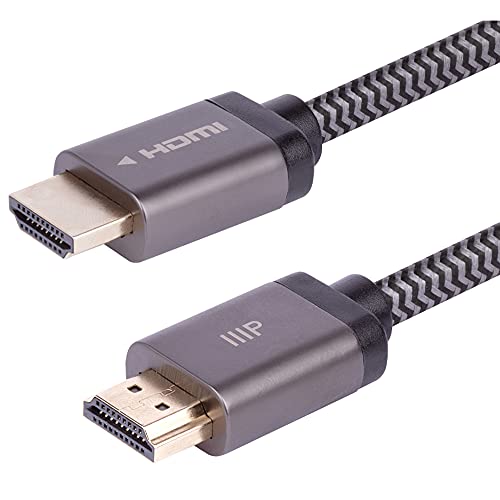
This cable carries the HDMI Licensing Administrator’s Certified Premium label, an independent certification that verifies bandwidth and signal quality claims. It supports 4K at 60Hz with HDR, a tier below the full 8K specification of newer HDMI 2.1 cables. Monoprice positions it as a reliable mid-tier option for buyers who do not need 8K or 4K120 support.
Pros
- Independent Premium Certification label verifies the cable’s actual specs
- Reliable 4K60 HDR support covers most current streaming and Blu-ray content
- Lower cost than full HDMI 2.1 certified cables
Cons
- 18Gbps bandwidth caps out below 8K and 4K120 capable cables
- Lacks VRR and ALLM gaming features found on newer cables
JSAUX 8K HDMI 2.1 Braided Cable
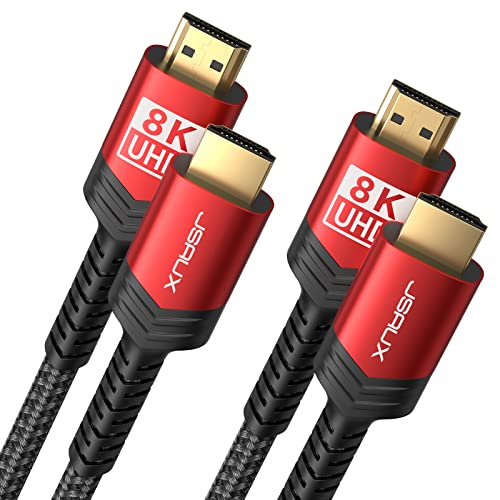
A nylon braided jacket resists fraying and kinking better than the standard rubber jackets used on most HDMI cables, useful for cables routed through tight spaces or frequently moved. It still supports the full 48Gbps HDMI 2.1 bandwidth, matching premium cables in raw specification. Gold-plated connectors resist corrosion slightly better than standard-plated connectors over years of use.
Pros
- Nylon braided jacket resists fraying better than standard rubber cables
- Full 48Gbps bandwidth matches premium certified cables
- Gold-plated connectors add some corrosion resistance over time
Cons
- Braided jacket is stiffer and harder to route tightly than rubber cables
- Not independently certified like the Belkin or Monoprice options

Amazon Basics High-Speed HDMI Cable
This cable covers standard 4K at 60Hz without HDR or the higher bandwidth features of HDMI 2.1, aimed at buyers connecting a basic streaming device or older console. Its lower cost makes it reasonable for short runs where cable quality matters less than for a long run behind a wall. Amazon Basics backs it with a standard limited warranty matching its budget positioning.
Pros
- Lowest cost option on this list for basic 4K connections
- Reasonable choice for short cable runs behind a TV stand
- Simple, no-frills design with a standard limited warranty
Cons
- Lacks confirmed HDR pass-through found on pricier cables
- No support for 8K or 4K120 gaming features

Cable Matters Active Optical HDMI Cable
An active optical design uses fiber internally to carry signal over much longer distances than standard copper HDMI cables without signal degradation. This makes it suited to running a cable through walls or across a large room, where copper cables risk dropouts past a certain length. Directional connectors mean one end must connect to the source device, a detail that differs from standard symmetrical HDMI cables.
Pros
- Fiber core maintains signal quality far beyond standard copper cable range
- Full 48Gbps bandwidth supports high resolution over long distances
- Suited specifically for in-wall or large-room installations
Cons
- Directional connectors require matching the correct end to source and display
- Costs more than standard copper cables of similar bandwidth

UGREEN 8K HDMI 2.1 Cable
UGREEN sells this cable across a wide range of lengths at a consistent price point, useful for matching a specific setup without overpaying for unused length. It supports the full HDMI 2.1 feature set, including 8K60 and 4K120, matching pricier branded cables on paper. A tinned copper core resists oxidation slightly better than bare copper over the cable’s lifespan.
Pros
- Available in many lengths to match specific setup needs without excess cable
- Full HDMI 2.1 feature set matches pricier certified cables on paper
- Tinned copper core resists oxidation better than bare copper
Cons
- Not independently certified like the Belkin or Monoprice options
- Build quality varies slightly more between length variants
The lineup, side by side
| # | Model | Bandwidth | Best for | Score | Price |
|---|---|---|---|---|---|
| 1 | Belkin Ultra HD High Speed HDMI 2.1 Cable | 48Gbps | Best Overall | 9.2 | Check price |
| 2 | Zeskit Maya 8K HDMI 2.1 Cable | 48Gbps | Best for Gaming Consoles | 8.9 | Check price |
| 3 | Monoprice Certified Premium High Speed HDMI Cable | 18Gbps | Best Certified Premium Reliability | 8.6 | Check price |
| 4 | JSAUX 8K HDMI 2.1 Braided Cable | 48Gbps | Best Braided Durability | 8.4 | Check price |
| 5 | Amazon Basics High-Speed HDMI Cable | 18Gbps | Best Budget | 8.0 | Check price |
| 6 | Cable Matters Active Optical HDMI Cable | 48Gbps | Best for Long-Distance Runs | 8.7 | Check price |
| 7 | UGREEN 8K HDMI 2.1 Cable | 48Gbps | Best Value Multi-Length Option | 8.5 | Check price |
Frequently asked questions
Does a more expensive HDMI cable actually improve picture quality?
Beyond a certain bandwidth threshold, no. A certified cable like the Belkin simply guarantees it reliably carries the signal its specification promises, rather than improving image quality beyond that.
What is the difference between HDMI 2.0 and HDMI 2.1?
HDMI 2.1 cables, like the Belkin and UGREEN models, support higher bandwidth up to 48Gbps, enabling 8K60 and 4K120, while HDMI 2.0 tops out around 18Gbps for 4K60.
Do I need an 8K HDMI cable for a 4K TV?
Not strictly. A cable rated for 4K60, like the Monoprice Certified Premium cable, covers most 4K televisions without needing the extra bandwidth of an 8K-rated cable.
What does HDMI certification actually verify?
Certification, like the labels on the Belkin and Monoprice cables, confirms through independent testing that the cable actually delivers its advertised bandwidth and features.
Can a long HDMI cable run lose signal quality?
Yes, standard copper cables can degrade over long distances. The Cable Matters Active Optical cable addresses this with a fiber core built for longer runs.
What is VRR and why does it matter for gaming?
Variable refresh rate matches the display’s refresh rate to the game’s frame rate, reducing screen tearing, a feature emphasized on the Zeskit Maya for console gaming.
Does a braided HDMI cable perform better than a standard one?
Not electrically. The JSAUX cable’s braided jacket improves physical durability against fraying, not signal performance over a standard rubber-jacketed cable.
Is an active optical HDMI cable worth the extra cost?
Only for long or in-wall runs. For a typical few-foot connection behind a TV, a standard copper cable like the Belkin or UGREEN works just as well.
Do all HDMI cables support eARC for soundbars?
No. eARC support, confirmed on the Belkin cable, depends on the cable’s specification and the connected devices, not just its physical connector.
Our pick
The Belkin Ultra HD High Speed HDMI 2.1 Cable earns the top recommendation for most setups, since its full certification and 8K60 or 4K120 support cover current and near-future displays reliably. Console gamers chasing the smoothest gameplay should choose the Zeskit Maya instead, as its VRR and ALLM features target that use case directly. Anyone running a cable through a wall or across a large room should skip standard copper cables and pick the Cable Matters Active Optical cable for its longer reliable range.
Marcus Chen
Marcus covered consumer electronics for enthusiast tech publications for six years before joining ChoiceCrest. He specializes in translating manufacturer spec sheets into plain-language buying advice, with a focus on audio, computing accessories and smart-home gear.