Voltage Tester Types Compared: Pen, Fork, and Contact
Fluke’s T6-1000 leads this group because it measures voltage and current through its open fork without test leads. The Klein Tools NCVT-3P is the top non-contact pen thanks to dual sensitivity ranges and a flashlight. For a simple pocket detector, the Fluke 1AC-II VoltAlert self-tests continuously and rarely misfires.
Non-contact pens, fork meters, and lead-based testers each answer a different question about a live circuit. The Fluke T6-1000 suits anyone working on circuits regularly, the Klein NCVT-3P covers everyday non-contact checks, and the Fluke 1AC-II fits in a kitchen drawer for occasional use.
Picking one is harder than the category name suggests, since detection range and alert type vary sharply between models. We compared seven testers on detection range, CAT ratings, alert clarity, and what electricians and homeowners report about false readings.
The best picks, ranked

Fluke T6-1000 Electrical Tester
FieldSense technology measures up to 1000V AC and 200A AC through the open fork, with no metallic contact required. Slide a wire into the jaw and the backlit display shows an actual number, not just a beep. CAT III 1000V and CAT IV 600V safety ratings cover both panel and service entrance work.
Pros
- Reads real voltage and current values, not just presence
- Open fork works in crowded panels without separating leads
- Also measures resistance with the included test leads
Cons
- Costs far more than a simple detection pen
- FieldSense needs a path to ground, so results vary on isolated wires

Klein Tools NCVT-3P Dual Range Tester
Two sensitivity ranges cover 12 to 1000V AC, finding low-voltage thermostat and irrigation wiring as well as mains circuits. A built-in flashlight lights up dark panels and crawl spaces. An IP67 housing survives dust, water, and a 2 meter drop.
Pros
- Detects low-voltage circuits most pens miss
- Flashlight doubles as a work light during outages
- Tough IP67 body shrugs off jobsite abuse
Cons
- AC only, so it cannot check DC circuits
- Dual modes confuse first-time users until the manual is read

Fluke 1AC-II VoltAlert
A continuous internal self-test confirms the battery and circuitry work before this pen’s 90 to 1000V AC reading gets trusted. The tip glows red and a beeper sounds when voltage is present. Electricians report keeping one in a shirt pocket across decades of models.
Pros
- Constant self-test guards against silent failures
- Simple one-mode operation leaves nothing to misread
- Slim body fits a shirt pocket
Cons
- 90V floor means it cannot find low-voltage wiring
- No flashlight or display
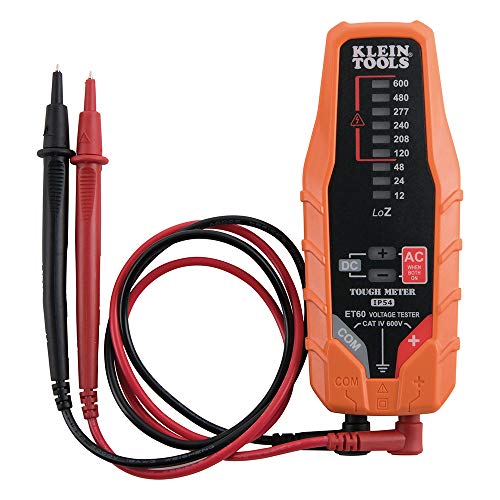
Klein Tools ET60 AC/DC Voltage Tester
Included test leads make this a contact tester, removing the guesswork non-contact pens carry. LED indicators step through voltage levels from 12 to 600V on both AC and DC circuits. Outlets, fuses, doorbells, and automotive work all fall within that one range.
Pros
- Direct contact reading confirms what a pen only suggests
- Handles DC, which most pens on this list cannot
- LED scale shows an approximate voltage level
Cons
- Requires touching bare contacts, so more care is needed
- LEDs give ranges, not exact digital values

Milwaukee 2202-20 Voltage Detector
A hi-vis housing built for trade use stands out in a crowded tool bag. Sensing runs from 50 to 1000V AC, pairing an audible alert with a visual one. An LED at the tip lights the exact spot being probed inside a dark box.
Pros
- Tip-mounted LED illuminates the wire being checked
- 50V floor catches more circuits than 90V pens
- Rugged housing built for tool-bag life
Cons
- Single sensitivity range only
- Bulkier than slim pocket pens

Sperry Instruments STK001 Tester Kit
A non-contact detector covering 50 to 1000V AC bundles with a plug-in GFCI outlet tester. Together they answer the two most common homeowner questions: is this wire live, and is this outlet wired correctly. Indicator lights on the outlet tester flag faults such as open ground and reversed polarity.
Pros
- Two tools cover most household electrical checks
- Outlet tester also trips GFCI outlets to verify protection
- Easy for non-electricians to interpret
Cons
- Build feels lighter than Klein or Fluke equivalents
- Pen lacks a low-voltage sensitivity mode

Klein Tools NCVT-1P Voltage Tester
Detection runs 70 to 1000V AC, signaled with a light and a beeper on Klein’s entry pen. The same CAT IV 1000V rating as pricier models applies here, and it survives a 2 meter drop. Occasional outlet, switch, and fixture checks are the one job this tool needs to do.
Pros
- Full CAT IV 1000V rating at a starter price point
- One-button operation with an auto power-off
- Pocket clip keeps it within reach
Cons
- 70V floor misses thermostat and landscape wiring
- No flashlight
How to pick the right one
What are the three types of voltage testers? Non-contact pens sense the field around an energized conductor and beep, fast but blind to the actual voltage value. Contact testers such as the Klein ET60 use leads touched to the circuit to show a voltage level. Fork-style meters like the Fluke T6-1000 combine both ideas, reading true numbers through an open jaw. Match the family to how much detail a given job requires.
What do CAT safety ratings actually mean? CAT ratings describe where a tester can safely be used, not how accurate it is. CAT III covers distribution wiring inside a building, including panels and fixed equipment. CAT IV covers the service entrance and outdoor connections, where fault energy runs highest. Every tester in this roundup carries at least a CAT III rating, and the Klein and Fluke pens reach CAT IV 1000V.
Why does a tester’s low-voltage floor matter? A pen rated 90 to 1000V stays silent on a 24V thermostat wire, a doorbell circuit, or landscape lighting. Dual-range models such as the Klein NCVT-3P drop to 12V and catch those systems. DC capability is a separate question entirely: only the Klein ET60 here reads DC, covering batteries, automotive circuits, and solar wiring.
How do you keep any voltage tester trustworthy? Verify the tester on a known live circuit before and after every check, since a dead battery reads exactly like a dead wire. Continuous self-test designs such as the Fluke 1AC-II reduce this risk but don’t remove the habit. Treat a silent pen as a prompt to confirm with a contact tester before touching conductors, especially on shielded or metal-clad cable where non-contact sensing is unreliable.
How they compare
| # | Model | Voltage | Best for | Score | Price |
|---|---|---|---|---|---|
| 1 | Fluke T6-1000 Electrical Tester | Up to 1000V AC via FieldSense | Best overall | 9.4 | Check price |
| 2 | Klein Tools NCVT-3P Dual Range Tester | 12 to 1000V AC, dual range | Best non-contact pen | 9.2 | Check price |
| 3 | Fluke 1AC-II VoltAlert | 90 to 1000V AC | Best for reliability | 9.0 | Check price |
| 4 | Klein Tools ET60 AC/DC Voltage Tester | 12 to 600V AC or DC | Best for AC and DC checks | 8.8 | Check price |
| 5 | Milwaukee 2202-20 Voltage Detector | 50 to 1000V AC | Best for jobsite durability | 8.5 | Check price |
| 6 | Sperry Instruments STK001 Tester Kit | Voltage pen plus GFCI outlet tester | Best value kit | 8.3 | Check price |
| 7 | Klein Tools NCVT-1P Voltage Tester | 70 to 1000V AC | Best budget | 8.0 | Check price |
Good to know
What is the best voltage tester for homeowners?
The Sperry STK001 kit covers the two checks most homeowners make, live wires and outlet wiring, for very little. Anyone wanting a single tougher pen should pick the Klein NCVT-3P for its low-voltage range and flashlight.
How does a non-contact voltage tester work?
It senses the electric field radiating from an energized conductor through insulation. No metallic contact is made, which keeps you clear of live parts, but it only confirms presence, not an exact voltage.
Can a voltage tester give a false negative?
Yes. Dead batteries, shielded cable, metal conduit, and poor grounding can all silence a pen on a live wire. Test the pen on a known live outlet first, and confirm critical checks with a contact tester.
Klein NCVT-3P vs Fluke 1AC-II, which should I buy?
Choose the Klein for versatility, since it detects down to 12V and includes a flashlight. Choose the Fluke for pure dependability, since its continuous self-test warns you the moment the pen itself fails.
Is a voltage tester the same as a multimeter?
No. A tester confirms whether voltage is present, while a multimeter measures exact voltage, current, resistance, and continuity. The Fluke T6-1000 sits between the two, showing real values without full multimeter functions.
Which voltage tester works on low voltage wiring?
The Klein NCVT-3P senses from 12V AC, making it the pick for thermostats, irrigation controllers, and doorbells. For low-voltage DC, use the Klein ET60 with its test leads.
Do voltage testers work on DC circuits?
Most non-contact pens are AC only because they rely on an alternating field. In this group, only the Klein ET60 reads DC, covering 12 to 600V for batteries, vehicles, and solar systems.
What does CAT IV 1000V mean on a tester?
It certifies the tool for use at the utility service entrance, the highest-energy measurement category, up to 1000 volts. A CAT IV pen such as the Klein NCVT-1P withstands larger transient spikes than CAT II or CAT III tools.
What is the best voltage tester for an electrician’s daily kit?
The Fluke T6-1000 earns its place for anyone opening panels regularly, since it reads real current and voltage instead of just confirming presence.
Fork meter vs non-contact pen, which is more accurate?
A fork meter like the Fluke T6-1000 is more accurate because it displays an actual measured value. A non-contact pen only confirms voltage is present above its sensitivity threshold, without a number.
Our pick
Professionals and serious DIYers should buy the Fluke T6-1000, since real voltage and current readings end the guessing a beeping pen leaves behind. For everyday checks, the Klein NCVT-3P covers everything from thermostat wire to mains. Keep a Fluke 1AC-II as the backup that self-tests so it never lies quietly.
Jake Monroe
Jake worked as a residential contractor for over a decade before shifting to full-time writing. He evaluates power tools, hand tools and workshop gear through the lens of someone who has actually used them on job sites, not just read the box.