What Makes a Colored Pencil Set Worth Buying?
Prismacolor Premier Soft Core is the overall pick for effortless blending and heavy pigment coverage on textured paper. Faber-Castell Polychromos suits detailed layering because its oil core holds a sharp point, and Arteza Professional Colored Pencils give beginners a large usable palette without a professional outlay.
Prismacolor Premier Soft Core is still the pencil most artists reach for when saturated color and easy blending matter most. Faber-Castell Polychromos serves tight detail and repeated layering better, since its oil based core keeps a point, while Arteza Professional Colored Pencils cover most beginner needs at a far lower entry point.
Comparing pencil ranges is harder than it looks. One brand behaves differently on smooth paper than on textured stock, core softness drives both blending and breakage, and lightfastness only matters once work is displayed. So we compared published binder types, core hardness, lightfastness ratings, and palette sizes, alongside what owners report about breakage, wax bloom, and daily durability.
What matters most
What is the difference between wax and oil based pencils? Binder type is the first decision. Wax based cores are softer, lay down heavy color quickly, and blend beautifully, but they wear fast, break more easily, and can develop a hazy wax bloom over thick layers. Oil based cores keep a sharp point, take many layers without clogging the paper, and never bloom, though full saturation needs more passes. Many artists own both and switch by task.
Do lightfastness ratings really matter? Ratings measure how fast a color fades under light. Sketchbook work kept closed barely needs them. Anything framed, sold, or displayed does, because unstable pigments visibly shift within years. Reds, violets, and pinks fade first historically, so check those swatches specifically rather than trusting a whole range equally. Polychromos and Luminance publish ratings per color.
Which paper works best with colored pencils? Paper shapes results as much as the pencils. Smooth surfaces reward oil based cores and fine detail, while toothy textured stock grabs pigment and flatters soft wax cores. Heavier sheets accept more layers before the surface fills. Scratchy or unblendable results often mean wrong paper, not bad pencils, so test one set on two surfaces before judging it.
Why do colored pencil leads keep breaking? Breakage is usually technique, not defect. Dropping a pencil fractures the core inside the wood with no visible sign, and a dull sharpener blade twists soft cores until they snap. Sharpen slowly with a fresh blade, use light pressure, and store pencils in a case rather than loose in a bag. Hand held blade sharpeners control very soft cores better than electric ones.
The top picks, ranked

Prismacolor Premier Soft Core Colored Pencils
A soft wax core lays down heavy pigment fast and blends almost like paint, which is why these dominate colored pencil tutorials. Burnishing and solvent blending both work well. Fragility is the trade off: soft cores snap more easily, and heavily layered work can develop wax bloom.
Pros
- Outstanding blending and coverage
- Very rich pigment load
- Huge colour range available
Cons
- Cores break if dropped
- Wax bloom on heavy layers

Faber-Castell Polychromos
An oil based core holds a sharp point far longer than wax pencils, making this the better tool for fine detail and controlled layering. No wax bloom ever forms, so finished pieces stay exactly as left. High lightfastness across the range matters for anything framed and displayed.
Pros
- Holds a point for fine detail
- No wax bloom on finished work
- Strong lightfastness ratings
Cons
- Needs more layers for full coverage
- Firmer feel takes adjustment

Caran d’Ache Luminance 6901
Luminance pairs a soft, highly pigmented core with the highest lightfastness ratings in general use, a rare combination. Blending feels like a wax pencil, yet the formula is built for work meant to last decades. Professionals selling originals buy this range; hobbyists rarely need it.
Pros
- Exceptional archival stability
- Soft blending without dull colour
- Consistent core quality
Cons
- Highest cost per pencil
- Smaller palette than rivals
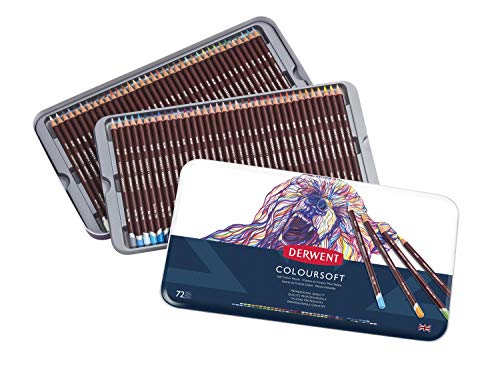
Derwent Coloursoft
An extra soft 4 mm core fills paper texture quickly and leaves a slightly velvety surface. Portraits, animal fur, and smooth gradients over large areas all suit it. Because the core wears so fast, expect frequent sharpening and keep a harder pencil nearby for detail work.
Pros
- Very smooth gradients
- Covers paper texture fast
- Comfortable on large areas
Cons
- Sharpens away quickly
- Too soft for fine linework

Arteza Professional Colored Pencils
Arteza sells large palettes with reasonably soft cores at a fraction of artist range prices. Pigment load runs lower than premium brands, so deep color takes heavy layering, but blending is acceptable and the color selection is generous. Think of it as the bridge between classroom sets and professional pencils.
Pros
- Big palette for the money
- Decent blending for the class
- Usable straight out of the tin
Cons
- Lower pigment load than artist ranges
- Lightfastness not fully documented

Castle Art Supplies Colored Pencil Set
This large starter set pairs a soft wax core with bright colors aimed at adult coloring books and casual drawing. Blending is adequate for hobby work, though dark shades lack the depth of artist grade pigment. Owners report the zip case genuinely helps keep a big set organised.
Pros
- Very affordable for the count
- Bright vivid colours
- Organised carry case
Cons
- Cores chip when sharpened hard
- Colour depth limited on dark shades

Staedtler Ergosoft Colored Pencils
A triangular soft grip barrel suits small hands and stops pencils rolling off the table. Bonded cores resist breaking when dropped, exactly what a school pencil needs. Color runs bright rather than deep, so treat these as a learning set instead of an artist range.
Pros
- Comfortable ergonomic grip
- Resists breakage when dropped
- Bright consistent colours
Cons
- Limited blending capability
- Small palette compared with artist sets
Side by side
| # | Model | Binder | Best for | Score | Price |
|---|---|---|---|---|---|
| 1 | Prismacolor Premier Soft Core Colored Pencils | Wax based | Best overall | 9.4 | Check price |
| 2 | Faber-Castell Polychromos | Oil based | Best for layering and detail | 9.2 | Check price |
| 3 | Caran d’Ache Luminance 6901 | Wax based, lightfast formula | Best premium | 9.0 | Check price |
| 4 | Derwent Coloursoft | Wax based | Best for soft blending | 8.8 | Check price |
| 5 | Arteza Professional Colored Pencils | Wax based | Best value | 8.6 | Check price |
| 6 | Castle Art Supplies Colored Pencil Set | Wax based | Best budget | 8.3 | Check price |
| 7 | Staedtler Ergosoft Colored Pencils | Triangular soft grip | Best for children and beginners | 8.0 | Check price |
Common questions
What is the difference between wax and oil based colored pencils?
Wax pencils blend more easily and cover paper faster, while oil pencils hold a point longer, layer more times, and never develop wax bloom. Neither wins outright; they suit different working styles.
Which colored pencils are best for blending?
Prismacolor Premier and Derwent Coloursoft blend most easily thanks to their soft wax cores. Both burnish smoothly and respond well to solvent blending with an odourless mineral spirit.
What is wax bloom and how do you stop it?
It is a hazy film that rises on heavily layered wax pencil work. Wipe gently with a soft cloth to remove it, then apply a light fixative spray to stop it returning on finished pieces.
Do I need lightfast colored pencils?
Only for work that will be displayed or sold. Sketchbook pages kept out of direct light are fine with any range, but framed pieces should use documented lightfast lines such as Polychromos or Luminance.
What paper is best for colored pencils?
Medium weight paper with slight tooth suits most work, holding pigment while still taking layers. Very smooth stock favours oil pencils and fine detail; heavy texture favours soft wax cores.
Why do my colored pencil leads keep breaking?
Usually an internal fracture from a drop, or a dull sharpener. Sharpen slowly with a fresh blade, press lightly, and store pencils in a case so the cores avoid repeated knocks.
How many colored pencils do I actually need?
Twenty four to thirty six colors cover most subjects if you layer, since mixing on the paper creates shades the tin lacks. Larger sets mostly save time rather than adding capability.
Can you use colored pencils over watercolor?
Yes, and it is a common technique. Let the wash dry fully, then add detail and texture with pencils on top. Oil based cores work especially well because they stay sharp on slightly buckled paper.
Are Prismacolor or Polychromos pencils better?
Prismacolor blends faster and covers heavier thanks to its soft wax core, while Polychromos holds detail, layers cleanly, and rates higher for lightfastness. Choose by style: expressive blending versus precise layered work.
The verdict
Prismacolor Premier Soft Core remains the easiest recommendation for rich color and effortless blending, provided the soft cores are handled gently. Faber-Castell Polychromos is the better tool for detailed, layered, display bound work, and Arteza Professional Colored Pencils let beginners practise widely without a big outlay. Choose your paper deliberately too, since it shapes results as much as the pencils.
Jake Monroe
Jake worked as a residential contractor for over a decade before shifting to full-time writing. He evaluates power tools, hand tools and workshop gear through the lens of someone who has actually used them on job sites, not just read the box.


