How to Pick the Right TV Panel Type and Screen Size
The Samsung S90D OLED delivers the strongest overall contrast and color for most living rooms. Buyers in bright rooms do better with a mini-LED set like the TCL QM8, while anyone on a tighter budget can still get a sharp picture from the Hisense U7N.
The Samsung S90D OLED stands out for near-perfect black levels and wide viewing angles that hold up in a typical living room layout. Its main tradeoff is lower peak brightness than mini-LED rivals in rooms with heavy daylight. Buyers with brighter rooms or tighter budgets have strong alternatives covered below.
We compared published panel specifications, brightness ratings, size availability and gaming features rather than running our own in-room brightness measurements.
Our top picks

Samsung S90D OLED (55 inch)
This QD-OLED panel combines OLED’s per-pixel black levels with a quantum dot layer that pushes color volume beyond standard OLED sets. Wide viewing angles keep color accurate from off-center seats, an advantage over most LED-based TVs. Four HDMI 2.1 ports support 4K at 144Hz for gaming consoles and PCs alike.
Pros
- Near-perfect black levels improve contrast in dark scenes
- Wide viewing angles keep color accurate from the side
- Four HDMI 2.1 ports suit multiple consoles or a gaming PC
Cons
- Peak brightness trails mini-LED sets in sunlit rooms
- OLED panels need care around static logos or UI elements

LG C4 OLED (55 inch)
An Alpha 9 Gen 7 processor handles upscaling and motion smoothing while keeping input lag low enough for competitive gaming. Four HDMI 2.1 ports support 4K at 144Hz along with variable refresh rate and auto low latency mode. LG’s OLED panel delivers the same per-pixel black levels found on the Samsung S90D, with a slightly cooler default color tone.
Pros
- Low input lag and VRR support suit competitive gaming
- Four HDMI 2.1 ports handle multiple high-end consoles
- Per-pixel black levels match premium QD-OLED contrast
Cons
- Lower peak brightness than the Samsung S90D or mini-LED sets
- Standard OLED color volume trails the quantum dot layer on QD-OLED

Sony Bravia 8 OLED (55 inch)
Sony tunes this OLED panel’s out-of-box color calibration closer to professional film standards than most competitors, which matters for viewers who skip manual picture adjustments. The XR processor applies object-based scene analysis, adjusting brightness and detail region by region rather than across the whole frame. Dolby Vision and Dolby Atmos pass-through both work without additional hardware.
Pros
- Out-of-box color calibration suits film viewing without adjustment
- XR processor analyzes scenes region by region for detail
- Full Dolby Vision and Dolby Atmos pass-through support
Cons
- Only two HDMI 2.1 ports versus four on the Samsung and LG sets
- Costs more than the LG C4 at matching screen sizes

TCL QM8 (65 inch)
Mini-LED backlighting with thousands of local dimming zones pushes peak brightness well past OLED, which helps picture visibility in rooms with large windows or overhead lighting. A larger 65 inch option costs less than similarly sized OLED alternatives in this list. Game Accelerator mode adds a dedicated low-latency setting alongside the set’s Google TV smart platform.
Pros
- Brightness output beats every OLED panel in this list
- Larger screen sizes cost less than comparable OLED models
- Game Accelerator mode suits console and PC gaming
Cons
- Black levels and off-angle color trail true OLED panels
- Blooming around bright objects can appear in very dark scenes
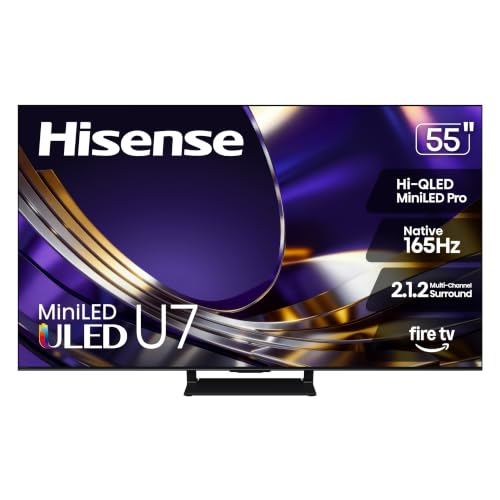
Hisense U7N (55 inch)
This mini-LED set undercuts the TCL QM8 on cost while still offering strong brightness and a 144Hz refresh rate for gaming. Google TV runs the smart platform, giving access to the same app library found on pricier Google TV sets. Local dimming zone count sits below the QM8’s, a reasonable tradeoff for the lower price.
Pros
- Lower cost than the TCL QM8 while keeping a 144Hz refresh rate
- Google TV platform matches the app library on pricier sets
- Brightness still comfortably exceeds standard LED TVs
Cons
- Fewer local dimming zones than the TCL QM8
- Off-angle viewing shows more color shift than OLED panels

Samsung QN90D Neo QLED (65 inch)
Neo QLED backlighting on this set combines mini-LED brightness with Samsung’s SmartThings hub features, letting the TV double as a smart home control point. An anti-glare screen coating helps in rooms with reflective light sources, an advantage over glossier panels. Tizen OS runs the smart platform, with Bixby, Alexa and Google Assistant all supported.
Pros
- SmartThings hub features extend beyond typical TV smart platforms
- Anti-glare coating helps in rooms with reflective lighting
- 165Hz refresh rate suits PC gaming at high frame rates
Cons
- Costs more than the TCL QM8 or Hisense U7N for similar brightness
- Tizen’s menu system has a steeper learning curve than Google TV

Insignia F50 Series Fire TV (50 inch)
This Amazon-made budget LED set covers the essentials, 4K resolution, HDR10 support and a built-in Fire TV platform, without the mini-LED or OLED technology found elsewhere in this list. Alexa voice control works hands-free, letting owners search or change inputs without pressing a remote button first. It suits secondary rooms or first TVs more than a primary home theater setup.
Pros
- Lower cost than every other TV in this list
- Hands-free Alexa control built into the Fire TV platform
- Simple setup suits secondary rooms or first-time buyers
Cons
- No HDMI 2.1 ports limits high frame rate gaming support
- Brightness and contrast trail every mini-LED or OLED set here
Before you buy
What to look for when choosing a TV Panel technology sets the baseline for contrast and color, with OLED and QD-OLED leading on black levels and mini-LED leading on peak brightness. Refresh rate and HDMI 2.1 port count matter most to gamers connecting a current console or PC. Screen size should match actual viewing distance rather than the largest size a budget allows, since oversized screens in small rooms can hurt rather than help picture quality.
OLED versus mini-LED for different rooms A dark or moderately lit living room suits OLED panels like the Samsung S90D or LG C4, where deep black levels matter more than raw brightness. Rooms with large windows or bright overhead lighting benefit more from mini-LED brightness, found on the TCL QM8, Hisense U7N and Samsung QN90D. Sony’s Bravia 8 OLED splits the difference somewhat with strong color accuracy at slightly lower brightness than mini-LED alternatives.
Gaming features worth checking before buying Four HDMI 2.1 ports, found on the Samsung S90D, LG C4 and Samsung QN90D, matter most for households running multiple current-generation consoles or a gaming PC alongside a console. A 144Hz or higher refresh rate benefits PC gamers more than console gamers, since most consoles cap out lower. Buyers who game casually can skip paying extra for ports or refresh rates they will not use.
Budget tradeoffs and smaller rooms The Insignia F50 Series covers basic 4K and HDR needs for a bedroom or secondary room without OLED or mini-LED pricing. The Hisense U7N offers a middle ground, adding mini-LED brightness and a 144Hz refresh rate at a lower cost than the TCL QM8. Buyers furnishing a first apartment or guest room should weigh whether OLED’s picture advantages justify the price gap over a well-reviewed mini-LED or LED set.
Side by side
| # | Model | Panel Type | Best for | Score | Price |
|---|---|---|---|---|---|
| 1 | Samsung S90D OLED (55 inch) | QD-OLED | Best Overall Picture Quality | 9.4 | Check price |
| 2 | LG C4 OLED (55 inch) | OLED | Best for Console and PC Gaming | 9.2 | Check price |
| 3 | Sony Bravia 8 OLED (55 inch) | OLED | Best for Movie and Film Color Accuracy | 9.0 | Check price |
| 4 | TCL QM8 (65 inch) | Mini-LED | Best Mini-LED for Bright Rooms | 8.8 | Check price |
| 5 | Hisense U7N (55 inch) | Mini-LED | Best Value Mini-LED | 8.6 | Check price |
| 6 | Samsung QN90D Neo QLED (65 inch) | Neo QLED (Mini-LED) | Best for Smart Home Integration | 8.5 | Check price |
| 7 | Insignia F50 Series Fire TV (50 inch) | LED | Best Budget Pick | 8.1 | Check price |
Common questions
Is OLED or mini-LED better for a TV?
It depends on the room. OLED panels like the Samsung S90D and LG C4 offer better black levels and viewing angles, while mini-LED sets like the TCL QM8 offer higher peak brightness for sunlit rooms.
What screen size TV should I buy for my living room?
A common guideline is to sit no closer than about 1.5 times the screen’s diagonal size in feet for comfortable 4K viewing, though personal preference varies.
Do I need HDMI 2.1 ports on a new TV?
Only if connecting a current-generation console or gaming PC that supports 4K at 120Hz or higher. Casual viewers and older consoles do not require HDMI 2.1.
Why are OLED TVs more expensive than LED TVs?
OLED panels use self-emissive pixels that are more complex and costly to manufacture than the backlit LED panels used in budget and mini-LED TVs.
Can OLED TVs get screen burn-in?
Modern OLED panels, including the Samsung S90D and LG C4, include pixel-shifting and other safeguards that make burn-in rare under normal mixed viewing.
What is the difference between mini-LED and regular LED?
Mini-LED backlighting uses many smaller LEDs with more local dimming zones than standard LED TVs like the Insignia F50, improving contrast and reducing blooming.
Is a 144Hz refresh rate worth it for a TV?
Mainly for PC gaming or fast-paced console titles. Movie and regular TV viewing does not require a refresh rate above 60Hz.
Which TV is best for a bright living room?
The TCL QM8 and Samsung QN90D both use mini-LED backlighting with high peak brightness, which holds up better than OLED in rooms with significant daylight.
Do budget TVs support 4K and HDR?
Yes. Even the budget-focused Insignia F50 Series supports 4K resolution and HDR10, though brightness and contrast trail pricier mini-LED and OLED sets.
Our pick
The Samsung S90D OLED is the strongest overall pick for most living rooms thanks to its contrast and wide viewing angles. Buyers in bright rooms should choose the TCL QM8 instead, since its mini-LED brightness handles daylight better than any OLED panel here. Anyone furnishing a secondary room on a tight budget should skip OLED entirely and consider the Insignia F50 Series for basic 4K and HDR coverage.
Marcus Chen
Marcus covered consumer electronics for enthusiast tech publications for six years before joining ChoiceCrest. He specializes in translating manufacturer spec sheets into plain-language buying advice, with a focus on audio, computing accessories and smart-home gear.