Indoor or Outdoor: Which TV Antenna Fits Your Home?
Mohu’s Leaf 50 balances range and easy indoor setup for most cord cutters. 1byone’s Amplified antenna delivers solid reception for less money. Channel Master’s FLATenna 35 suits close-in viewers who want free channels without an amplifier.
Dropping cable while keeping local channels starts with Mohu’s Leaf 50, which leads for balanced range and simple indoor mounting. Value conscious shoppers do better with the 1byone Amplified antenna instead. Channel Master’s FLATenna 35 covers budget close-in reception without an amplifier. Seven real antennas appear below, split across indoor and outdoor use, so you can match one to your distance from the towers.
TV antennas prove trickier to buy than they look, since the factor that matters most, distance to the broadcast towers and what sits between you and them, never shows up in a product photo. We compared published range ratings, amplification and mounting type, then weighed those against how owners report performance at different distances and in different building types.
How to pick the right one
How do you know your distance to the broadcast towers? Distance to the broadcast towers, and whatever stands between you and them, decides antenna performance more than any other factor. Free online coverage tools let you enter your address and see which stations reach you and from which direction. Close-in viewers in strong signal areas can use a simple unamplified panel like the FLATenna 35, while those farther out need longer range or outdoor antennas such as the ClearStream 2MAX or RCA ANT751E. Check your signal map before buying anything.
Amplified or unamplified: which TV antenna do you need? An amplifier boosts a weak incoming signal, which helps at longer distances or with long cable runs. Amplification is not a cure-all, though, since it can overload a tuner in strong signal areas and cause dropouts. An unamplified antenna like the FLATenna 35 sometimes performs better up close because of that. Amplified models such as the Mohu Leaf 50 and 1byone suit moderate distances instead, so match amplification to your range rather than assuming more boost always means more channels.
Indoor, attic or outdoor: where should you mount an antenna? Placement often matters more than the model itself. Indoor panels install easily but fight walls, wiring and interference along the way. Attic mounting hides the antenna while clearing much of that obstruction. Outdoor antennas like the RCA ANT751E and Winegard Elite 7550 sit above the interference for the strongest, steadiest reception but require mounting and cabling. Renters usually start indoors, while homeowners chasing distant towers benefit most from an attic or roof install.
Directional or multidirectional: which pattern fits your area? Directional antennas focus reception in one direction, giving more reach toward towers you aim at, but they demand accurate pointing and favor towers clustered together. Multidirectional antennas, like the ClearStream 2MAX and Winegard Elite 7550, pull signal from multiple directions instead, which suits areas where stations broadcast from scattered points. Check whether your local towers sit together or spread out, then choose the pattern that matches, since the wrong type can leave channels missing.
The top picks, ranked

Mohu Leaf 50 Amplified Indoor TV Antenna
A thin, paintable panel mounts flat to a wall or window and includes its own signal amplifier. Owners report a strong channel list at moderate distances from the towers. Balanced range and a long coax cable make it an easy first antenna for most cord cutters.
Pros
- Thin, paintable panel blends into a room
- Amplifier boosts moderate-range reception
- Long coax cable for flexible placement
Cons
- Walls and distance can still limit channels
- Amplifier needs a nearby power source

Antennas Direct ClearStream 2MAX Indoor/Outdoor Antenna
Multidirectional reception on this indoor, attic or outdoor antenna reaches distant towers that flatter panels miss. An open loop design targets both VHF and UHF signals. Homes farther from broadcast towers or in weaker signal areas gain the most from its longer effective range.
Pros
- Long effective range for distant towers
- Flexible indoor, attic, or outdoor mounting
- Multidirectional for towers in different spots
Cons
- Bulkier than flat indoor panels
- Outdoor mounting takes more effort

1byone Amplified Indoor HDTV Antenna
A low cost flat panel bundles a signal booster and sticks to a window or wall for quick setup. Owners report a solid channel count for the price paid. Renters and first time cord cutters get a practical way to test over the air TV without spending much.
Pros
- Affordable with an included booster
- Thin panel mounts on a window or wall
- Long cable for easier placement
Cons
- Reception varies with placement and distance
- Build feels basic compared to premium panels

RCA ANT751E Outdoor Yagi TV Antenna
Directional reception locks onto distant towers reliably once this outdoor antenna is aimed correctly. Both VHF and UHF signals come through a mast or roof mounted design. Clearing indoor walls and interference gives it steadier, stronger reception than any panel antenna manages.
Pros
- Outdoor placement avoids indoor interference
- Long directional range for distant towers
- Weather-resistant build for the roof
Cons
- Directional design must be aimed at towers
- Installation requires mounting and cabling
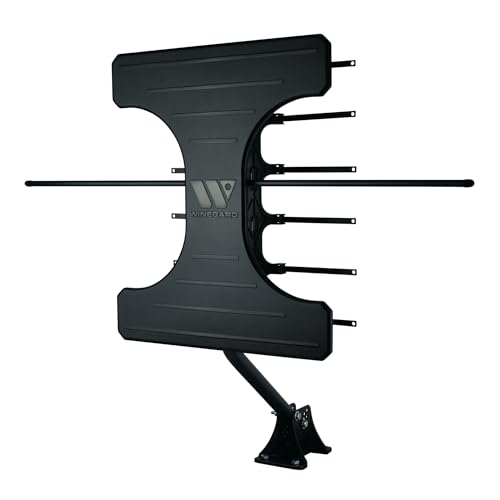
Winegard Elite 7550 Outdoor HDTV Antenna
A built in amplifier pushes long range performance out of this premium outdoor antenna, with a strong VHF and UHF channel list to show for it. Multidirectional pickup reduces the need for precise aiming. Rugged housing suits permanent roof or attic installation for households chasing the most reliable reception.
Pros
- Long range with a built-in amplifier
- Multidirectional, so aiming is forgiving
- Rugged housing for permanent installs
Cons
- Higher price than indoor antennas
- Requires outdoor or attic mounting work

GE Pro Bar Amplified Indoor TV Antenna
Sitting near or behind a TV, this compact amplified bar antenna suits rooms where a flat panel looks awkward. An adjustable amplifier and a smart swivel base help fine tune reception. Apartments and secondary TVs at closer range to the towers are the best match.
Pros
- Compact bar sits neatly by the TV
- Adjustable amplifier for fine-tuning
- Swivel base helps aim reception
Cons
- Shorter effective range than outdoor antennas
- Placement near electronics can add interference
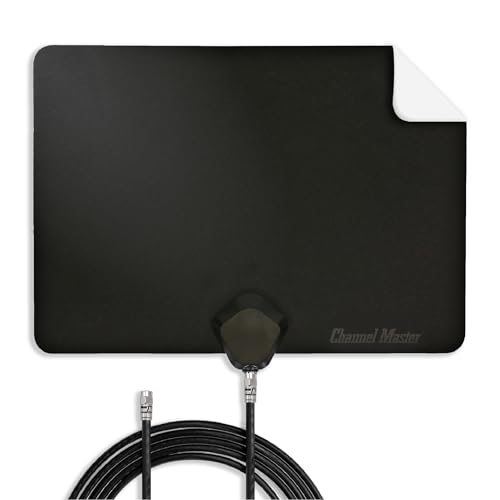
Channel Master FLATenna 35 Indoor TV Antenna
Skipping the amplifier and extra hardware keeps this flat panel simple and affordable. Owners report solid results for viewers reasonably close to the towers. No power connection is needed, which makes it a no fuss budget choice in a strong signal area.
Pros
- Affordable and simple with no power needed
- Thin panel mounts on a wall or window
- Reliable in strong-signal areas
Cons
- Shorter range without an amplifier
- Not suited to distant or weak-signal areas
Compared at a glance
| # | Model | Mounting | Best for | Score | Price |
|---|---|---|---|---|---|
| 1 | Mohu Leaf 50 Amplified Indoor TV Antenna | Indoor flat panel | Best overall | 9.4 | Check price |
| 2 | Antennas Direct ClearStream 2MAX Indoor/Outdoor Antenna | Indoor, attic, or outdoor | Best for range | 9.1 | Check price |
| 3 | 1byone Amplified Indoor HDTV Antenna | Indoor flat panel | Best value | 8.9 | Check price |
| 4 | RCA ANT751E Outdoor Yagi TV Antenna | Outdoor mast or roof | Best outdoor | 8.7 | Check price |
| 5 | Winegard Elite 7550 Outdoor HDTV Antenna | Outdoor or attic | Best premium | 8.5 | Check price |
| 6 | GE Pro Bar Amplified Indoor TV Antenna | Freestanding bar | Best for tight spaces | 8.2 | Check price |
| 7 | Channel Master FLATenna 35 Indoor TV Antenna | Indoor flat panel | Best budget | 8.0 | Check price |
Common questions
What is the best TV antenna overall?
Based on specifications and owner feedback, the Mohu Leaf 50 ranks first overall. Its thin, paintable panel, included amplifier and balanced range make it easy to mount indoors and reliable for suburban homes at moderate distance from the towers, which suits most cord cutters.
How do I know how far I am from the broadcast towers?
A free online signal locator tool, once you enter your address, shows which stations reach you, how strong each signal is and the direction of each tower. That information tells you whether a short-range indoor panel, an amplified antenna or an outdoor model fits your situation, and it helps aim a directional antenna correctly.
Do amplified antennas always work better?
No. An amplifier helps with weak signals and long cable runs, but it can overload a tuner and cause dropouts in strong signal areas. Living close to the towers often means an unamplified antenna like the Channel Master FLATenna 35 performs better. Match amplification to distance rather than assuming more boost helps.
Are outdoor antennas better than indoor ones?
Generally yes for range and reliability, since an outdoor antenna clears the walls, wiring and interference that limit indoor models. Options like the RCA ANT751E and Winegard Elite 7550 reach distant towers more steadily. Installation effort and cabling are the tradeoff, so renters and close-in viewers often still do fine indoors.
Where should I place an indoor TV antenna?
Mount it as high as possible near a window facing the towers, away from large metal objects and other electronics that cause interference. Rescanning for channels after each placement change helps, since even a small position shift can add or lose stations. A longer coax cable gives more freedom to find the best spot.
How many channels will a TV antenna get?
It depends entirely on location, antenna choice and placement. Homes near major markets can receive dozens of free channels, while rural areas may get only a handful. Running a channel scan after setup shows exactly what comes through, and adjusting position or upgrading to a longer-range model can add more.
Is over the air TV really free?
Yes. Once you own the antenna, local broadcast channels stay free to watch with no subscription, since they transmit over public airwaves. A TV with a built in tuner or a separate tuner box is still required. No monthly fees apply, which is why an antenna often pays for itself quickly compared to cable.
Why do I need to rescan for channels?
Your TV only shows channels found during its last scan, so moving or adjusting the antenna calls for a rescan to pick up newly received stations. Broadcasters occasionally change frequencies too, which can drop channels until you rescan. Running a fresh scan is quick and often recovers or adds stations you were missing.
Our pick
For most homes, Mohu’s Leaf 50 is the TV antenna to buy, thanks to balanced range, an included amplifier and simple indoor mounting. Choose the 1byone Amplified for solid reception at a lower price, or the Channel Master FLATenna 35 if you live close to the towers and want free channels without an amplifier.
Marcus Chen
Marcus covered consumer electronics for enthusiast tech publications for six years before joining ChoiceCrest. He specializes in translating manufacturer spec sheets into plain-language buying advice, with a focus on audio, computing accessories and smart-home gear.
You might also need

Top Wireless TV Antennas for Cord Cutters

Home Projectors That Actually Deliver a Sharp, Bright Image
